The swarming concept is still used frequently by the Taliban in Afghanistan. Laymen often see combat swarming as a low-tech, antiquated tactic used by 3rd world countries that needlessly sacrifices rank n’ file soldiers. Swarming, however, is still considered a viable alternative by top-tier militaries, such as the Russian Army. This is not to say the Soviets practice a combat doctrine that knowingly sacrifices soldier’s lives. Russian swarming tactics stress the close & rapid closure of ground forces with that of the enemy. The benefits are twofold: 1.) It denies the enemy adequate time to deploy their defenses, and; 2.) The close, physical proximity of the enemy makes red & blue force deconfliction difficult for the defenders to use mortars, artillery, and close air support without killing their own troops. Swarming in 21st century combat is not about troops climbing out of a trench to rush forward against a heavily entrenched enemy, and lose more than half your troops in a 10 minute battle. What it is about, is: well trained troops; good tactical planning; battlefield discipline & execution, and; adequate supply of quality infantry weapons & ammunition used at the platoon-level and below.
Since swarming is most commonly used by a numerically superior foe, it is incumbent upon the defenders to rapidly lay down the heaviest possible volume of return fire. American Special Operation Forces, like the SEALs and Army Special Forces A-Teams, are taught, and they practice relentlessly, their DA (direct action) drills that map out ahead of time what each man in the unit will do if they walk into a firefight. A good example of the concept are the LRRPs employed by the U.S. Army during the Vietnam War.
The most prolific LRRP operations in Vietnam were conducted by the secretive American Studies & Observation Group (SOG) under the Military Assistance Command, Vietnam (MACV). SOG’s LRRP teams were managed by three company-sized units known as Command & Control North (CCN), and CCC in South Vietnam‘s central highlands, and CCS for southern operations in the area west of Saigon. The primary purpose of these special LRRP teams was cross-border ISR missions into Laos and Cambodia. The LRRPs typically deployed in teams of 4-7 men. Each team was led by an American Army NCO (usually an E-5 Sergeant, E-6 Staff Sergeant or E-7 Sergeant 1st Class), with an American assistant team leader (ATL), and an American RTO (radio-telephone operator). Newly arrived Americans always started out as the RTO, then ATL, and finally the TL. It was standard practice for all LRRP operations to place mission experience over rank. Even newly arrived officers to CCN/CCC/CCS had to start-out as RTOs. When a LRRP team was inserted into enemy territory, all rank was checked at-the-door. The balance of the team was made up of indigenous, Montangard tribesmen who were highly skilled guerilla fighters.
One of the early issues experienced by LRRP units was the lack of properly trained soldiers for missions behind-enemy-lines. Appropriate combat skills for LRRPs coming through the Army’s regular training pipeline is Ranger School. The need for hundreds of thousands of troops in Vietnam, however, outstripped most every training school’s peace-time ability to produce an adequate number of graduates. Training schools for ground combat, such as: Infantry, Artillery, and Combat Engineering have a track record of scaling-up the number of graduates when needed. Ranger School, like other special operations training, is focused on quality graduates, not quantity. These schools have always had high washout rates, and increasing the headcount of graduates is difficult at best. There was no way the Ranger School could accommodate Vietnam’s need for trained commandos. MACV solved the problem in-country by conducting their own Reconnaissance Commando training…they called it “Recondo” School.
With the opening of SOG’s Recondo School, MACV authorized them to begin LRRP recruiting amongst the Army units already in-country. SOG established some vetting criteria for potential candidates, including: 1.) Soldiers had to have more than half of their one year tour still remaining; 2.) Other than Rangers or Green Berets, candidates had to carry the basic infantry MOS, 11 Bravo, and; 3.) Candidates had to be jump qualified paratroopers. With the foregoing requirements, SOG’s recruiting focused on in-country units, like: the 173rd Airborne Brigade, and both the 82nd & 101st Airborne Division.
As the ranks of the LRRP teams began to fill, new arrivals learned what they would be doing. They soon realized that mission planning was far more detailed than anything they had done previously. LRRPs faced a vastly larger enemy force, with swarming tactics as a very real possibility. Every mission into Laos or Cambodia was a deadly serious undertaking, with platoon-sized, or larger, enemy troops bivouacked throughout the patrol area.
LRRP missions were undertaken as clandestine “sneak n’ peek” operations. A successful mission was characterized by three things: 1.) LRRP infils & exfils were completed when & where mission planning intended; 2.) No LRRPs were killed or injured from enemy contact, and; 3.) The team was able to collect useful intelligence about the enemy. An unfortunate fact-of-life, however, was many patrols experienced firefights with the enemy. This was in spite of all the LRRP’s careful planning, excellent training and practical field experience. As often as not when a firefight broke-out, the enemy had numerical superiority by several magnitudes, and at some point they would attempt to swarm & overrun the LRRP’s position.
Extreme measures were taken while on patrol to avoid detection. No eating, smoking or talking was allowed while on-the-move, just hand signals. Each man needed to use his senses to the utmost degree to maintain situational awareness. Part of the pre-mission planning included each man’s assigned position while patrolling in lieu of randomly taking turns. For example, the Montangards were more familiar with the local area, and their stealthy guerilla field-craft was finely honed, so, one of them was assigned to “walk-the-point” during mission planning. The 2nd position – known as “walking slack” – was either one of the Montangards, or some TLs preferred to do it themselves. Because the RTO carried their radio lifeline, he was always placed 3rd or 4th in-line. Another Montangard took the second-to-last position, and the ATL normally brought-up the rear to keep an eye on the team’s back-trail.
Since a firefight could break-out at any moment, mission planning laid-out in advance what actions the LRRPs would take as soon as shots were fired. While the team was still in their base camp, they practiced DA drills. DA drills were conducted much like a football team’s practice inside the gym, where the team takes-up their assigned patrol positions and they walk through the DA drills. Depending on the direction of enemy contact – left or right flank, front or rear – each team member had an assigned location to move to, without being told by the TL. The first few seconds of a firefight can set the tone for what happens next. A numerically superior force intent upon swarming a defender’s position, has to be stopped at first contact. If a LRRP team was ambushed, but, they first had to figure out how to respond, it could be a death sentence for the whole team. DA drills honed the LRRP’s ability to instantly respond from muscle memory, so to speak. The DA moves eliminated the time wasted waiting for the TL’s orders.
Because the enemy’s goal was to kill as many LRRPs as possible, then attempt to swarm or overrun them, the LRRP’s immediate and most important priority was breaking contact with the attackers, not stand & fight. In a literal sense, aside from the basic combat tenet of staying alive, which is: “shoot, move, and communicate,” the LRRP’s first step was to lay down an incredibly massive amount of firepower. In nearly every piece written about defensive DA tactics against a larger force, the author stresses the need for extreme violence-of-action. Other than killing the enemy, the volume of fire delivered in a DA move also sowed immediate doubt in the enemy’s mind; maybe they just bit-off more than they could chew? This was demonstrated very effectively in the book and movie, “Lone Survivor.” The Taliban fighters thought they were up against a 30-40 man platoon of soldiers, not four Navy SEALs.
Our understanding of counter-swarming by a small commando or special forces unit is sound advice, and has been successfully used many times. But, what about a larger unit of platoon-size or greater, possessing common infantry skills gained by no more than basic training, plus four weeks of infantry AIT (advanced individual training)? Standard infantry soldiers lack the benefit of more specialized ground combat training received by paratroopers, Rangers, SEALs, etc. This means that if a conventional infantry unit engages in a protracted firefight with a larger enemy force, they lack the more specialized skills, such as DA drills, etc. In this case, the importance is critical for every individual infantryman, and his/her platoon leadership to never stop shooting, moving, and communicating, or an enemy’s swarming attack might just succeed.
The need to keep shooting, moving, and communicating was never demonstrated better than on D-Day during World War II, on the beaches of Normandy, France. As much as every Allied soldier that day was scared-to-death, the platoon sergeants and officers constantly exhorted the men to move forward, and get off of the beach. For many young men that day, moving forward seemed counter-intuitive, but, their leaders knew there was a greater chance of dying if they remained stationary, backed-up, or tried to move left or right. Continuing to shoot and move forward was no guarantee of remaining alive; it would, however, help the majority of the soldiers stay alive.

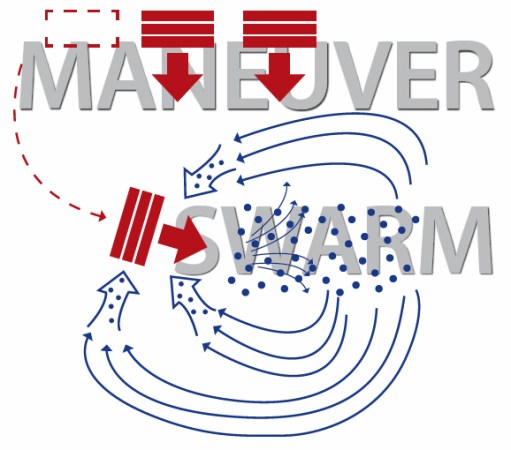 Swarming diagram courtesy of warontherocks.com
 The REPORT on NATIONAL SECURITY KINETICS™