Military Operations, History & Cyber Warfare, National Security, World War II

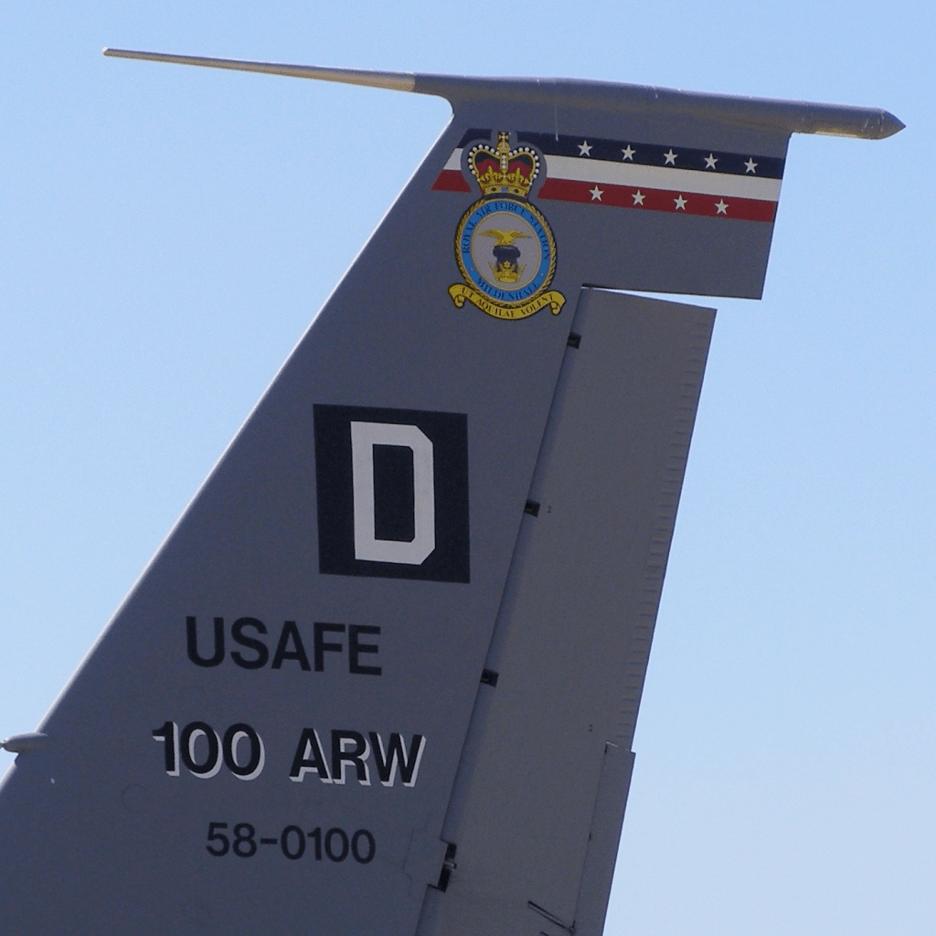
The Story of the Iconic “Square D” Tail Code of the 100th Air Refueling Wing

It All Started With a…

As it is with most things in life, nothing comes to pass overnight. It’s usually a series of events linked together that yield the outcome. If just one link in the event chain breaks, the outcome is likely to be a non-event. 

The iconic Square D tail code on the 100th Aerial Refueling Wing’s KC-135 tankers came to pass and endures due to an obscure, inauspicious event. It would be the starting point for a series of incredibly important links that would not become evident until many decades later.

***

A few months before World War I ended in November 1918, an ordinary dinner party occurred at Gray’s Inn in London for VIPs and politicians. There was no stated or unstated purpose for the party. Hindsight being 20/20, the party likely included informal conversations about the war and legislative issues. 

Gray’s Inn…an unusual place that is still in the hospitality industry, but in the 1700s it was a watering hole frequented by barristers (lawyers). It evolved into a barrister’s registry, and the Inn’s rooms started being rented as a barrister’s office. Further evolution led to becoming the oldest business to examine and certify barristers, similar to the American Bar Association. Image: Chensiyuan l Wikimedia Commons

Two gentlemen RSVP’d, and both of them were moderate VIPs and politicians combined. This is referring to Sir Winston S. Churchill and Franklin D. Roosevelt (FDR). 
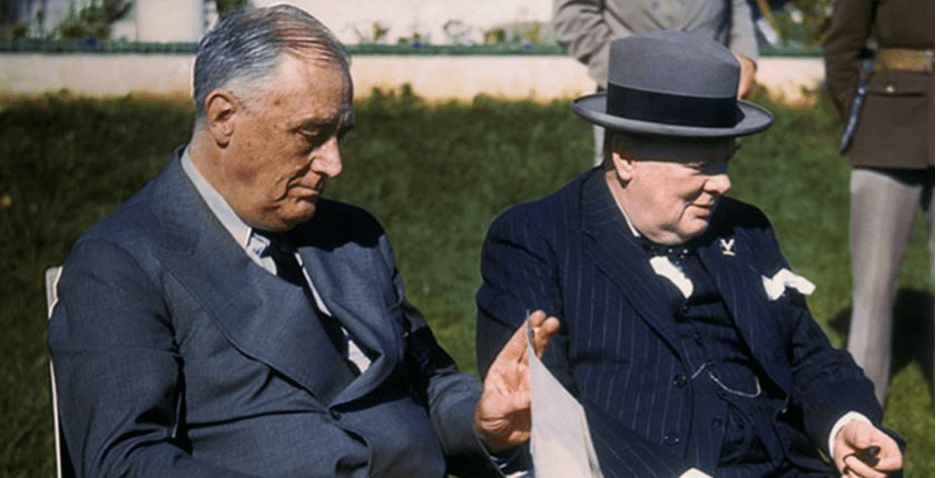
Image: National Archives

The dinner party the two future icons attended in 1918 had no memorable moments, yet it still served as their introduction. Neither man made any effort to contact the other throughout the 1920s and early 30s. There was one thing, however, Churchill never forgot: they both served in political leadership over their respective navies. This would be a useful fact many years later. 

The future of the United States as a superpower and military titan was greatly influenced by these two men. With Great Britain being the only superpower before World War II and their experience in large-scale military mobilization on a worldwide basis, it would be critical to America’s massive growth. The Square D tail code would come to pass as a small success story from these historic relationships.

Why Churchill?

In 1918, Churchill (and many others!) might have concluded that he had reached his “Peter Principle” comeuppance.  The idea behind the principle is that professional workers get promoted up the ladder until they reach a career level they are not competent. This hard assessment stemmed from a 1915 war strategy decision concocted by Winston Churchill. He was a member of the House of Commons, and he held one of the top five most important prime minister appointments, First Lord of the Admiralty…the equivalent of the Secretary of the U.S. Navy. 

If there was any aspect of conducting war by Great Britain that set them apart, it was the Royal Navy. The number one way the British projected strength and commercial success around the world was the Royal Navy. This meant in Churchill’s mind that in time of war, the Royal Navy was the most critical conveyance of projected power. The Royal Navy was the military glue that held the Empire together. 

Seeking to support the British Army by relieving strategic pain points, Churchill convinced the War Cabinet that a second front to pressure Turkey, Germany’s ally, was needed. The goal was to seize control of the Dardanelles, the Bosporus Strait, and the Black Sea. Churchill planned to use the Royal Navy and an Allied Army consisting of troops from France, Great Britain, Australia, and a few lesser forces, to make landfall on the Gallipoli Peninsula, then move north to the Dardanelles choke point. 
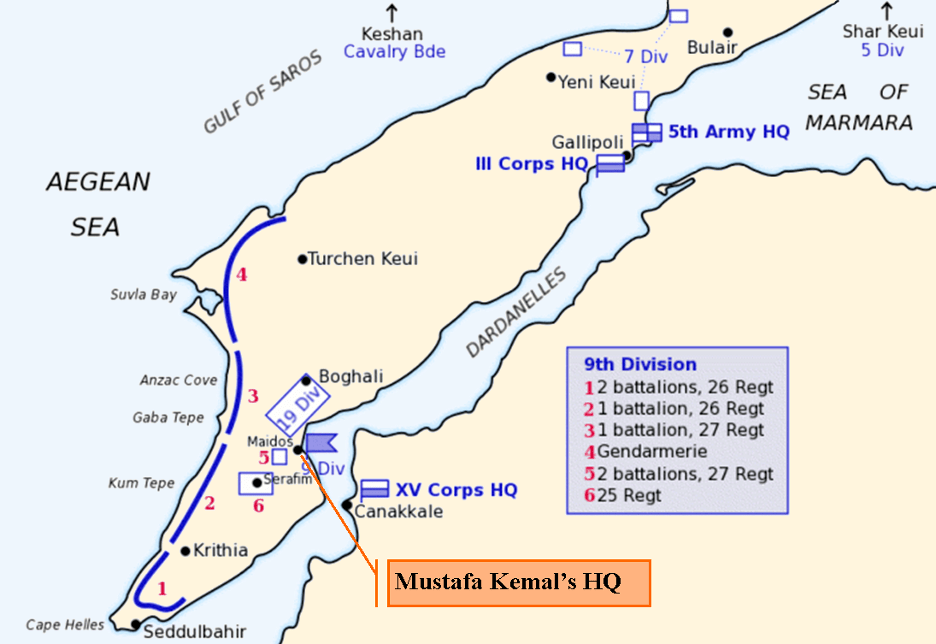
Turkish territory on both sides of the Dardanelles Strait. Allied forces landed on the Aegean side of the Gallipoli Peninsula; mountains and hills run the length of it. Turkish forces were positioned to protect the strait. The British “strategy” was to make a sneak attack from behind the Turks. The Allies were discovered immediately, and Turkish soldiers rained hell on the Allies as they tried to fight going uphill. Image: Ottoman Reference l GNU Free Documentation License

For followers of World War I History, we know the outcome of the Gallipoli Campaign: it was an Allied disaster on the water and the land.  They completely underestimated the Turks at every turn. To make matters worse, the British were shocked when it was discovered that the enemy was using submarines; several ships were lost. Tactically, the Allies and Turks both had 250,000 casualties each. But it was a costly, strategic failure for the Allies. The area in and around the Dardanelles remained solidly under Turkish control. 

The Gallipoli disaster fell squarely in the lap of Winston Churchill, First Lord of the Admiralty. Churchill was forced out of his War Cabinet role.  He remained a Member of Parliament (MP), but took a leave of absence to reactivate his British Army commission and report to the Western Front in France.  

After serving for a year on the front lines in France, he returned to his seat in Parliament. Churchill clamored for a high-level cabinet position.  His first cabinet ministry commenced in 1908 under his friend, Herbert Asquith. But, an election put David Lloyd George in the Prime Minister’s chair; he was not in the same political party as Churchill.

Lloyd George had no interest in putting Churchill in a senior cabinet job. From 1916-1922, Lloyd George posted Churchill to several lower ministries, ostensibly to keep him away from 10 Downing Street. In 1922, Stanley Baldwin, the new Prime Minister, brought Churchill back from his low-level assignments and made him Chancellor of the Exchequer (similar to U.S. Treasury Secretary) until 1929.

When a new Prime Minister came aboard in 1929, Churchill expected he would be replaced at the Exchequer, but was surprised that he was not even given a low-level ministry. He remained in the House of Commons, but was not given any assignment by the Prime Minister. It would be 10 years before Churchill served in a cabinet position again.

Why Roosevelt?

Churchill saw his political fortunes peak as First Lord of the Admiralty, but felt he was mired in a political slump when he had his chance encounter with FDR at the dinner party. Roosevelt, on the other hand, was eight years younger and was a rising political star. Throughout the Wilson Administration, Roosevelt was the Assistant Secretary of the Navy. The 1920s and beyond looked very promising for FDR. What happened instead sidelined him for the decade; he developed a serious case of polio. 
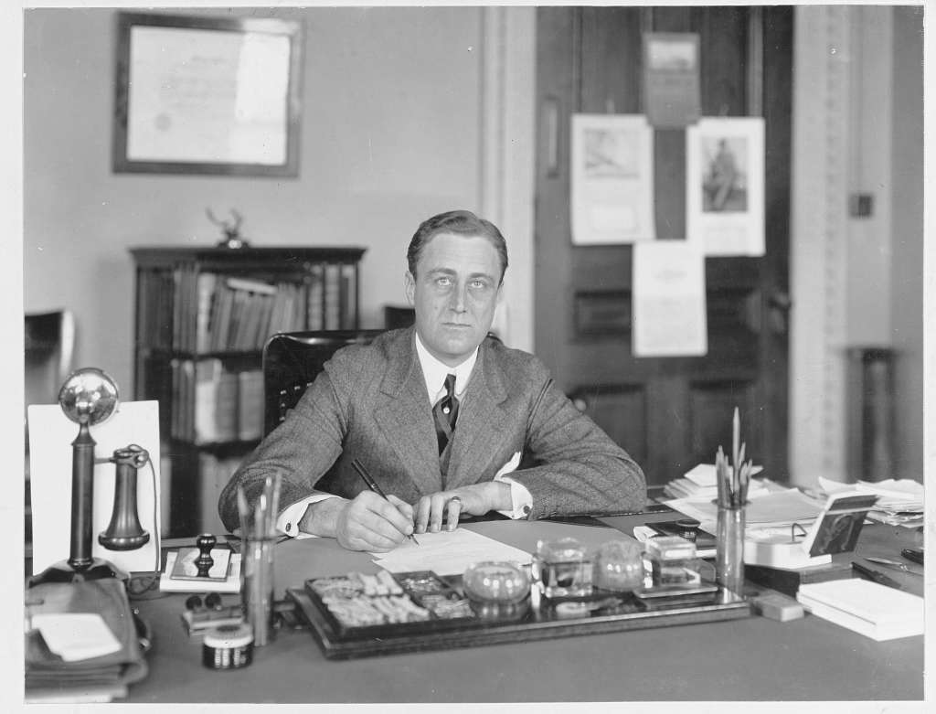
FDR at his desk in the Navy Headquarters building.  Image: U.S. Naval History and Heritage Command

Even though FDR came from an old, monied family and sought the best doctors, he would never walk unaided again. He had no idea what the future held for him, but he was not quitting. 

Although some geopolitically savvy people like Churchill and Roosevelt could see trouble brewing in the future, neither man could foresee their leadership role in the struggle to come, or the importance of their growing friendship. 

The dinner party attended in 1918 by the two future icons may have been for no particular purpose, but it served as the starting point of a historical relationship. 

The 1930s Arrive

Although it did not register with FDR until the 1930s, a country does not become the sole superpower in the world like the United Kingdom did, without the largest navy, a professional army, a strong industrial base, a mature higher education system, a deeply experienced scientific, research and development community, an unparalleled geopolitical and diplomatic core located in every corner of the world, a global, full-time, seasoned, successful, and skilled intelligence collection & espionage apparatus since the 1890s, and lastly, the muscle memory to implement a large military logistics and war mobilization program. 

How did the United States measure up in comparison to the British capabilities worldwide? Although the U.S. had some capabilities to varying degrees, none of them exceeded the U.K.’s level of competency. The idea that the United States was ready to assume the mantle of the world’s “Arsenal of Democracy” was still many years in the future. Fortunately, Winston Churchill understood all of this quite well and reasoned that at some point down the road, he needed to cultivate America and her new President.

The Rise of Hitler and Nazi Germany

Winston Churchill was well educated, well-traveled, and a shrewd judge of character. Just because he was relegated to the “backbench” in the House of Commons, with no portfolio of duties from the Prime Minister, did not mean he was disinterested in affairs of state. In short, you could take the boy out of geopolitics, but you could not take geopolitics out of the boy.  

As far as Winston Churchill was concerned, a constitutional monarchy with a well-developed system of colonies was the best form of government. A constitutional democracy like the United States had its uses, but he could not be too harsh about the U.S. because, after all, his mother was an American.

Other forms of government, however, such as totalitarianism, dictatorships, Nazism, Fascism and Communism, were scourges to Churchill. He was wary and had deep distrust of the likes of Josef Stalin, and the rise of Nazism led by Adolf Hitler. Unfortunately, no one at 10 Downing Street or Buckingham Palace was overly interested in the assessment from a supposed washed-up geopolitician. 
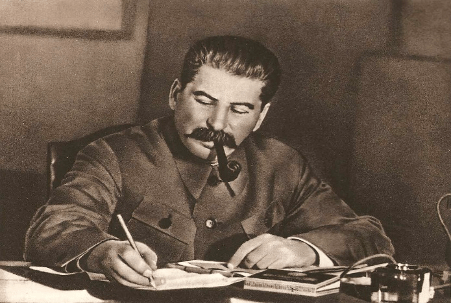
Images: Stalin: Segunda Guerra Mundial l Flickr. Hitler: Travis McCrea l Flickr l Public domain

In 1922, Italy became a Fascist dictatorship under Mussolini. Japan invaded Manchuria in 1931, and the Nazis finally captured enough seats in the Reichstag to ultimately have Hitler assume the chancellorship in January 1933. Churchill decided it was time for America’s geopolitical learning process to begin by engaging the new President, Franklin Roosevelt. 

Private Communication Between Two Former Naval Persons

Churchill pondered the what-ifs of another world war. Great Britain was the only superpower in 1914.  When World War I ended, the British Empire had lost 886,000 sailors and soldiers. Injuries accounted for an additional one million men.  The total number of British wounded and dead equaled 12.5% of the entire country’s population of men, women, and children. It was a well-known fact that after three years of war, the British Army was running out of military age men to recruit or draft.  And finally, the financial cost incurred by Great Britain during the war nearly bankrupted the country. 

It was crystal clear to Churchill that if another world war befell Great Britain, she would be fighting it alone and ultimately defeated. In Churchill’s learned opinion, the free world would likely not survive if the Americans did not enter the war, or belatedly, after three years of fighting, as it was in World War I. 

The correspondence between Roosevelt and Churchill has been archived in more than a dozen known worldwide repositories. It is so voluminous that calling it massive would be an understatement. These holdings include official documents and some of the private, personal letters between the two men.


The official correspondence between FDR and Churchill started within days of Germany’s September 1939 invasion of Poland. This communication between the two leaders was permissible because both of them were in senior government leadership positions as President and First Lord of the Admiralty. 

Informal, private communication, however, started in 1934. This communication between a sitting President and a House of Commons backbencher would have been scandalous if it had leaked to the public. Churchill was the first to send a handwritten letter to FDR. He initiated the practice of greeting each other with “From one naval person to another naval person.” The letters were written as opinions and not official government policies and plans. 

Churchill covered the geopolitical issues of concern. Roosevelt discussed the American public’s desire to stay out of foreign wars. Eventually, the letters covered the U.S. Congress’s series of neutrality laws passed in the 1930s and the difficulty of providing security assistance to Allied countries engaged in conflict. 

When the Churchill/Roosevelt communication became official in 1939, their private correspondence had put the two men on the same page, saving valuable time when war broke out. 

Communications After Churchill Became Prime Minister

America’s neutrality laws began to be repealed in bits & pieces starting in September 1940, with most of the laws rolled back by March 1941. At this point, Great Britain and the United States slowly started exchanging military liaison officers to become familiar with each other’s military capabilities, industrial sector, and their methods for military service induction and training. 

Learning from each other was the right thing to do, but there were limits to the liaison efforts until America formally entered World War II in December 1941. High level meetings in 1941 developed the plan to focus on wresting control of Europe from the Nazis and Italian Fascists as the first major goal. This agreement came to be known as the Atlantic Charter.

Churchill, Roosevelt, and Their Combined Chiefs of Staff’s First Actions

For America’s initial war activities in 1942, it was totally focused on quickly getting military equipment and trained soldiers, sailors, and airmen deployed to the European Theater of Operations. Naturally, the arrival of American help could not come fast enough for the British. 

One of the greatest concerns conveyed by Churchill and his military chiefs was making sure that everything needed for America to fight, dovetailed together in the ETO.  Simple examples of British concern included having airmen in the ETO, but not enough planes to fly, or vice versa. Or having enough planes, but a limited supply of bombs. 
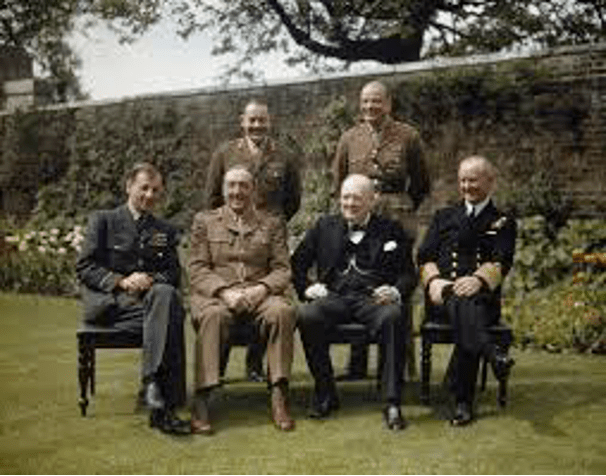
Churchill and his military chiefs. Image: British Imperial War Museum l Public Domain

The U.S. logistics effort to move men, materiel, and machines in a choreographed manner was an iterative process throughout the war. It required 24/7 vigilance and communication between all parties. The Square D tail code’s genesis is an outgrowth of America’s choreographed logistics effort. 

The Details of the Square D Story
When the U.S. Army Air Force began its preparations for mobilization and deployment to the ETO, neither the British nor the Americans had any valid information to predict how many men, machines, and munitions would be needed to fight the war. Comparing prewar and postwar aircraft inventory data shows that by war’s end, the Air Force had over 10 times as many planes as it had before the war. 

It was clear that to produce that many planes, the Air Force had to keep the factories running 24/7/365 until they were told to stop.  It was understood that everyone involved in military induction, capital equipment (i.e.; planes, ships, and tanks, et al) acquisition, and munitions manufacturing had to remain focused on their work and keep a careful record of everything. 

“Rosie the Riveter”  Image: Firkin l OpenClipArt l Public Domain

As the planes rolled off the assembly lines (that is correct, plural, Lockheed and Douglas Aircraft built B-17s under license), the Air Force had to orchestrate what happened next. They had to decide where to send them and which organization was the new owner. This seems fairly tame on the surface, but with all aspects of the military expanding at a prodigious rate, it was not easy.

An example of the Air Force’s efforts to keep pace with the expansion was a gaggle of newly produced B-17 Flying Fortresses from Boeing in Seattle, WA.  The planes were flown to Walla Walla Army Air Base, WA, in November 1942, where a newly formed unit took ownership. The unit and its planes would change bases five more times stateside before the unit deployed to the ETO in June 1943!
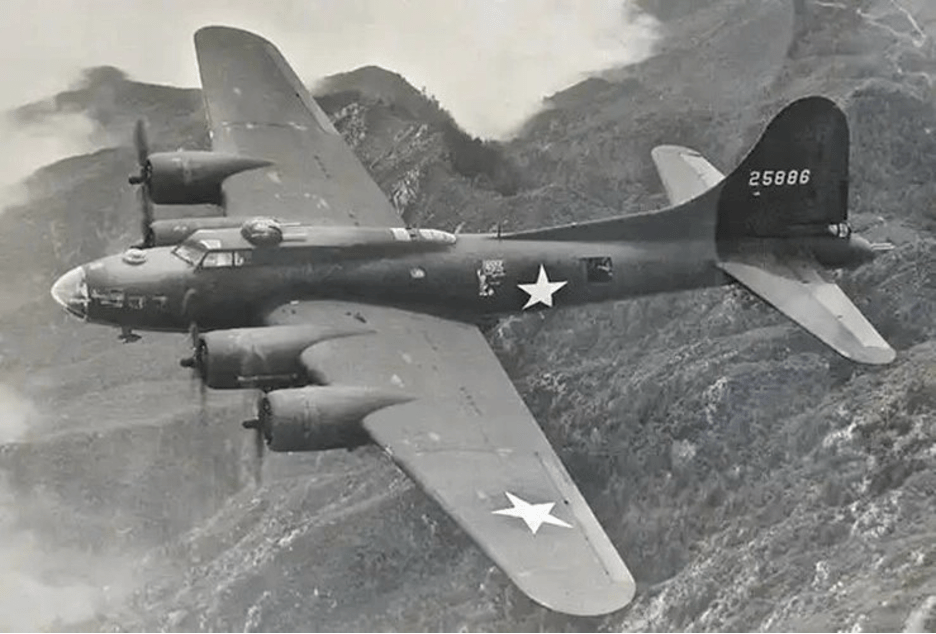
B-17F circa 1942 flying over the Cascade Mountains. Image: U.S. Army Air Force l DVIDS

The Air Force’s Expanding Organizational Structure

The Air Force entered World War II with the same structural components as they have today. Starting at the bottom: squadron, group, wing, air division, numbered air force, and command. During the war, Air Force Headquarters decided that the primary building block would be the “Group,” commanded by a full colonel. Squadrons would be led by a lieutenant colonel. Due to the exigencies of war, a group was sometimes led by a lieutenant colonel, and squadrons were led by a major. 

One of the biggest problems the Air Force dealt with (and not very well!) during the war was assigning unit numbers. Unit numbers were ordinarily managed very meticulously by Air Force Headquarters. The war expansion forced HQ to delegate new unit activations to the numbered air forces, two levels below. 

To exercise some semblance of control, HQ issued procedures for use by the numbered air force’s S-3 operations staffers. Each S-3 staff was given a large block of unit numbers to use. 

This workaround unit activation process created an unforeseen glut of unit numbers for wings and below. It became common practice to issue new numbers for not only unit activations, but also deactivated units being reactivated or transferred. It was much easier for S-3 shops to just use new numbers in lieu of reusing numbers from deactivated units. 

Although Air Force headquarters would reclaim its provenance over unit numbering after the war, the process did not change. One major revamping of the unit numbering system was attempted in the 1950s, but it did not help the situation. 

Aside from the glut of unit numbers, it also left behind prior awards and decorations. This was not properly corrected until 1966. 

Activating the Unit that Would Receive the Square D Tail Code

The U.S. Army Air Force activated the 100th Bombardment Group (Heavy) in June 1942, at Orlando Army Air Base, FL. It was originally slated to get Consolidated B-24 Liberator bombers. This changed to B-17s when the 100th arrived in Walla Walla, WA. 

The 100th BG group was assigned four squadrons: the 349th Bombardment Squadron, 350th Bombardment Squadron, 351st Bombardment Squadron, and the 418th Bombardment Squadron. 

After the 100th BG arrived at Walla Walla, it received the first four B-17 Flying Fortresses from the Boeing factory in Seattle, WA. Crew training started immediately. They began deployment preparations for England in April 1943.
The Army Air Force continued to follow Royal Air Force advice on how to apply unit identifications. Using tail codes based on a unit’s home base was of no value because of the dozens of airfields used in England, and it was information no one wanted the Germans to have. 

The solution was to have deploying groups use lettered tail codes. The first bomb group to depart stateside carried the Square A tail code. This meant something to American airmen, but didn’t mean a lot in terms of useful intelligence for the Germans.

Little did the deploying bomber crews know that the huge, lettered tail codes would be invaluable during combat sorties in sorting out which planes belonged to which group. No one realized until they started flying combat sorties that a mission with more than 100 B-17s in formation was commonplace. 

Anytime an air crewman spotted a large, lettered tail code in the air, it was a comfort to know they were with the right group of planes. It was left unstated, however, that the big tail codes also helped identify a B-17 that had been hit and was not likely to make it home. 

The 100th Bomb Group Deploys to the ETO.

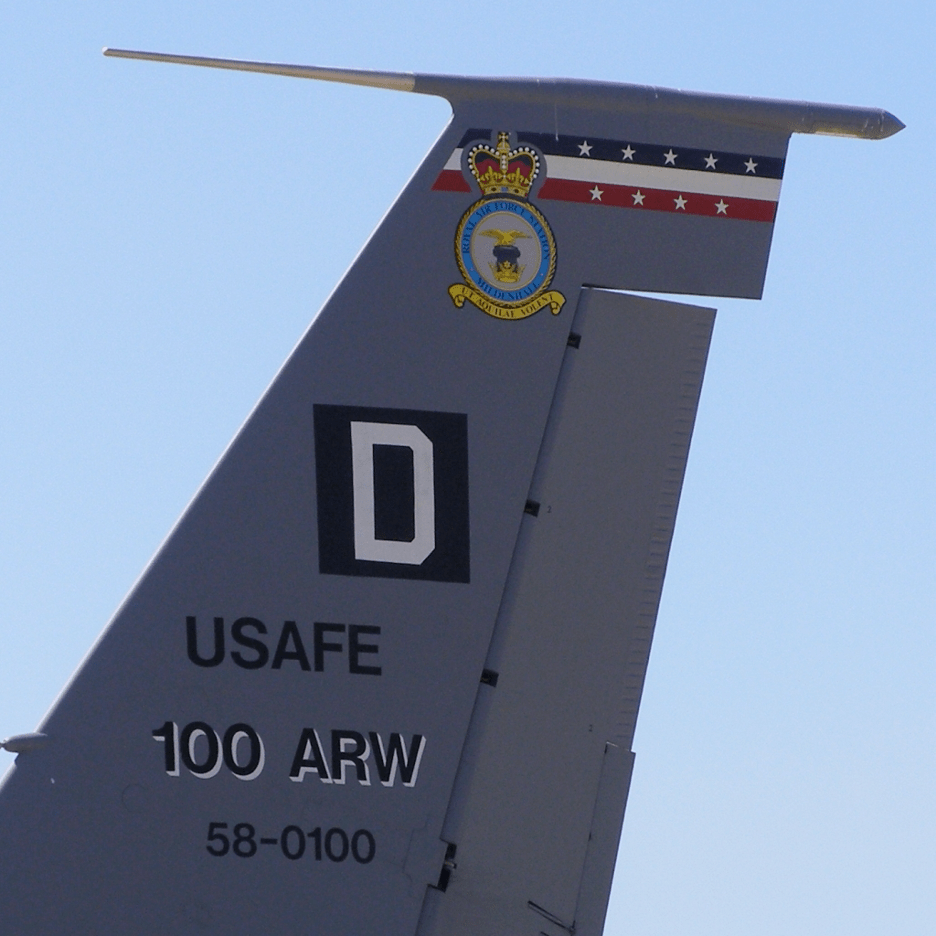
The 100th deployed as the fourth group simultaneously with three other B-17 groups. The 100th was given the Square D tail code.
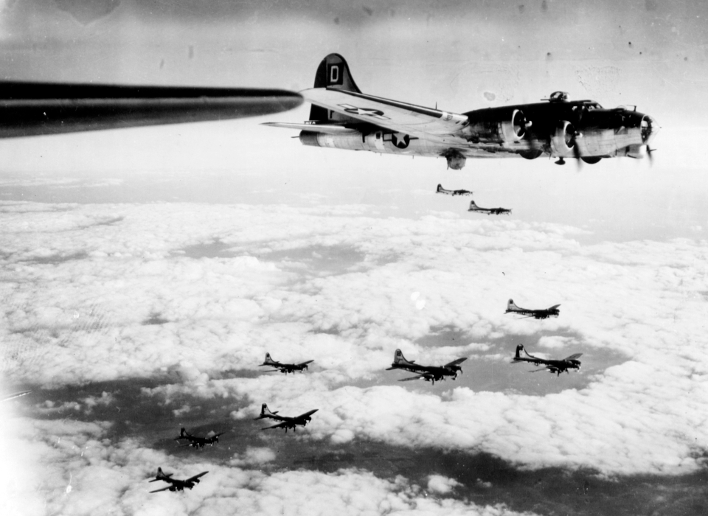
Image: National Archives

The 100th ground troops departed in early May 1943 on the Queen Elizabeth, and the aircrews departed in late May in their B-17s on the North Atlantic flying route. All elements of the 100th BG were in place by June 9, 1943, at Thorpe Abbots Army Airfield, number 139. Thorpe Abbots was the home base for the 100th until the war ended. 
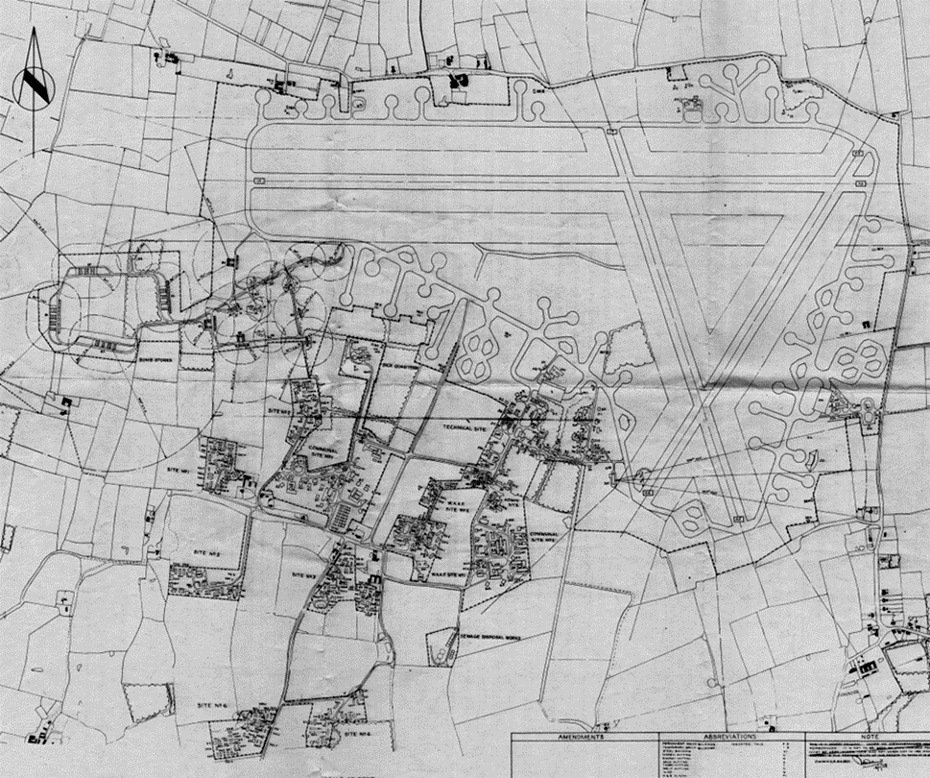
Thorpe Abbots Army Airfield – three runways and 50 hardstands for aircraft parking. Note the distance between the hardstands to avoid collateral damage if one plane is hit in a German air raid, it won’t affect the other planes. Image: British National Archives

About two weeks later, the 100th flew its first combat mission against the submarine pens in Bremen, Germany. This raid was the starting point for the legacy of the “Bloody Hundredth.” This legacy was depicted in the 2024 miniseries, “Masters of the Air.” Click the link for an informative podcast.

The 100th’s first mission claimed three B-17s from the 349th Bomb Squadron; No one survived.  All told, the group lost 182 B-17s throughout the war.  This is double the number of planes the group had when they reported in on June 9, 1943, to Thorpe Abbots.

Coming to grips with the loss of 182 aircraft is hard enough.  The human toll is even worse.  The 100th BG started with 960 crewmen. Over 800 were killed in action, and 950 were captured and spent the rest of the war in a POW camp.
Image: The National W.W. II Museum

The 100th picked up the Bloody Hundredth sobriquet from other groups due to the amount of losses it took. By war’s end, the losses were not much more than any other group, but their losses were infamous for the circumstances in which they transpired. 

The 100th BG flew the disastrous (for the Allies!) raids on Schweinfurt, Regensburg, and Bremen. Typical 100th losses on these raids were 12 of 13, 13 of 15, and nine of 12 aircraft. 
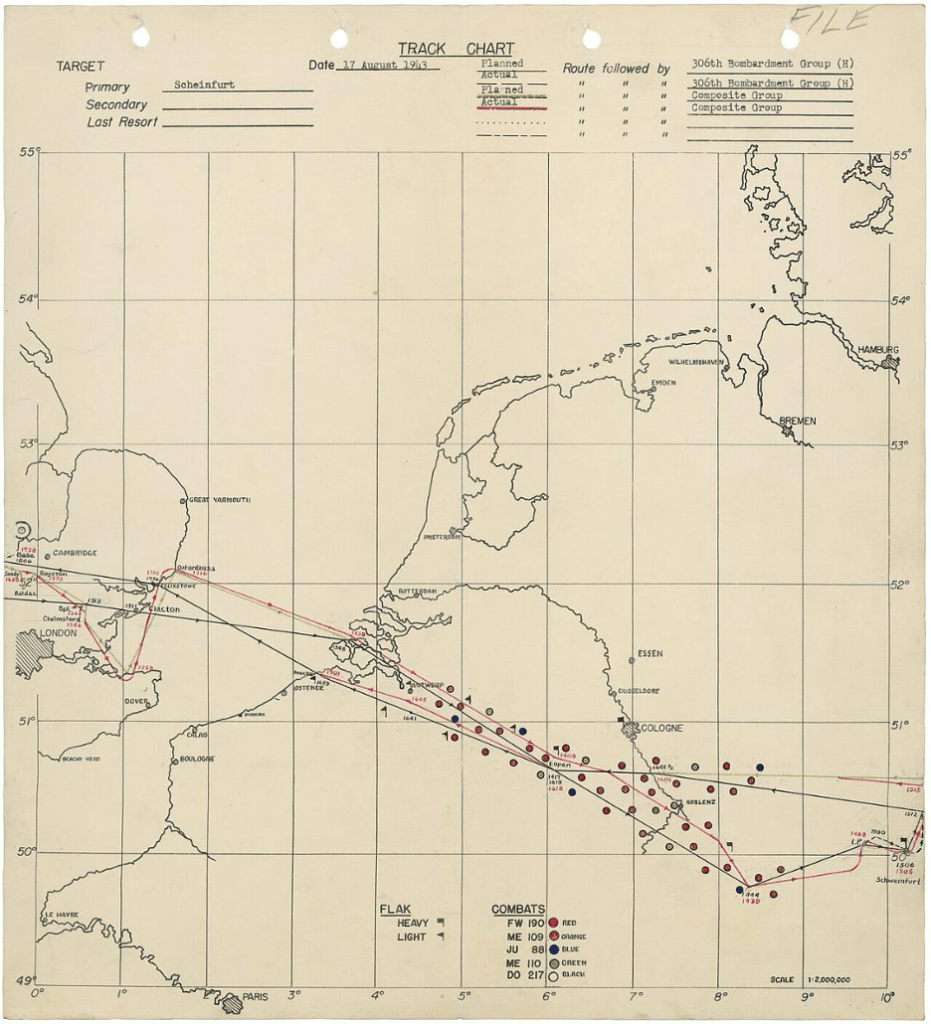
The B-17 raids on the Schweinfurt ball bearing plant and the Regensburg Messerschmitt Me-109 factory were conducted on the same day, with staggered TOTs (time over target). Regensburg is about 110 miles farther southeast of Schweinfurt. Conceptually, the plan was to have the Regensburg B-17 gaggle fly ahead of the B-17 formation going to Schweinfurt. The Regensburg planes made some faulty navigation decisions and accidentally flew over Schweinfurt. The Wehrmacht flak gunners and Luftwaffe fighter pilots had a field day.  What planes still remained in the formation flew onward to Regensburg. Anti-aircraft protection had been alerted and inflicted more losses. The follow-on B-17s headed for Schweinfurt, unaware that the anti-aircraft batteries and the Luftwaffe knew the B-17s were coming. It was another slaughter.
A 100th BG navigator in the nose of a B-17. Nothing like sitting exposed in a Plexiglas fishbowl.  It does not seem to be a very safe place while under attack by enemy fighters and 88mm anti-aircraft flak. Come to think of it, there was no place among the 10 crew positions that was any safer than the other nine guys.  Image: National Archives

Another tough run for the 100th became known as “Black Week,” October 8-14, 1943. On October 10th, they put up 18 B-17s on a mission against Munster, Germany.  Only one B-17 returned from the raid, with two engines out and two of its airmen seriously wounded. 

The tale of the Bloody Hundredth staggered through 1944 with the same sobering results. The group flew its last combat mission in April 1945. 

The 100th Bomb Group’s Legacy

During the 100th’s 22 months of combat, it flew 306 missions (some were more than just a single out & back), and was credited with 8,630 sorties. It had more ETO flying hours and sorties than any other bomb group. The group dropped nearly 20,000 tons of bombs and 435 tons of humanitarian supplies. 

The group’s gunners shot down a confirmed 261 German planes, with 1,010 probables, and 139 possibly destroyed. 
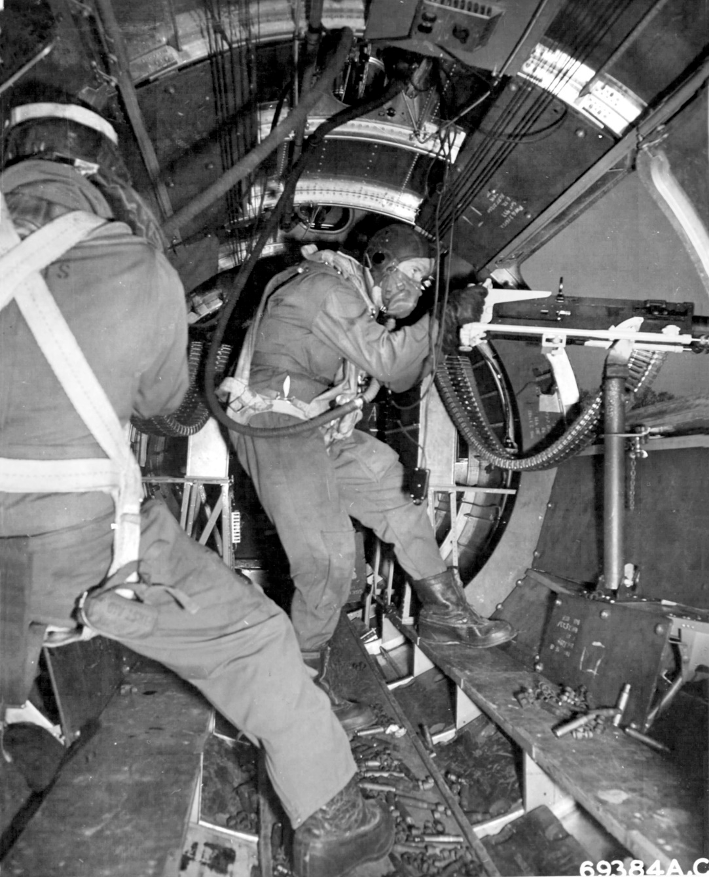
Image: U.S. Army Air Force l British Imperial War Museum

The accolades of the 100th Bombardment Group include:

· Distinguished Unit Citations:
— Germany, Aug. 17, 1943
— Berlin, Germany, March 4, 6 and 8,  1944

· French Croix de Guerre with Palm:
— June 25 to Dec. 31, 1944

· Service Streamers:
— Air Offensive, Europe
— Normandy
— Northern France
— Rhineland
— Ardennes-Alsace
— Central Europe
— Air Combat

The Post-war Period and the 100th Bomb Group 

The Bloody Hundredth returned to the U.S. and deactivated In December 1945, at Camp Kilmer, NJ. 

History will show that the 100th was one of the first four bomb groups to deploy to England, and it was the last one to come home. 

Air Force headquarters issued policies governing the process for units and aircraft returning stateside. Any unit that was going to fly their planes home had to remove all non-regulation markings or those applied due to ETO operations. These policies meant that ad hoc nose art and tail codes had to be removed. Naturally, the airmen were more upset about removing the nose art than the tail codes!

When the 100th was prepping to go home, the 8th Air Force held firm on the B-17’s nose art had to be removed, the group was allowed to fly home with the Square D tail code intact. The 8th Air Force saw this waiver as a nod of honor for the achievements of the last bomb group to fly home. 
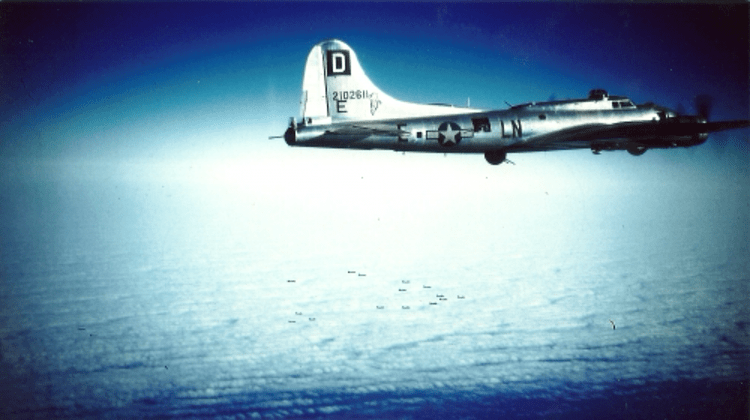
Image: The 100th Bombardment Group l USAAF l National Archives

The 100th BG was dormant less than two years when it was reactivated as a unit of the Air Force Reserve in May 1947 at Miami Army Airfield, FL. This coincided with the Air Force separating from the Army to become a standalone service branch. 

The separation from the Army allowed the Air Force to stand up its own reserve component. In the case of the reactivated 100th Bomb Group, they were assigned to be the Formal Training Unit for the Boeing B-29 Superfortress. 

One practice adopted by the Air Force after the war was to connect the unit’s members when awards were received to future members of the unit. This meant the 100th’s Distinguished Unit Citation and the French Croix de Guerre ribbons were to be worn by future members. I served in the 100th during Vietnam when its mission was strategic reconnaissance. I always wondered why we had to wear the ribbons earned 25 years ago. 

As for the 100th’s Square D tail code, in a weird case of mystery, the new commander when it was reactivated allowed the Square D tail code to be applied to the worn-out B-29s being received. The mystery is due to no readily accessible records indicating who was the commander of the newly reactivated 100th BG. 

In any case, the mystery commander’s decision to reactivate the Square D tail code was allowed to stand, and has been a source of pride for airmen assigned to the 100th ever since. In a nod to the maintenance of unit history, the Square D tail code is now carried by the 100th Air Refueling Wing based out of RAF Mildenhall, England.

It cannot be overstated that all of the other bomber units were not allowed to display their tail codes. It was a singular honor that accrued to just the 100th Bomb Group. 

The 100th BG’s B-17s, airmen, and the Thorpe Abbots Airfield may be gone, but the accomplishments live on in the iconic Square D tail code proudly displayed on the 100th ARW’s KC-135 Stratotankers. 

The entire U.S. military has been, and still is, standing on the shoulders of giants for 250 years. The bond of America’s troops will never be broken. 

Being a fourth-generation American service veteran, I remember my great-grandfather’s admonishment when I joined the Air Force. He spoke about carrying forward the torch of selfless service. He then said, “…and don’t drop the damn thing!” I did not drop it, and neither has any of the 100th’s alumni in the past 83 years. 

The Square D: a fitting tribute to the 100th Bomb Group and its future successors.

vietvetsteve@reportnatlsecykinetics.com

Seattle, Washington 

USA

Subscribe and Save This Website with an app on your iPhone/iPad or Android phone: While on this website, click on the appropriate button in the upper right hand corner as if you were going to Share the site with someone else. Click on ADD TO HOME SCREEN, and you’re done. On a PC, do the following: Click More Tools > Create Shortcut, and then check “Open as window.”
Standard
American Politics, American Society, Controversy, Life in America, National Security, Socialism

American Socialism?

Introduction 

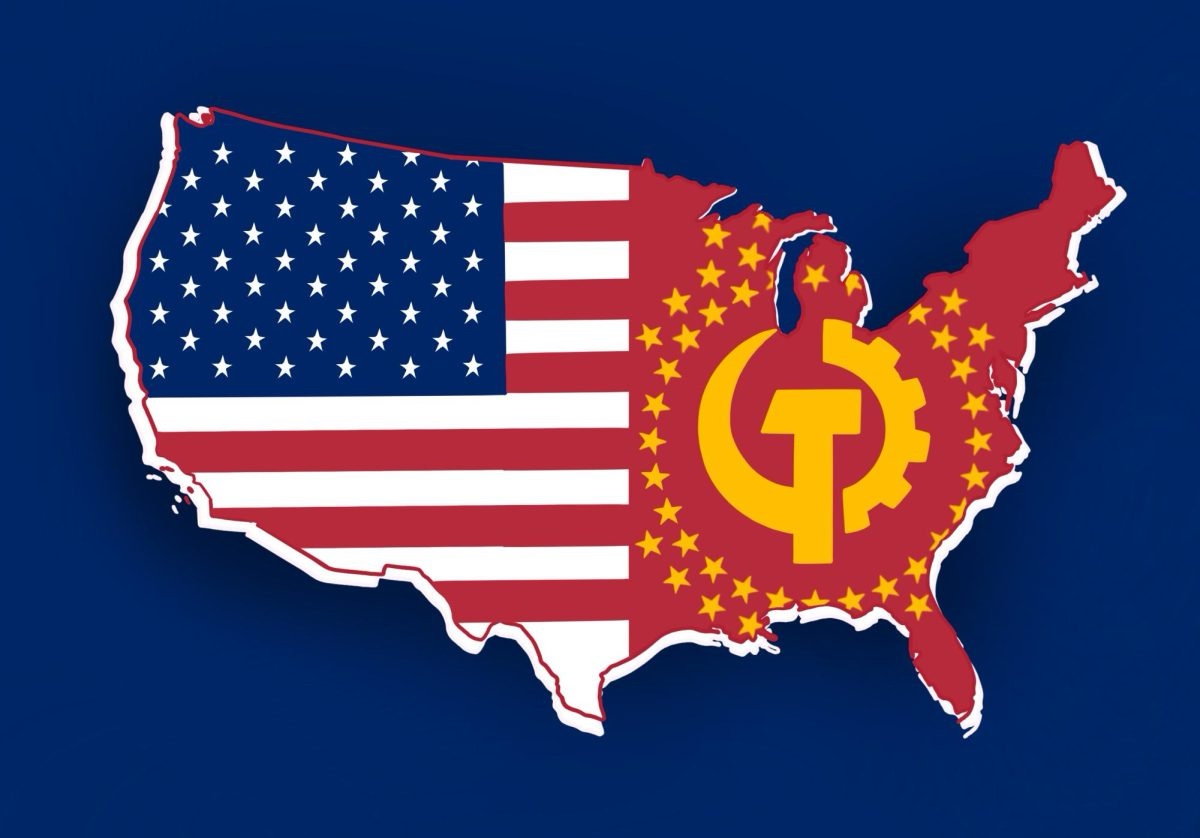
When the socialist, Zohran Mamdani, became the mayor of New York City in January 2026, it seemed to set a whole lot of things in motion. It’s interesting because it’s only been a couple of years ago that some of the progressive Congressional  Representatives in the “the squad,” found themselves voted out of office. Plenty of voters thought that the progressive squad was on a downhill slide. Senator Bernie Sanders and Congresswoman Alexandria Ocasio-Cortez, however, were still just as vocal as ever in their socialist rhetoric. 

Mamdani’s victory in New York City, the largest city in the country, and home to Wall Street and the New York Stock Exchange, was not anticipated by anyone until it was too late. Progressive politicians were impressed. A prevailing attitude developed; if New York City could be turned from blue to Navy blue, then was it doable elsewhere? Many Progressives think it is. 

Mainstream Democrats were surprised when 28 Progressive members of the Democratic Socialists of America (DSA) beat-out incumbent Democratic members of Congress. As my Dad (in his late 90s) would say, “this is not your New Dealer grandfather’s Democratic Party anymore.” No, it surely is not. 

Progressive elites now have the answer to their question of whether donating dollars to DSA-backed election campaigns are worth the investment. In the minds of those monied, far left-wingers, yes, they are. 

Some readers are familiar with my professional writer’s motto, “If I Can’t Prove It, I Don’t Write It.” The same readers know my penchant for writing about what is going on behind the headlines, and not regurgitate them. To that end, let’s take a look at Socialism in politics and society globally, with a broader view from 30,000 feet. 

Globally, current day Socialism is a mixed bag of some legitimate success, and some legitimate failures. But the majority of socialist-based countries are muddling along in the middle, and dealing with the inevitable consequences of a system with the ideal of “one-size-fits-all,” except when it doesn’t.

Origins of the Socialist Movement

Just to level-set the narrative about Socialism and Communism, and keep it simple, all Communist countries are Socialistic. But most Socialist countries are not Communists. Many pundits say that either Communism is Socialism on steroids, or Socialism is Communism-lite. If you are pro-Socialism, you are quick to assert that you are not a Communist. Whereas, Socialism’s detractors are just as quick to label Socialists as Communists. For the sake of this discussion, I’ll give Socialism the benefit of the doubt that it is not Communism-lite.

Up through the 1700s, most countries were monarchies, with much of the working class being minimally educated. The working class saw Socialism as a fair method of government and society. The problem that most would-be Socialists had was a lack of education, money, and political experience in running a government. 

What is now called Great Britain, went through multiple internal wars in the 1600s and the first half of the 1700s. I am purposely using “internal wars” instead of civil wars because there were conflicts between barons, the Parliament and the Crown, and between the states of Ireland, Scotland and England. All of these conflicts have been loosely referred to as the Wars of the Three Kingdoms. Although each conflict had its nuances, they basically came down to discord over the British monarchy. 

The second most important country in the world during the same timeframe was France. The French Revolution ran throughout the 1790s; it led to the deposing of King Louis XVI in 1793. Shortly thereafter, the king was executed. 

Aside from the wars just mentioned in France and Great Britain, there were five other major internal wars worldwide. Nearly all of them were rooted in the dislike of monarchies. The term, “Socialism” was popularized in the 1820s and 1830s in Great Britain and France during the Industrial Revolution. The Industrial Revolution further exacerbated the “us vs them” mentality. The Socialist movement gained global attention starting in 1848, when the socialist Karl Marx, PhD, published his book, “The Communist Manifesto.” Marx’s book gave credibility to Socialism as a movement to be reckoned with over the next 100 years. 

America’s Dealings with Socialism 

At the time of the American Revolution, the Founding Fathers were wary of all the “Great Powers” of Europe. In that era it was commonplace for influential monarchies to run roughshod over anyone who got in their way. The Founding Fathers would readily agree with this characterization. Other than France, the 13 colonies preferred to have prominent powers visit America for international trade purposes, but go home when they were done. 

President George Washington wrote in his 1797 Farewell Address that, “America’s destiny & future prosperity is rooted in being a global trader, traveling to distant lands, but returning home to the America we fought for. America is, and will be, “In” this world, but we are not “Of” this world. We are “Of” America, and nowhere else. Why else would we have sacrificed so much to form this great land, only to be of the world that we strove to separate from?” 

The Founding Fathers had a distaste for monarchies for many reasons. One of those reasons was mistreatment and oppression of the working class. It was just another reason to eschew monarchies in the formation of the United States of America. 

Karl Marx’s book was translated from German to English, and became available in the U.S. in the 1850s. The timing of its arrival and serious interest was subordinated by the Civil War. 

The basic freedoms enjoyed by Americans mitigated the popularity of Socialism until the 1880s. A union organizer, Eugene V. Debs, gained prominence when he adopted the Socialist movement as part of his labor organizing activities. He ultimately ran for President.  Debs was a founder of the Social Democratic Party of America. He was on the Presidential ballot in 1900, 1904, 1908, 1912, and 1920 as a socialist.  He was twice convicted of Federal crimes and sent to jail. 

Even though Debs became a revered socialist leader amongst the working class, the rest of the country ranged from ambivalence to deep seated mistrust of the Socialist movement in America. 

Socialism Around the World 

Since Socialism never became mainstream in American politics or society, proponents of the movement have largely been forced to cite Socialism’s acceptance in other countries. Its detractors easily point to other countries that have had less success with it. The following information is a 2026 look at Socialism Around the World. Some countries listed are known for extreme socialism, which is Communism.

Countries with Socialist Dominance for the Longest Duration

  1. North Korea  – 78 years
  2. China – 77 years
  3. Vietnam – 71 years
  4. Cuba – 67 years
  5. Laos – 51 years
  6. Guyana – 50 years
  7. India – 50 years
  8. Portugal – 50 years
  9. Tanzania – 49 years
  10. Sri Lanka – 48 years

It’s significant to note that no country had enough moxie or favorable political climate to make the leap into a Socialist state until after World War II. Most countries with deep-seated Socialism, like Cuba, Vietnam, North Korea and China, came from civil wars, colonialism, or monarchies.

Socialist Countries with Socialism Added to Their Constitution

  1. Portugal
  2. India 
  3. Sri Lanka
  4. Cuba
  5. Guyana
  6. Tanzania 

Democratic Countries, then Socialistic, and back to a Democracy

  1. Czechoslovakia
  2. Venezuela
  3. Chile
  4. San Marino

Countries in a Different Socialistic System

Countries in the fourth category are known as Social Democracies. These European countries have had socialist and left-wing democratic parties in power for many decades. They are classified as Social Democracies because their economies are based on capitalism, but their political bent is solidly liberal. The biggest difference between the Socialist countries noted above and the Social Democracies is their limit on where and how socialism is applied. The Social Democracies are mindful of going too far with Socialism. This is always a concern with Socialists wanting to push even farther to the Left.

Social Democracies are informally referred to as followers of the “Nordic Model.” The following five countries are in this category:

  1. Denmark
  2. Finland
  3. Iceland
  4. Norway, and 
  5. Sweden 

These nations are the most frequently cited as examples of socialism that works. The Nordic Model is known for certain common social institutions, which are:

  1. Universal Healthcare: 100% funded through taxes.
  2. Free Higher Education: The government fully subsidizes a college education for as high as someone wants to go. Needless to say, they have a highly educated workforce, and many citizens in these countries are fluent in English and their native tongue. 
  3. Strong Labor Unions: Nearly all non-management workers are covered by collective bargaining, including many occupations that are salaried jobs in the U.S. (i.e.; accountants, engineers, nurses, etc.)
  4. High Taxation: High personal income and consumption taxes fund the extensive welfare state. 

Surprisingly, the high taxation hasn’t been a common factor in wealthy citizens leaving the Nordic countries. This is mostly due to the insistence that for the amount of taxes paid, it had better be for the best of everything. The Nordic countries have world class healthcare, superb public safety and a low crime rate, and their public works, like roads, electricity generation, parks, and so on, are the best in Europe. 

Another factor that doesn’t give the elites a reason to leave is taxation has been limited to earned income tax and sales tax. The one exception is Norway, which passed a law levying a wealth tax in 2022. The detractors warned the Norwegian Government repeatedly of the negative byproducts of a wealth tax; no one listened. 

Not only did wealthy Norwegians raise the warning flag, but the other four neighboring countries spoke up, too. All of them had tried wealth taxation and failed miserably. The laws were rescinded 15-20 years ago. 

The expected exodus of rich Norwegians came to pass; many of them moved to Switzerland. 

Instead of the government in Oslo dialing back on the wealth tax, they doubled down! The Government enacted legislation that instituted an Exit Tax for people with a high asset valuation. Oslo is now trying to extricate itself from the mess they created. 

A key fact about the Nordic countries’ use of Socialism that is lost on most proponents is, how did they manage to implement the Socialist reforms so successfully? The answer is pretty simple: after World War II ended, all European countries, especially those occupied by the Germans, had devastated economies and massive rebuilding to undertake. Having no healthcare system, a seriously depleted workforce of people with college educations, the government’s concluded that starting out with nothing, gave the opportunity to adopt socialist programs and policies that would benefit everyone. 

If the United States tried to implement widespread socialist practices, it would create massive problems that would be difficult to overcome. The costs would be exorbitant and the public would end up with mediocre goods and services. 

A Novel Idea for Collecting More Taxes

Redistribution of wealth has never worked in a democracy or a democratic republic like the United States. Some taxing authorities in America are always looking for a path to untapped tax revenue. An example of this occurred in the 1990s in Los Angeles County, CA.

At the time, Los Angeles County was home to the two largest aerospace contractors that produced satellites…TRW, Inc, and Hughes Aircraft Company. Most people don’t realize who actually owns the non-governmental satellites orbiting the Earth. Often times a satellite will be launched, with the stated commercial sponsor, like AT&T, for example. AT&T would fund the development and manufacturing costs, but then would sell it back to TRW or Hughes. Satellites of that era might have 25-30 discrete channels. AT&T had no need for that many channels, and no expertise in operating a satellite. They might retain 4-5 channels, but Hughes or TRW would lease out the remaining channels for a profit. 

Given the satellite business that the two companies worked in, their niche was exclusive and no one had the capital to invest in a start-up Satellite company. And neither company could afford the costs of moving elsewhere.  The bulk of their supply chain and engineering talent pool was in Southern California. 

This got the Los Angeles County Tax Assessor to thinking about TRW and Hughes’ satellite businesses. The tax assessor said it was normal for the County to assess property taxes on real estate, but also any assets owned by a person or company. Companies, for example, paid taxes yearly on their inventory of parts and equipment. In the tax assessor’s wisdom, he concluded the satellites each company owned that were circling the Earth were capital assets and ought to be taxed. 

County governments had no taxing authority outside the county, nor outside of the state or the country. The courts ultimately ruled that L.A. County could not impose taxes on the satellites flying overhead. The ruling was strictly based on lack of jurisdiction. 

In Conclusion…

Other than the Nordic countries that embraced socialist programs from the beginning, all the rest have struggled with the movement. Many of the countries embracing socialism either limp along, or they establish an authoritarian state to force the system to work. 

I doubt this analysis will convince anyone to forego the pursuit of Socialism. The best we can hope for is educating the rest of us that widespread Socialism in America is a disaster waiting to happen. Just look at the mess that Socialism has left in its wake. 

vietvetsteve@reportnatlsecykinetics.com

Seattle, Washington 

USA

Subscribe and Save This Website with an app on your iPhone/iPad or Android phone: While on this website, click on the appropriate button in the upper right hand corner as if you were going to Share the site with someone else. Click on ADD TO HOME SCREEN, and you’re done. On a PC, do the following: Click More Tools > Create Shortcut, and then check “Open as window.”
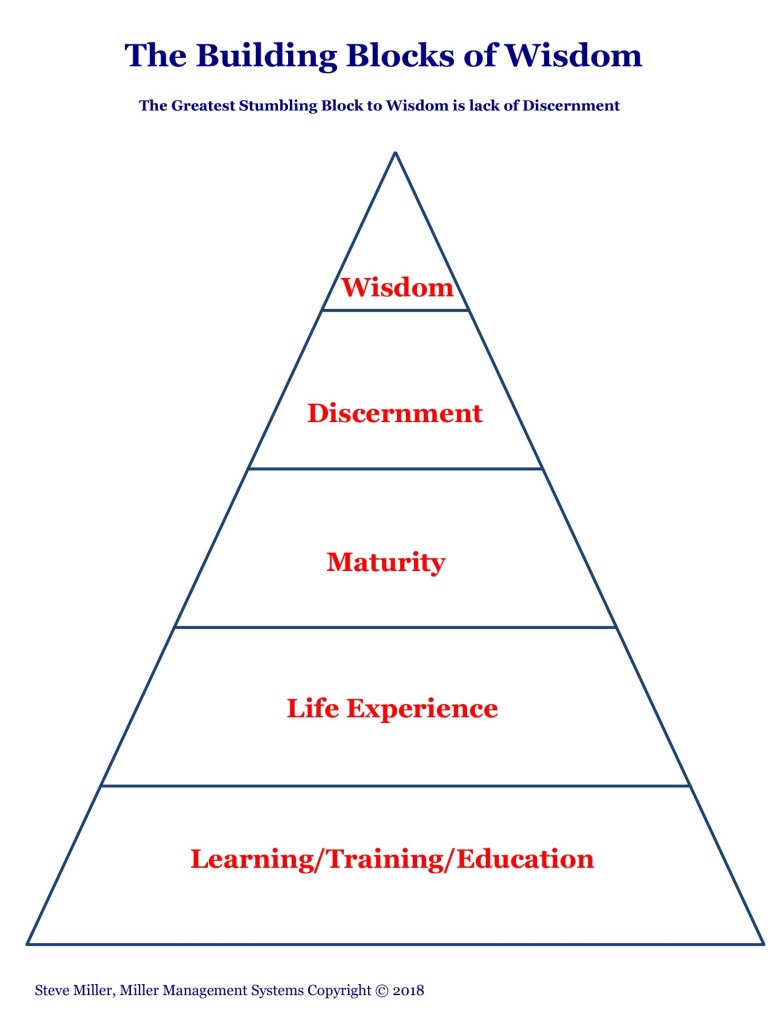
This concept works for anyone in all walks of life
Standard
American Politics, Foreign Direct Investment, Foreign Policy Research & Analysis, National Security, Regulations, U.S. Code

Committee on Foreign Investment in the United States (CFIUS)

Introduction 

Foreign capital investments in the U.S. have taken on a new focus designed to minimize transactions that could affect U.S. National Security. The recently updated CFIUS regulations are daunting. Any person or organization interested in investing in the U.S. would do well to study this report. If you decide to go forward with your transaction, you have the option of meeting the regulatory requirements on your own, or hire an experienced consultant to administer the process on your behalf.

Foreign Capital Transactions are scrutinized in accordance with The Defense Production Act of 1950, as amended seven times in the intervening years. The first six updates regarding Foreign Investments occurred in 1975, 1976, 1988, 1992, 2006, and 2007. Even with these changes, the U.S. Government was still behind-the-times in monitoring foreign capital investments. 

The U.S. Government’s reluctance to tighten Foreign Investment regulations is deeply rooted in America’s 250 year-old belief in democracy, and free enterprise, which discourages regulation until proven necessary. 

President George Washington wrote in his 1797 Farewell Address that, “America’s destiny & future prosperity is rooted in being a global trader, traveling to distant lands, but returning home to the America we fought for. America is, and will be, “In” this world, but we are not “Of” this world. We are “Of” America, and nowhere else. Why else would we have sacrificed so much to form this great land, only to be of the world that we strove to separate from?” 

The sentiment expressed by President Washington of being a “Global Trader” was a desire America had for all, and looked forward to the commerce they would bring to us.

You might wonder why the Treasury Department, and Congress didn’t enact Foreign Investment legislation and regulations as they are now, and not wait 70 years to get there? The simple answer is trying to balance free enterprise with protection of American interests. Each round of changes were as far as Congress, and the White House were willing to go at that point in time. 

It wasn’t until the changes made in January 2020 did the Act finally have the teeth to make a serious effort in monitoring foreign nationals, and their money investments in the U.S.

The 2020 legislation approved tighter regulations, appropriated funding, and authorized the Treasury Department to create a support staff for the Committee on Foreign Investments in the United States (CFIUS). The new staffers would be in the just created Office of Investment Security (OIS). To ensure this important work wasn’t cycled to the bottom of someone’s organization chart, the new legislation mandated no less than an Assistant Secretary to lead the new OIS. 

The 2020 changes were the first time the regulations expanded Foreign Investment (known in the regulations as a “Covered Transaction”) eligibility criteria. Previously, a Covered Transaction ONLY included one type, which was: a Foreign Person or Entity representing a Foreign Government that was/is either acquiring controlling interest, or a 100% buyout of a U.S. business.

The term “Foreign Entity” can be a foreign government, an offshore company, partnership, consortium, an institution of higher learning, or other entities with a principal place of business outside the United States.

The iterative transformation of Foreign Investment monitoring by the U.S. Government is not uncommon in American politics. The USG went from being naive about Foreign Investing, to studying/reporting on it, to becoming a dedicated, funded, and staffed bureau led by no less than an Assistant Secretary, to a regulatory body charged with identifying & investigating Covered Transactions, levying fines, and halting deals.

Whether a Foreign Investor is a Person or Entity, they are generically referred to as a “Foreign Investor.”

Origins of the Defense Production Act

The Defense Production Act of 1950 that President Truman signed into law, didn’t have specific language about foreign investment/ownership. It surfaced tangentially on several occasions when a foreigner’s investment or ownership in a U.S. defense contractor wasn’t cooperating with Government priorities for the U.S. Armed Forces. Originally, the Commerce Department was the primary executive agency for the 1950 Act due to the focus on business and industry, and not on financial matters. As you can imagine, with no funding, and no finance-savvy staff, Commerce didn’t go looking for Foreign Investment/ ownership issues. The Act was mostly for providing the President in wartime, the tools to direct the priorities of the government and commercial enterprise to ready the military for sustained combat.

What was the Status of Foreign Investment After the Korean War?

Foreign investment and/or ownership in the U.S. wasn’t a concern in the 1950s and 1960s. Foreign countries, even America’s World War II allies, were still focused on rebuilding their economies; there was very little surplus funding for overseas investment. 

The 1970s changed everything. The Vietnam War was winding down, and so was NASA’s Apollo Moon Landing Program. That meant that the Pentagon and NASA scaled back and/or cancelled hundreds and hundreds of purchase orders. With the loss of backlogged orders, defense & aerospace OEMs made deep manpower cuts.

Another ominous watershed event occurred in 1967 that created future negative effects on the U.S. economy; the Arab-Israeli Six Day War. The Arab world was shocked when the Israeli Defense Force, in only six days, captured parts of Syria, Jordan and Egypt. To this day, Syria and Jordan still haven’t been given back what they lost. Egypt, on the other hand, lost the entire Sanai Peninsula! The Israelis gave it back in 1975.

Israeli occupation of the captured Sanai Peninsula led to closure of the Suez Canal for eight years; it was the dividing line of a war zone. The canal closure would lead to future supply chain problems, and escalating costs in the U.S. Balance of Trade. Monetary Problems, and Gold Reserves Prior to the 1970s was nil; it left the U.S. with a foreign trade surplus. The Cost of Goods Sold for American manufacturers was competitive, with little need for offshore outsourcing. Global demand for American products remained high. 

After two years of the Suez Canal closure, it started to disrupt American commerce overseas, and at home. Shipping costs and lead-times went up. Coupled with the downturn in the defense/aerospace sector, and the climbing cost of living, rising export shipping prices, and increasing international customer pricing dissatisfaction, led them to start looking for non-U.S. sourcing alternatives. Offshore competition tightened, and by 1980, the U.S. trade surplus had evaporated. Its difficult to remember that 50 years ago there used to be a trade surplus!

Problems started brewing with Americas gold reserves. Gold prices had been fixed at $35 an ounce per the Bretton-Woods Treaty signed in 1945. 

Because the dollar was the most stable currency in the world, many countries pegged their currency at a fixed exchange based on the dollar. All denominations of dollar currency could be exchanged at the owners discretion from the U.S. Treasury for a corresponding amount of actual gold. Offshore buyers and sellers involved in U.S. trade typically required transactions in their own currency to avoid adverse exchange rates vs the dollar. But, with the dollar losing value by the day, offshore companies switched to transacting business in dollars. The dollar continued to weaken to the point that U.S. monetary practices & fiscal policies were in serious trouble.

Investment experts worldwide advised their clients to buy as many dollars as possible, and maximize their business transactions in dollars. Then they were instructed to cash-in all of their dollars at the U.S. Treasury in exchange for gold at a fixed value of $35/ounce. The U.S. monetary system was hemorrhaging money, but not the paper currency. The Federal government was essentially selling-off its gold reserves at a discount! 

President Nixon Takes Action

By 1971, in addition to depleting the gold reserves, the prime interest rate, unemployment, and inflation were all climbing toward double digits, and by 1975, all three were above 11%! The economy was also nicked by higher gas prices due to Arab states raising the cost per barrel of oil as an economic “hand-slap” for American support of Israel after the Six Day War. Every remedy they tried failed to slow down the approaching financial crash. 

Nixon consulted with his advisors, and then issued an Executive Order, taking drastic measures. The E.O. froze food and gas prices. The second major action was removing the American monetary system from the Gold Standard. 

As is the case with many Government measures that are meant to mitigate a serious problem, they work okay for awhile, but eventually people find ways to work around the impediments, and the special measures become ineffective (recall that was exactly what happened across the country during the Covid-19 Pandemic). Food and gas price freezes experienced this; after 18 months the Government rescinded the program. On the other hand, removing the dollar from the Gold Standard was intended to be temporary, but it worked so well, it has never been changed back. 

Two years later in 1973, with the economy continuing its downhill slide, Egypt and Syria attacked Israel all over again in what became known as the Yom Kippur War. The outcome for the Arab states was worse than the last conflict in 1967. This time the U.S. did a lot more to help the IDF. Saudi Arabia decided the U.S. went too far, so they convinced OPEC to put a 100% embargo on all petroleum products going to the U.S. This created the Gas Crisis, with gas stations running out, and waiting lines stretching up to a mile down the street. 

Executive Order 11858 

The second new problem was Foreign Investments. President Gerald Ford’s E.O. 11858 issued in May 1975, aimed to deal with this emerging National Security threat. At the time, however, the greater concern was possible effects on the economy. 

Whereas, the U.S. was in a strong economic position prior to the 1970s, which did not encourage Foreign Investment – it was just too expensive – but now it was the opposite. The economic woes of the 1970s made Foreign Investment in the U.S. far more attractive and affordable.

President Ford issued the E.O. for two reasons: 

1.) By far, the largest block of foreign investors in the 1970s were OPEC countries. As discussed previously, OPEC, in general, and the Arab members, in specific, were causing enough havoc in the country already due to the U.S. support of Israel. America produced very little of its own oil in the previous 20 years due to OPECs ability to refine it and sell it at a lower price. Letting OPEC countries invest in the U.S. energy sector could lead to losing control of a strategic industry and weaken National Security. 

2.) President Ford had been a Republican member of the House of Representatives for 24 years prior to his 1973 appointment as Vice President. He was the House Minority Leader for his last eight years. Ford knew all too well that the Senate was in the middle of a Democratic-controlled 26-year run, and the Democratic hold on the House was even more one-sided, half way through a 40-year run. 

The Democratic Congress was extremely active during the Nixon Administration, and if they were so inclined, could enact legislation covering foreign investment. Even if Ford vetoed the bill, the Democrats could easily muster the votes to override the veto. Ford’s Treasury and Commerce Departments already mapped-out the investment review process, and didn’t want Congress’ heavy-hand in it. 

E.O. 11858 became the primary vehicle for CFIUS investment review for the next 40+ years. The Foreign Investment review environment changed steadily over the decades. Whereas, the thrust of E.O. 11858 was mostly about CFIUS having the ability to stick its nose into any Foreign Investment it wanted to, its greatest value was as a deterrent to would-be Foreign Investors with an ulterior motive. 

The intervening years showed that foreign investors gradually came to realize that CFIUS was a “paper tiger;’ it no longer had the deterrence value it once had. A determined foreign investor who was willing to take steps to avoid obvious red flags, had a good chance of going unnoticed. Crafty investors learned the authority stemming from E.O. 11858 only empowered CFIUS to conduct an investigation. It did not give any specific remedies/actions that CFIUS could take, other than report their findings to the White House, the Commerce and Treasury Secretaries. 

Since CFIUS’  investigation rules had no provisions for taking action, if/when they identified a risk, it made each of these sticky foreign investment scenarios a real chore to alleviate or mitigate. If negotiations failed to find a workable solution, and the foreign investor was unwilling to accept a compromise, the only legal means for the U.S. Government to prevail was to file a Federal Court case to obtain an injunction to stop the acquisition.

CFIUS’ statutes and regulations often lagged contemporary business practices of the day. Two CFIUS cases illustrate the changing landscape of Foreign Investments over the years. In 1988, Japans large integrated circuits manufacturer, Toshiba Electronics, responded to Fairchild Instruments Request for Proposal to sell-off its I.C. chip production plant, Fairchild Semiconductor. Fairchild accepted Toshibas offer, and the deal moved forward. 

Treasury regulations in 1988 provided for just one Foreign Investment category with mandatory transaction notices to CFIUS: Foreign Investments directly or indirectly involving foreign government ownership. All other Foreign Investments were voluntary notification only. Conversely, CFIUS could investigate ANY Foreign Investment deal they saw, notification or not. 

CFIUS learned of the Toshiba deal at the 11th hour, and did a cursory review. They identified a number of specialized I.C. chips for the Pentagon that carried a Secret security classification. Since CFIUS, and the President had no authority to stop a deal, it took some lengthy negotiations to complete the deal. Fairchild and Toshiba agreed to remove the military chips and transfer the orders to a different Fairchild division. 

CFIUS didn’t want future transactions to back the President into a corner with no authority to stop a national security-related deal. Congress passed the Exon-Florio Amendment, allowing the President to stop a deal, if needed. There were two regulatory factors that wouldn’t change until the 2020 legislation: 

1.) Foreign Investment regulations were too narrow for mandatory CFIUS notifications; investments other than foreign government deals needed mandatory notification, too. 

2.) If CFIUS’ advice was to block an investment, but it was already a done deal, the President had no authority to stop it. 

In 2006, Dubai Ports World (DPW), a logistics company owned by the United Arab Emirates Government, closed a deal to buy P&O’s (Peninsular & Oriental Steamship Company) port operations division. P&O is a British company. No American company was involved, so CFIUS had no jurisdiction. The New York Port Authority logged-in some DPW visitors to look around the port, which seemed odd, since no one had heard of DPW. The Port Authority reported it to the U.S. Coast Guard, who routed it to the Treasury Dept when they heard that a foreign maritime company acquired the vendor contract for port operations. CFIUS investigated the DPW acquisition, noting that it was already a done deal. CFIUS identified six American ports that P&O had been operating; all six had some warehouses and cargo cranes formerly owned by P&O, and nothing else. CFIUS concluded that owning some warehouses, and cranes didn’t affect national security; the case was closed. 

Congress caught wind of the DPW deal, and disagreed with CFIUS conclusion; they wanted the deal annulled, ex post facto. Although the Exon-Florio Amendment authorized the President to kill a deal on national security grounds after a CFIUS investigation, there was no legal path to retroactively kill a transaction that was legally concluded. Both Homeland Security, and Treasury felt that no further action was necessary. Nevertheless, President Bush was tired of Congress publicly carping about it. He directed CFIUS to contact DPW to workout a deal. DPW arranged to sell-off the warehouses and cranes to a U.S. entity. 

Foreign Investment and National Security Act of 2007 

The circumstances surrounding the Dubai Ports World deal exposed some of the cumbersome inefficiencies in Foreign Investment vetting that CFIUS members had been harping on for two decades. The whole CFIUS system had been a patchwork of disjointed Executive Orders, administrative procedures, laws, and regulations for 32 years. A complete overhaul of the CFIUS system was long overdue. Tossing aside political correctness, the Congresss novice meddling in Foreign Investment monitoring, and their interest in favorable media optics, complicated CFIUS’ work. CFIUS staffers were uniquely qualified for their jobs. They were trained intelligence officers with backgrounds as accountants, lawyers, and industrial engineers. Members of Congress may have had applicable college degrees, but had little experience analyzing foreign investments from a national security perspective. 

Overhauling the legislation related to Foreign Investment vetting would have been Congress’ most helpful contribution to CFIUS’ work. Unfortunately, the overhaul wouldn’t happen for another 13 years. In the interim, Congress passed the Foreign Investment and National Security Act of 2007 (FINSA). 

FINSA fixed some of CFIUS’ problems, but it still came down to adding another band-aid on top of the previous band-aids to a broken process. My take on the FINSA legislation is: it really didn’t help CFIUS do their job; it was mostly about broadening, and raising the awareness level of senior government officials, including Congress, of CFIUS’ critical work product. Highlights of FINSAs changes included: 

1.) Changed CFIUSs operating authority from President Ford’s 1975 E.O. 11858, to statutory authority by incorporating it into the U.S. Code. The U.S. Code is the permanent body of laws used throughout the country at all levels of government. 

2.) Made CFIUS membership permanent and added the Secretary of Energy, the Director of National Intelligence (DNI), and Secretary of Labor as ex officio members. 

3.) Required the Secretary of the Treasury to designate an agency with lead responsibility for reviewing a Covered Transaction. Previously, there were a half dozen executive departments designated as permanent CFIUS members. In practice, most of the heavy lifting was done by the Treasury Department as the overall chairman, and the Commerce Department was the communication conduit to business & industry. The other CFIUS members were happy to let Treasury & Commerce do the work, and attend committee meetings, as needed. 

Over the previous 10 years, it became common that when a particular CFIUS case mostly affected one department, like the DoD, State, or DoJ, they didn’t offer a lot of help to Treasury or Commerce. FINSA added language that if the CFIUS chairman from Treasury determined that a case was largely in the sphere of one department, their committee member was required to be the case manager, responsible for driving it to completion. 

4.) The Act added more national security factors the President could use in making his decision to block a specific foreign investment. 

5.) Required that no one lower than an Assistant Secretary for each CFIUS member department must certify to Congress that a reviewed transaction has no unresolved national security issues; for investigated transactions, the certification must be at the Secretary or Deputy Secretary level. For usage by CFIUS, Review, and Investigate are not synonymous. A Review by CFIUS means the transaction was vetted against six yes/no criteria. A “No” for all six criteria, means there are no unresolved national security issues, and no full scale investigation is needed. Any of the six criteria that are answered with a “Yes,” means CFIUS has to conduct a full scale investigation. 

6.) It provided Congress with confidential briefings upon request on cleared transactions and annual classified and unclassified reports. Foreign Investment Risk Review Modernization Act (FIRRMA) Between 2007-2017, no changes to CFIUS were undertaken like the ones discussed above. What did change was the nature of the foreign investments landscape in the U.S. In 2007, there were less than 40 Covered Transactions to be reviewed. 

By 2017, Covered Transactions jumped by 800% to nearly 240! In the three year period of 2015-2017, inclusive, there were 552 Covered Transactions that required CFIUS review. Of the 552 deals, 143 of them alone, involved China. The second most was Canada at just 66 Covered Transactions. Tellingly, none of the foregoing Covered Transactions included real estate; there were no statutory requirements to review real estate deals. No one knew how many real estate deals involved a foreign investor, nor did they know if there were national security implications. But, numerous deals involving Chinese investors acquiring property adjacent to national securitysensitive sites were getting a lot of media attention. 

Previous FINSA legislation added an annual reporting requirement to Congress. CFIUSs annual report was due 30 days after fiscal year-end, which was September 30th; it was due by the end of October. After reading the FY2017 report, both the Senate, and the House agreed that with the rise in Covered Transactions, a strong presence in foreign investing by China, and the sharp increase in Foreign Investments for real estate adjacent to national security sensitive sites, Congress needed to invest the extra time & work to do a complete refresh of the applicable statutes … no more band-aids. August 2018, President Trump signed FIRRMA, effective January 2020. FIRRMA’s legislative highlights included the following: 

1.) In Presidential Authority: Preexisting ability to block, or suspend, proposed or pending foreign “mergers, acquisitions, or takeovers” by or with any foreign person that could result in foreign control of any United States business. FIRRMA added joint venture transactions to mergers, acquisitions, or takeovers. Congress was mindful of numerous existing U.S. statutes, and regulations that overlapped each other. They didn’t want FIRRMA to add more bureaucratic “red tape” to a work-stream that might already be covered by other laws and/or regulations. To that end, Congress added two stipulations to verify before a Presidential Determination under FIRRMA is issued. CFIUS had to document that other U.S. laws were inadequate or inappropriate to protect national security; and they must have “credible evidence” that the foreign interest exercising control might take action that threatens to impair national security. 

2.) Scope of Transactions: Prior to FIRRMA, there was only one Covered Transaction that CFIUS was mandated to investigate: those involving foreign governments and/or a foreign person acting as their agent. 

FIRRMA added the following new Covered Transactions: 

  • Real Estate transactions; 
  • Critical Infrastructure investments; 
  • Critical Technologies investments; 
  • Transactions that might lead to a Privacy Breach of Personally Identifiable Information of a U.S. citizen; 
  • Any change in a foreign investors rights regarding a U.S. business; Any transaction/arrangement designed to evade CFIUS regulations. 
  • Case Studies and Examples: Because the statutes and regulations were broadened, and deepened so much, CFIUS anticipated a significant increase in misunderstandings, and confusion over how to apply all of the rule changes. Each step in applying the new regulations comes with 6-10 specific examples to illustrate what should/should not be done under the circumstances of the case.
  • Definitions of Foreign Person, Foreign Entity, Excepted Foreign Investor, and Excepted Foreign Country. Foreign Person: 
  • Any investor who’s not a U.S. Citizen, nor a Green Card Holder; 
  • Foreign Entity: All other foreign investors not meeting the Foreign Person definition; 
  • Excepted Foreign Investor: A newly defined term. The vast majority of Foreign Investors are citizens or entities of America’s allies. If the investor is an entity or citizen of, or a citizen who’s representing an entity with a principal place of business in the United Kingdom, Canada, Australia, or New Zealand, they are an Excepted Foreign Investor, and there’s no CFIUS filing requirement. 
  • Excepted Foreign Country: A newly defined term. Any of the four countries listed above who’s the direct or indirect foreign investor to what would otherwise be a Covered Transaction, has no CFIUS filing requirement. 

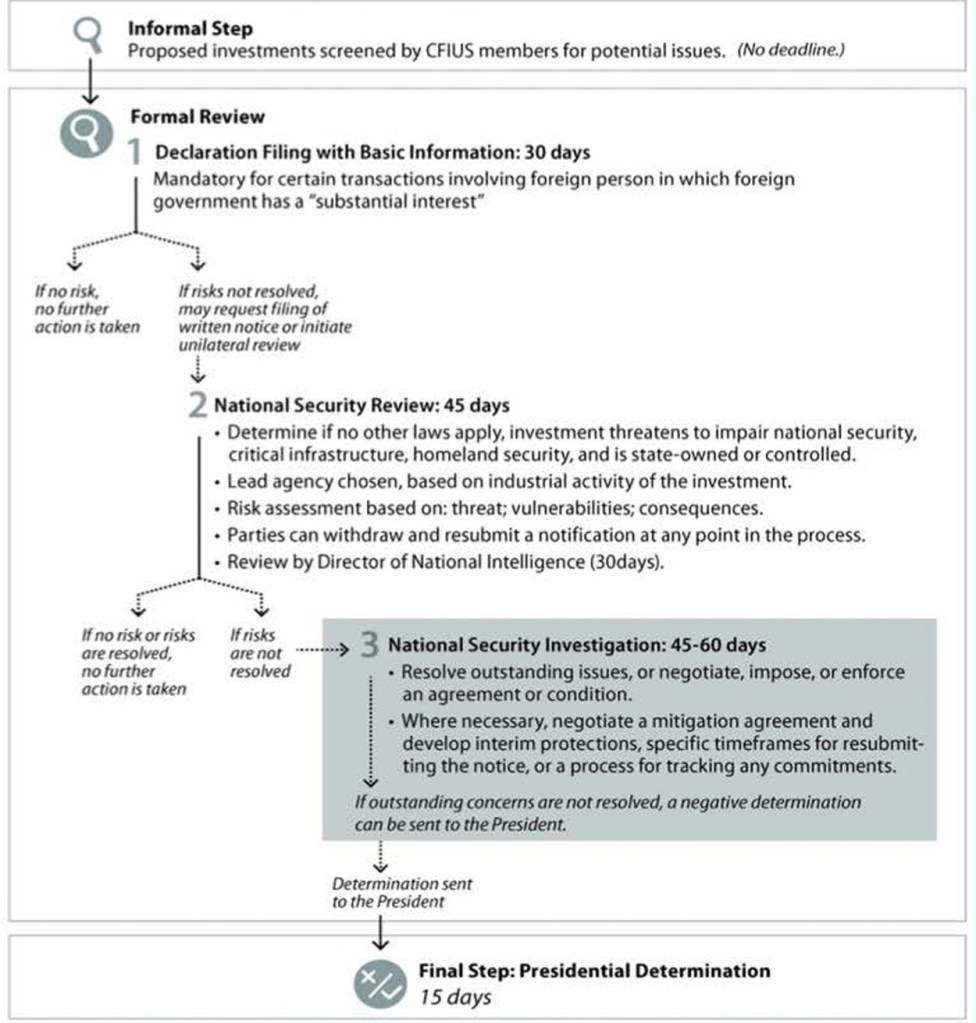
3.) Filing Requirements (flowchart for reference below): 

  • ANY Foreign Person or Foreign Entity that wants to invest or buyout any U.S. business, regardless of a Covered Transaction or not, and whether CFIUS has issued a decision or not, does not confer any nullification of other U.S. laws or regulations. For example: If the U.S. business makes/sells products that are subject to Export Controls, and is listed as a non-military critical item on the Commerce Control List (CCL), or a military item on the United States Munitions List (USML), or both, it cannot be exported without an Export License from the Commerce Department. 

The license is required if any Foreign Person or Entity will access the product itself, or any engineering data, manufacturing procedures, or training materials. Even if CFIUS grants Safe Harbor, and the investment is completed, the Foreign Person or Entity cannot gain access to any of the U.S. businesss CCL or USML products or data. Put simply, just because a Foreign Person or Entity now has a controlling interest or 100% ownership, they still cannot have access to anything on the CCL or USML. This means they cannot even walk through the manufacturing department. Anything they saw or heard would constitute an Export Control violation. ANY Foreign Person or Foreign Entity that wants CFIUS to do an Informal Review of a pending or proposed Foreign Investment, can complete, and file the Declaration form (a short, five page questionnaire asking for only basic meta data). Filing an Informal Declaration for review is not charged the filing fee that must accompany a formal filing. Informal filings have no due date imposed on CFIUSs review completion. An informal review is affording a foreign investor a “Free Look:’ The informal review does not evaluate any of the deals actual details.

  • If CFIUS issues a “Safe Harbor” ruling, and the foreign investor moves forward with their investment, no further action is required. 
  • If CFIUS finds the investment is a Covered Transaction, they will issue a letter to the foreign investor stating as such, and whether the filed Declaration has incomplete information or not. In most cases when the Declaration is incomplete, or has some other material problem, CFIUS usually recommends that the foreign investor withdraw the Declaration, and resolve the noted problem, then formally file a Voluntary Notice with the required filing fee. A Voluntary Notice is also in questionnaire format, but asks for 4-5 times more information than a Declaration. A Declaration does not review the detailed merits of the deal, just whether its a Covered Transaction or not. The Declaration doesn’t need to be resubmitted informally or formally, unless the Foreign Investor wants to be doubly sure that it’s a Covered Transaction before making a formal filing. 
  • Once a deal has been identified as a Covered Transaction, the Foreign Investor must file a formal, Voluntary Notice. It might seem like a Free Look informal Declaration ought to be the first step in every transaction review. The reason it is not the standard first step is due to time sensitivity on the Investors part. 
  • Free Look Declarations have no time limit for CFIUS to respond. CFIUS is not staffed to conduct informal Declarations as a separate work-stream; they work them as time permits. If a Foreign Investor is under a time crunch to get the deal done, its best to skip the informal review, and go straight to a formal filing of a Declaration or Voluntary Notice. This filing starts the response clock of 30 days for a formal Declaration, or 45 days for a Voluntary Notice. In any case, if it looks like the investment is a Covered Transaction, a formal Declaration is moot, and cannot result in a Safe Harbor determination. It has to be a Voluntary Notice, which triggers an in-depth investigation. 
  • ANY Foreign Person or Foreign Entity thats unaffiliated with a Foreign Government, and intends to make a passive, non-controlling, first time investment of 10% or less in any U.S. business, is not a Covered Transaction, and does not require any type of CFIUS filing. 
  • An informal Declaration filing is always an option for investors that want a Safe Harbor assurance to validate their own interpretation. Any subsequent incremental investment, even if it’s under 10% like the previous investment, is now considered to be a Covered Transaction, requiring a Voluntary Notice filing. 
  • Foreign Person or Entity thats unaffiliated with a Foreign Government acquires more than 10% of a U.S. business thats involved in Critical Infrastructure work, Critical Technology work, or handles Personally Identifiable Information of a U.S. citizen, its considered a Covered Transaction, and will need to file a formal Declaration or Voluntary Notice for a CFIUS investigation. The CFIUS website has a list of applicable types of Critical Infrastructure work, and a 2nd list for applicable Critical Technologies. 

If a Foreign Person or Entity that’s unaffiliated with a Foreign Government acquires a controlling interest (any amount greater than 49%) in a real estate parcel thats one mile or less from a national security sensitive site, it constitutes a Covered Transaction. 

The actual regulatory requirements for a Covered real estate Transaction are complicated, and the list of sensitive sites is regularly adjusted. To simplify the determination if a proposed real estate transaction is a Covered Transaction or not, the CFIUS website has a continuously updated list of all national security sensitive sites. You cannot see the whole list. The Foreign Investor can access the list and input an address or zip code, and the list will display all sensitive sites within a 50 mile radius of the address. It also lists the distance to each site in miles, and any fraction of a mile. 

Any real estate investment by a Foreign Person or Entity cannot be less than one mile from a sensitive site. One mile or less is a Covered Transaction, and requires a formal filing of a Voluntary Notice.

Mitigation Efforts and Case Tracking: CFIUS doesn’t conduct general surveillance of the Foreign Investment marketplace; it’s too time consuming. Although a Foreign Investor may have a Covered Transaction requiring a formal filing, CFIUS’ only regulatory obligation is to conduct an investigation. If an Investor filing is not done by either omission or commission, even if the investment Transaction is completed, CFIUS still has a regulatory obligation to conduct an investigation. 

If CFIUS is unaware of a Covered Transaction until after the deal is done, CFIUS may levy an administrative penalty, or complete the formal investigation, and issue a written warning, or in a worst case scenario, have the President block the transaction, and require the transaction to be reversed if CFIUS is unable to complete an investigation and decide if the Transaction is a Safe Harbor deal or not. In most cases a mitigation agreement will be executed by CFIUS and the Investor, then tracked through to completion. 

vietvetsteve@reportnatlsecykinetics.com

Seattle, Washington 

USA

Subscribe and Save This Website with an app on your iPhone/iPad or Android phone: While on this website, click on the appropriate button in the upper right hand corner as if you were going to Share the site with someone else. Click on ADD TO HOME SCREEN, and you’re done. On a PC, do the following: Click More Tools > Create Shortcut, and then check “Open as window.”
Standard
American Society, Donald Trump, Election 2024, Joe Biden, Kamala Harris, Life in America, National Security, u.s. constitution, U.S. Presidency

Words of Wisdom From President George Washington

Standard
American Society, Demographics, Donald Trump, Election 2024, Identity Politics, Joe Biden, Kamala Harris, Life in America, National Security, U.S. Presidency

The Demise of Identity Politics Due to America’s Changing Demographics

Standard
National Security, U.S. Presidency

The Democrat’s 2024 “All or Nothing” Presidential Campaign

The Democrat’s 2024 “All or Nothing” Presidential Campaign

Image