Introduction
Foreign capital investments in the U.S. have taken on a new focus designed to minimize transactions that could affect U.S. National Security. The recently updated CFIUS regulations are daunting. Any person or organization interested in investing in the U.S. would do well to study this report. If you decide to go forward with your transaction, you have the option of meeting the regulatory requirements on your own, or hire an experienced consultant to administer the process on your behalf.
Foreign Capital Transactions are scrutinized in accordance with The Defense Production Act of 1950, as amended seven times in the intervening years. The first six updates regarding Foreign Investments occurred in 1975, 1976, 1988, 1992, 2006, and 2007. Even with these changes, the U.S. Government was still behind-the-times in monitoring foreign capital investments.
The U.S. Government’s reluctance to tighten Foreign Investment regulations is deeply rooted in America’s 250 year-old belief in democracy, and free enterprise, which discourages regulation until proven necessary.
President George Washington wrote in his 1797 Farewell Address that, “America’s destiny & future prosperity is rooted in being a global trader, traveling to distant lands, but returning home to the America we fought for. America is, and will be, “In” this world, but we are not “Of” this world. We are “Of” America, and nowhere else. Why else would we have sacrificed so much to form this great land, only to be of the world that we strove to separate from?”
The sentiment expressed by President Washington of being a “Global Trader” was a desire America had for all, and looked forward to the commerce they would bring to us.
You might wonder why the Treasury Department, and Congress didn’t enact Foreign Investment legislation and regulations as they are now, and not wait 70 years to get there? The simple answer is trying to balance free enterprise with protection of American interests. Each round of changes were as far as Congress, and the White House were willing to go at that point in time.
It wasn’t until the changes made in January 2020 did the Act finally have the teeth to make a serious effort in monitoring foreign nationals, and their money investments in the U.S.
The 2020 legislation approved tighter regulations, appropriated funding, and authorized the Treasury Department to create a support staff for the Committee on Foreign Investments in the United States (CFIUS). The new staffers would be in the just created Office of Investment Security (OIS). To ensure this important work wasn’t cycled to the bottom of someone’s organization chart, the new legislation mandated no less than an Assistant Secretary to lead the new OIS.
The 2020 changes were the first time the regulations expanded Foreign Investment (known in the regulations as a “Covered Transaction”) eligibility criteria. Previously, a Covered Transaction ONLY included one type, which was: a Foreign Person or Entity representing a Foreign Government that was/is either acquiring controlling interest, or a 100% buyout of a U.S. business.
The term “Foreign Entity” can be a foreign government, an offshore company, partnership, consortium, an institution of higher learning, or other entities with a principal place of business outside the United States.
The iterative transformation of Foreign Investment monitoring by the U.S. Government is not uncommon in American politics. The USG went from being naive about Foreign Investing, to studying/reporting on it, to becoming a dedicated, funded, and staffed bureau led by no less than an Assistant Secretary, to a regulatory body charged with identifying & investigating Covered Transactions, levying fines, and halting deals.
Whether a Foreign Investor is a Person or Entity, they are generically referred to as a “Foreign Investor.”
Origins of the Defense Production Act
The Defense Production Act of 1950 that President Truman signed into law, didn’t have specific language about foreign investment/ownership. It surfaced tangentially on several occasions when a foreigner’s investment or ownership in a U.S. defense contractor wasn’t cooperating with Government priorities for the U.S. Armed Forces. Originally, the Commerce Department was the primary executive agency for the 1950 Act due to the focus on business and industry, and not on financial matters. As you can imagine, with no funding, and no finance-savvy staff, Commerce didn’t go looking for Foreign Investment/ ownership issues. The Act was mostly for providing the President in wartime, the tools to direct the priorities of the government and commercial enterprise to ready the military for sustained combat.
What was the Status of Foreign Investment After the Korean War?
Foreign investment and/or ownership in the U.S. wasn’t a concern in the 1950s and 1960s. Foreign countries, even America’s World War II allies, were still focused on rebuilding their economies; there was very little surplus funding for overseas investment.
The 1970s changed everything. The Vietnam War was winding down, and so was NASA’s Apollo Moon Landing Program. That meant that the Pentagon and NASA scaled back and/or cancelled hundreds and hundreds of purchase orders. With the loss of backlogged orders, defense & aerospace OEMs made deep manpower cuts.
Another ominous watershed event occurred in 1967 that created future negative effects on the U.S. economy; the Arab-Israeli Six Day War. The Arab world was shocked when the Israeli Defense Force, in only six days, captured parts of Syria, Jordan and Egypt. To this day, Syria and Jordan still haven’t been given back what they lost. Egypt, on the other hand, lost the entire Sanai Peninsula! The Israelis gave it back in 1975.
Israeli occupation of the captured Sanai Peninsula led to closure of the Suez Canal for eight years; it was the dividing line of a war zone. The canal closure would lead to future supply chain problems, and escalating costs in the U.S. Balance of Trade. Monetary Problems, and Gold Reserves Prior to the 1970s was nil; it left the U.S. with a foreign trade surplus. The Cost of Goods Sold for American manufacturers was competitive, with little need for offshore outsourcing. Global demand for American products remained high.
After two years of the Suez Canal closure, it started to disrupt American commerce overseas, and at home. Shipping costs and lead-times went up. Coupled with the downturn in the defense/aerospace sector, and the climbing cost of living, rising export shipping prices, and increasing international customer pricing dissatisfaction, led them to start looking for non-U.S. sourcing alternatives. Offshore competition tightened, and by 1980, the U.S. trade surplus had evaporated. Its difficult to remember that 50 years ago there used to be a trade surplus!
Problems started brewing with Americas gold reserves. Gold prices had been fixed at $35 an ounce per the Bretton-Woods Treaty signed in 1945.
Because the dollar was the most stable currency in the world, many countries pegged their currency at a fixed exchange based on the dollar. All denominations of dollar currency could be exchanged at the owners discretion from the U.S. Treasury for a corresponding amount of actual gold. Offshore buyers and sellers involved in U.S. trade typically required transactions in their own currency to avoid adverse exchange rates vs the dollar. But, with the dollar losing value by the day, offshore companies switched to transacting business in dollars. The dollar continued to weaken to the point that U.S. monetary practices & fiscal policies were in serious trouble.
Investment experts worldwide advised their clients to buy as many dollars as possible, and maximize their business transactions in dollars. Then they were instructed to cash-in all of their dollars at the U.S. Treasury in exchange for gold at a fixed value of $35/ounce. The U.S. monetary system was hemorrhaging money, but not the paper currency. The Federal government was essentially selling-off its gold reserves at a discount!
President Nixon Takes Action
By 1971, in addition to depleting the gold reserves, the prime interest rate, unemployment, and inflation were all climbing toward double digits, and by 1975, all three were above 11%! The economy was also nicked by higher gas prices due to Arab states raising the cost per barrel of oil as an economic “hand-slap” for American support of Israel after the Six Day War. Every remedy they tried failed to slow down the approaching financial crash.
Nixon consulted with his advisors, and then issued an Executive Order, taking drastic measures. The E.O. froze food and gas prices. The second major action was removing the American monetary system from the Gold Standard.
As is the case with many Government measures that are meant to mitigate a serious problem, they work okay for awhile, but eventually people find ways to work around the impediments, and the special measures become ineffective (recall that was exactly what happened across the country during the Covid-19 Pandemic). Food and gas price freezes experienced this; after 18 months the Government rescinded the program. On the other hand, removing the dollar from the Gold Standard was intended to be temporary, but it worked so well, it has never been changed back.
Two years later in 1973, with the economy continuing its downhill slide, Egypt and Syria attacked Israel all over again in what became known as the Yom Kippur War. The outcome for the Arab states was worse than the last conflict in 1967. This time the U.S. did a lot more to help the IDF. Saudi Arabia decided the U.S. went too far, so they convinced OPEC to put a 100% embargo on all petroleum products going to the U.S. This created the Gas Crisis, with gas stations running out, and waiting lines stretching up to a mile down the street.
Executive Order 11858
The second new problem was Foreign Investments. President Gerald Ford’s E.O. 11858 issued in May 1975, aimed to deal with this emerging National Security threat. At the time, however, the greater concern was possible effects on the economy.
Whereas, the U.S. was in a strong economic position prior to the 1970s, which did not encourage Foreign Investment – it was just too expensive – but now it was the opposite. The economic woes of the 1970s made Foreign Investment in the U.S. far more attractive and affordable.
President Ford issued the E.O. for two reasons:
1.) By far, the largest block of foreign investors in the 1970s were OPEC countries. As discussed previously, OPEC, in general, and the Arab members, in specific, were causing enough havoc in the country already due to the U.S. support of Israel. America produced very little of its own oil in the previous 20 years due to OPECs ability to refine it and sell it at a lower price. Letting OPEC countries invest in the U.S. energy sector could lead to losing control of a strategic industry and weaken National Security.
2.) President Ford had been a Republican member of the House of Representatives for 24 years prior to his 1973 appointment as Vice President. He was the House Minority Leader for his last eight years. Ford knew all too well that the Senate was in the middle of a Democratic-controlled 26-year run, and the Democratic hold on the House was even more one-sided, half way through a 40-year run.
The Democratic Congress was extremely active during the Nixon Administration, and if they were so inclined, could enact legislation covering foreign investment. Even if Ford vetoed the bill, the Democrats could easily muster the votes to override the veto. Ford’s Treasury and Commerce Departments already mapped-out the investment review process, and didn’t want Congress’ heavy-hand in it.
E.O. 11858 became the primary vehicle for CFIUS investment review for the next 40+ years. The Foreign Investment review environment changed steadily over the decades. Whereas, the thrust of E.O. 11858 was mostly about CFIUS having the ability to stick its nose into any Foreign Investment it wanted to, its greatest value was as a deterrent to would-be Foreign Investors with an ulterior motive.
The intervening years showed that foreign investors gradually came to realize that CFIUS was a “paper tiger;’ it no longer had the deterrence value it once had. A determined foreign investor who was willing to take steps to avoid obvious red flags, had a good chance of going unnoticed. Crafty investors learned the authority stemming from E.O. 11858 only empowered CFIUS to conduct an investigation. It did not give any specific remedies/actions that CFIUS could take, other than report their findings to the White House, the Commerce and Treasury Secretaries.
Since CFIUS’ investigation rules had no provisions for taking action, if/when they identified a risk, it made each of these sticky foreign investment scenarios a real chore to alleviate or mitigate. If negotiations failed to find a workable solution, and the foreign investor was unwilling to accept a compromise, the only legal means for the U.S. Government to prevail was to file a Federal Court case to obtain an injunction to stop the acquisition.
CFIUS’ statutes and regulations often lagged contemporary business practices of the day. Two CFIUS cases illustrate the changing landscape of Foreign Investments over the years. In 1988, Japans large integrated circuits manufacturer, Toshiba Electronics, responded to Fairchild Instruments Request for Proposal to sell-off its I.C. chip production plant, Fairchild Semiconductor. Fairchild accepted Toshibas offer, and the deal moved forward.
Treasury regulations in 1988 provided for just one Foreign Investment category with mandatory transaction notices to CFIUS: Foreign Investments directly or indirectly involving foreign government ownership. All other Foreign Investments were voluntary notification only. Conversely, CFIUS could investigate ANY Foreign Investment deal they saw, notification or not.
CFIUS learned of the Toshiba deal at the 11th hour, and did a cursory review. They identified a number of specialized I.C. chips for the Pentagon that carried a Secret security classification. Since CFIUS, and the President had no authority to stop a deal, it took some lengthy negotiations to complete the deal. Fairchild and Toshiba agreed to remove the military chips and transfer the orders to a different Fairchild division.
CFIUS didn’t want future transactions to back the President into a corner with no authority to stop a national security-related deal. Congress passed the Exon-Florio Amendment, allowing the President to stop a deal, if needed. There were two regulatory factors that wouldn’t change until the 2020 legislation:
1.) Foreign Investment regulations were too narrow for mandatory CFIUS notifications; investments other than foreign government deals needed mandatory notification, too.
2.) If CFIUS’ advice was to block an investment, but it was already a done deal, the President had no authority to stop it.
In 2006, Dubai Ports World (DPW), a logistics company owned by the United Arab Emirates Government, closed a deal to buy P&O’s (Peninsular & Oriental Steamship Company) port operations division. P&O is a British company. No American company was involved, so CFIUS had no jurisdiction. The New York Port Authority logged-in some DPW visitors to look around the port, which seemed odd, since no one had heard of DPW. The Port Authority reported it to the U.S. Coast Guard, who routed it to the Treasury Dept when they heard that a foreign maritime company acquired the vendor contract for port operations. CFIUS investigated the DPW acquisition, noting that it was already a done deal. CFIUS identified six American ports that P&O had been operating; all six had some warehouses and cargo cranes formerly owned by P&O, and nothing else. CFIUS concluded that owning some warehouses, and cranes didn’t affect national security; the case was closed.
Congress caught wind of the DPW deal, and disagreed with CFIUS conclusion; they wanted the deal annulled, ex post facto. Although the Exon-Florio Amendment authorized the President to kill a deal on national security grounds after a CFIUS investigation, there was no legal path to retroactively kill a transaction that was legally concluded. Both Homeland Security, and Treasury felt that no further action was necessary. Nevertheless, President Bush was tired of Congress publicly carping about it. He directed CFIUS to contact DPW to workout a deal. DPW arranged to sell-off the warehouses and cranes to a U.S. entity.
Foreign Investment and National Security Act of 2007
The circumstances surrounding the Dubai Ports World deal exposed some of the cumbersome inefficiencies in Foreign Investment vetting that CFIUS members had been harping on for two decades. The whole CFIUS system had been a patchwork of disjointed Executive Orders, administrative procedures, laws, and regulations for 32 years. A complete overhaul of the CFIUS system was long overdue. Tossing aside political correctness, the Congresss novice meddling in Foreign Investment monitoring, and their interest in favorable media optics, complicated CFIUS’ work. CFIUS staffers were uniquely qualified for their jobs. They were trained intelligence officers with backgrounds as accountants, lawyers, and industrial engineers. Members of Congress may have had applicable college degrees, but had little experience analyzing foreign investments from a national security perspective.
Overhauling the legislation related to Foreign Investment vetting would have been Congress’ most helpful contribution to CFIUS’ work. Unfortunately, the overhaul wouldn’t happen for another 13 years. In the interim, Congress passed the Foreign Investment and National Security Act of 2007 (FINSA).
FINSA fixed some of CFIUS’ problems, but it still came down to adding another band-aid on top of the previous band-aids to a broken process. My take on the FINSA legislation is: it really didn’t help CFIUS do their job; it was mostly about broadening, and raising the awareness level of senior government officials, including Congress, of CFIUS’ critical work product. Highlights of FINSAs changes included:
1.) Changed CFIUSs operating authority from President Ford’s 1975 E.O. 11858, to statutory authority by incorporating it into the U.S. Code. The U.S. Code is the permanent body of laws used throughout the country at all levels of government.
2.) Made CFIUS membership permanent and added the Secretary of Energy, the Director of National Intelligence (DNI), and Secretary of Labor as ex officio members.
3.) Required the Secretary of the Treasury to designate an agency with lead responsibility for reviewing a Covered Transaction. Previously, there were a half dozen executive departments designated as permanent CFIUS members. In practice, most of the heavy lifting was done by the Treasury Department as the overall chairman, and the Commerce Department was the communication conduit to business & industry. The other CFIUS members were happy to let Treasury & Commerce do the work, and attend committee meetings, as needed.
Over the previous 10 years, it became common that when a particular CFIUS case mostly affected one department, like the DoD, State, or DoJ, they didn’t offer a lot of help to Treasury or Commerce. FINSA added language that if the CFIUS chairman from Treasury determined that a case was largely in the sphere of one department, their committee member was required to be the case manager, responsible for driving it to completion.
4.) The Act added more national security factors the President could use in making his decision to block a specific foreign investment.
5.) Required that no one lower than an Assistant Secretary for each CFIUS member department must certify to Congress that a reviewed transaction has no unresolved national security issues; for investigated transactions, the certification must be at the Secretary or Deputy Secretary level. For usage by CFIUS, Review, and Investigate are not synonymous. A Review by CFIUS means the transaction was vetted against six yes/no criteria. A “No” for all six criteria, means there are no unresolved national security issues, and no full scale investigation is needed. Any of the six criteria that are answered with a “Yes,” means CFIUS has to conduct a full scale investigation.
6.) It provided Congress with confidential briefings upon request on cleared transactions and annual classified and unclassified reports. Foreign Investment Risk Review Modernization Act (FIRRMA) Between 2007-2017, no changes to CFIUS were undertaken like the ones discussed above. What did change was the nature of the foreign investments landscape in the U.S. In 2007, there were less than 40 Covered Transactions to be reviewed.
By 2017, Covered Transactions jumped by 800% to nearly 240! In the three year period of 2015-2017, inclusive, there were 552 Covered Transactions that required CFIUS review. Of the 552 deals, 143 of them alone, involved China. The second most was Canada at just 66 Covered Transactions. Tellingly, none of the foregoing Covered Transactions included real estate; there were no statutory requirements to review real estate deals. No one knew how many real estate deals involved a foreign investor, nor did they know if there were national security implications. But, numerous deals involving Chinese investors acquiring property adjacent to national securitysensitive sites were getting a lot of media attention.
Previous FINSA legislation added an annual reporting requirement to Congress. CFIUSs annual report was due 30 days after fiscal year-end, which was September 30th; it was due by the end of October. After reading the FY2017 report, both the Senate, and the House agreed that with the rise in Covered Transactions, a strong presence in foreign investing by China, and the sharp increase in Foreign Investments for real estate adjacent to national security sensitive sites, Congress needed to invest the extra time & work to do a complete refresh of the applicable statutes … no more band-aids. August 2018, President Trump signed FIRRMA, effective January 2020. FIRRMA’s legislative highlights included the following:
1.) In Presidential Authority: Preexisting ability to block, or suspend, proposed or pending foreign “mergers, acquisitions, or takeovers” by or with any foreign person that could result in foreign control of any United States business. FIRRMA added joint venture transactions to mergers, acquisitions, or takeovers. Congress was mindful of numerous existing U.S. statutes, and regulations that overlapped each other. They didn’t want FIRRMA to add more bureaucratic “red tape” to a work-stream that might already be covered by other laws and/or regulations. To that end, Congress added two stipulations to verify before a Presidential Determination under FIRRMA is issued. CFIUS had to document that other U.S. laws were inadequate or inappropriate to protect national security; and they must have “credible evidence” that the foreign interest exercising control might take action that threatens to impair national security.
2.) Scope of Transactions: Prior to FIRRMA, there was only one Covered Transaction that CFIUS was mandated to investigate: those involving foreign governments and/or a foreign person acting as their agent.
FIRRMA added the following new Covered Transactions:
- Real Estate transactions;
- Critical Infrastructure investments;
- Critical Technologies investments;
- Transactions that might lead to a Privacy Breach of Personally Identifiable Information of a U.S. citizen;
- Any change in a foreign investors rights regarding a U.S. business; Any transaction/arrangement designed to evade CFIUS regulations.
- Case Studies and Examples: Because the statutes and regulations were broadened, and deepened so much, CFIUS anticipated a significant increase in misunderstandings, and confusion over how to apply all of the rule changes. Each step in applying the new regulations comes with 6-10 specific examples to illustrate what should/should not be done under the circumstances of the case.
- Definitions of Foreign Person, Foreign Entity, Excepted Foreign Investor, and Excepted Foreign Country. Foreign Person:
- Any investor who’s not a U.S. Citizen, nor a Green Card Holder;
- Foreign Entity: All other foreign investors not meeting the Foreign Person definition;
- Excepted Foreign Investor: A newly defined term. The vast majority of Foreign Investors are citizens or entities of America’s allies. If the investor is an entity or citizen of, or a citizen who’s representing an entity with a principal place of business in the United Kingdom, Canada, Australia, or New Zealand, they are an Excepted Foreign Investor, and there’s no CFIUS filing requirement.
- Excepted Foreign Country: A newly defined term. Any of the four countries listed above who’s the direct or indirect foreign investor to what would otherwise be a Covered Transaction, has no CFIUS filing requirement.
3.) Filing Requirements (flowchart for reference below):
- ANY Foreign Person or Foreign Entity that wants to invest or buyout any U.S. business, regardless of a Covered Transaction or not, and whether CFIUS has issued a decision or not, does not confer any nullification of other U.S. laws or regulations. For example: If the U.S. business makes/sells products that are subject to Export Controls, and is listed as a non-military critical item on the Commerce Control List (CCL), or a military item on the United States Munitions List (USML), or both, it cannot be exported without an Export License from the Commerce Department.
The license is required if any Foreign Person or Entity will access the product itself, or any engineering data, manufacturing procedures, or training materials. Even if CFIUS grants Safe Harbor, and the investment is completed, the Foreign Person or Entity cannot gain access to any of the U.S. businesss CCL or USML products or data. Put simply, just because a Foreign Person or Entity now has a controlling interest or 100% ownership, they still cannot have access to anything on the CCL or USML. This means they cannot even walk through the manufacturing department. Anything they saw or heard would constitute an Export Control violation. ANY Foreign Person or Foreign Entity that wants CFIUS to do an Informal Review of a pending or proposed Foreign Investment, can complete, and file the Declaration form (a short, five page questionnaire asking for only basic meta data). Filing an Informal Declaration for review is not charged the filing fee that must accompany a formal filing. Informal filings have no due date imposed on CFIUSs review completion. An informal review is affording a foreign investor a “Free Look:’ The informal review does not evaluate any of the deals actual details.
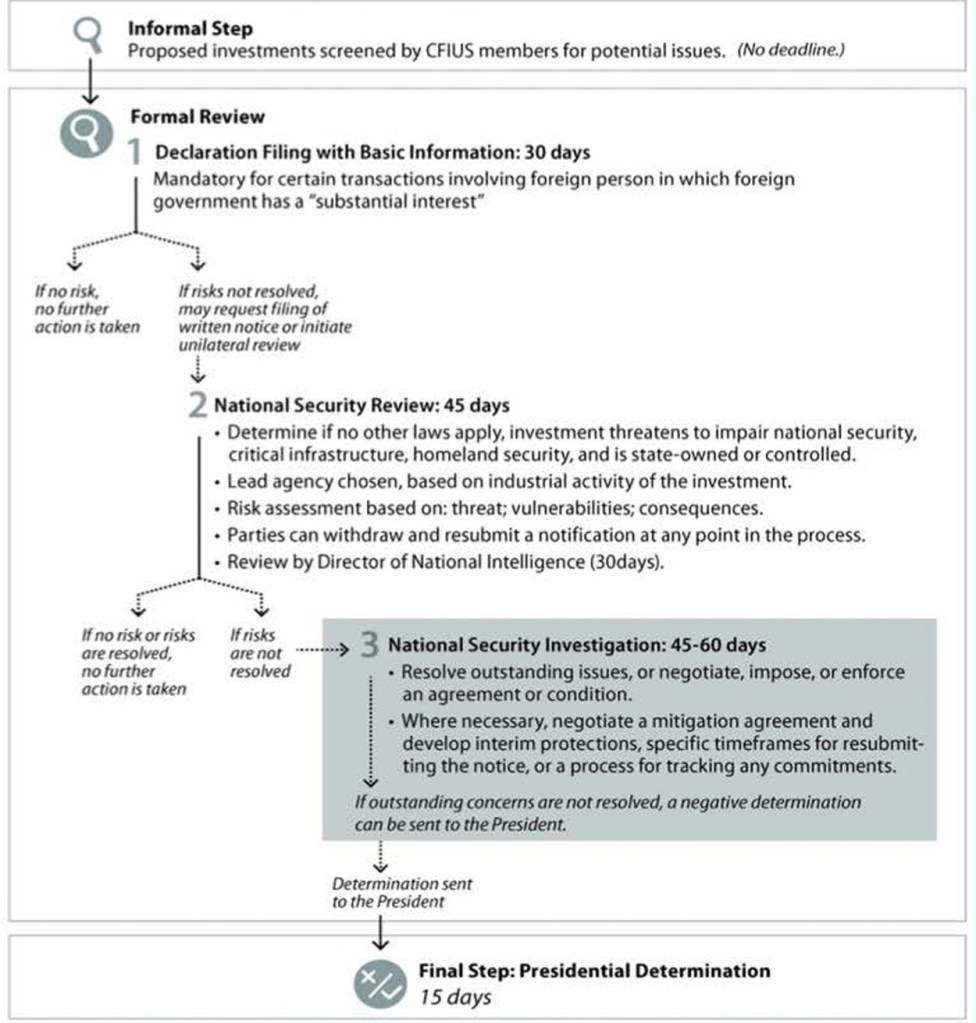
- If CFIUS issues a “Safe Harbor” ruling, and the foreign investor moves forward with their investment, no further action is required.
- If CFIUS finds the investment is a Covered Transaction, they will issue a letter to the foreign investor stating as such, and whether the filed Declaration has incomplete information or not. In most cases when the Declaration is incomplete, or has some other material problem, CFIUS usually recommends that the foreign investor withdraw the Declaration, and resolve the noted problem, then formally file a Voluntary Notice with the required filing fee. A Voluntary Notice is also in questionnaire format, but asks for 4-5 times more information than a Declaration. A Declaration does not review the detailed merits of the deal, just whether its a Covered Transaction or not. The Declaration doesn’t need to be resubmitted informally or formally, unless the Foreign Investor wants to be doubly sure that it’s a Covered Transaction before making a formal filing.
- Once a deal has been identified as a Covered Transaction, the Foreign Investor must file a formal, Voluntary Notice. It might seem like a Free Look informal Declaration ought to be the first step in every transaction review. The reason it is not the standard first step is due to time sensitivity on the Investors part.
- Free Look Declarations have no time limit for CFIUS to respond. CFIUS is not staffed to conduct informal Declarations as a separate work-stream; they work them as time permits. If a Foreign Investor is under a time crunch to get the deal done, its best to skip the informal review, and go straight to a formal filing of a Declaration or Voluntary Notice. This filing starts the response clock of 30 days for a formal Declaration, or 45 days for a Voluntary Notice. In any case, if it looks like the investment is a Covered Transaction, a formal Declaration is moot, and cannot result in a Safe Harbor determination. It has to be a Voluntary Notice, which triggers an in-depth investigation.
- ANY Foreign Person or Foreign Entity thats unaffiliated with a Foreign Government, and intends to make a passive, non-controlling, first time investment of 10% or less in any U.S. business, is not a Covered Transaction, and does not require any type of CFIUS filing.
- An informal Declaration filing is always an option for investors that want a Safe Harbor assurance to validate their own interpretation. Any subsequent incremental investment, even if it’s under 10% like the previous investment, is now considered to be a Covered Transaction, requiring a Voluntary Notice filing.
- Foreign Person or Entity thats unaffiliated with a Foreign Government acquires more than 10% of a U.S. business thats involved in Critical Infrastructure work, Critical Technology work, or handles Personally Identifiable Information of a U.S. citizen, its considered a Covered Transaction, and will need to file a formal Declaration or Voluntary Notice for a CFIUS investigation. The CFIUS website has a list of applicable types of Critical Infrastructure work, and a 2nd list for applicable Critical Technologies.
If a Foreign Person or Entity that’s unaffiliated with a Foreign Government acquires a controlling interest (any amount greater than 49%) in a real estate parcel thats one mile or less from a national security sensitive site, it constitutes a Covered Transaction.
The actual regulatory requirements for a Covered real estate Transaction are complicated, and the list of sensitive sites is regularly adjusted. To simplify the determination if a proposed real estate transaction is a Covered Transaction or not, the CFIUS website has a continuously updated list of all national security sensitive sites. You cannot see the whole list. The Foreign Investor can access the list and input an address or zip code, and the list will display all sensitive sites within a 50 mile radius of the address. It also lists the distance to each site in miles, and any fraction of a mile.
Any real estate investment by a Foreign Person or Entity cannot be less than one mile from a sensitive site. One mile or less is a Covered Transaction, and requires a formal filing of a Voluntary Notice.
Mitigation Efforts and Case Tracking: CFIUS doesn’t conduct general surveillance of the Foreign Investment marketplace; it’s too time consuming. Although a Foreign Investor may have a Covered Transaction requiring a formal filing, CFIUS’ only regulatory obligation is to conduct an investigation. If an Investor filing is not done by either omission or commission, even if the investment Transaction is completed, CFIUS still has a regulatory obligation to conduct an investigation.
If CFIUS is unaware of a Covered Transaction until after the deal is done, CFIUS may levy an administrative penalty, or complete the formal investigation, and issue a written warning, or in a worst case scenario, have the President block the transaction, and require the transaction to be reversed if CFIUS is unable to complete an investigation and decide if the Transaction is a Safe Harbor deal or not. In most cases a mitigation agreement will be executed by CFIUS and the Investor, then tracked through to completion.
vietvetsteve@reportnatlsecykinetics.com
Seattle, Washington
USA
Subscribe and Save This Website with an app on your iPhone/iPad or Android phone: While on this website, click on the appropriate button in the upper right hand corner as if you were going to Share the site with someone else. Click on ADD TO HOME SCREEN, and you’re done. On a PC, do the following: Click More Tools > Create Shortcut, and then check “Open as window.”

