
Military Operations, History & Cyber Warfare

Why Is the White House Coordinating the War against ISIS Instead of the Pentagon?

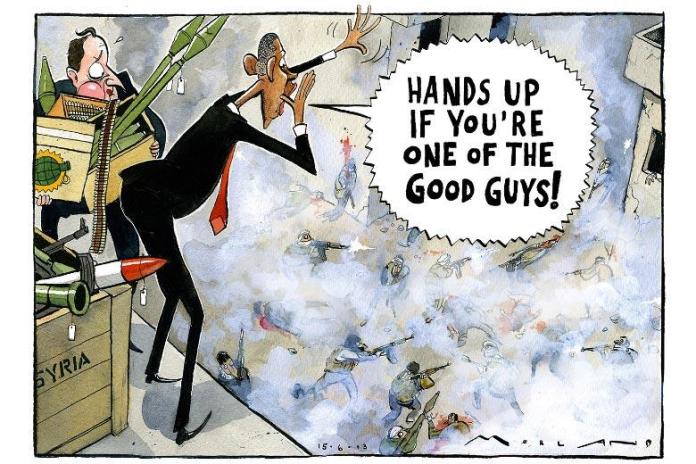
isis-war-cartoon
Cartoon by Morton Morehead, accessed October 2014 on reddit.com
The facts on the ground in Syria and Iraq are very complex.  Trying to ensure coalition leadership gets the targeting done right is akin to attempting to pull your kid off of a spinning merry-go-round blindfolded…there’s lots of opportunity to get it wrong.  A comment posted on reddit.com in response to Morehead’s cartoon says it all:  “Shoot the guys with the beards!  No the other beards…The brown guys with the headscarves! The ones running away, and the other ones not running away. F_ _ _-it…kill everyone to be sure we got……?” (italics added for emphasis) Comment attributed to reddit.com subscriber ‘1blckbx’
Aside from writing, consulting and other workstreams I am involved in, I also do professional speaking and teach college.  Anyone who has attended one of my events knows that almost everything I see in life starts out in my mind as a funny thought.  In most forums where serious material is being discussed, I suppress my humorous anecdotes and stick to the discussion at hand.   But, the confusion and conflicting agendas seen in Iraq and Syria that are faced 24/7 by the forces involved in Operation INHERENT RESOLVE, is sometimes so exasperating that the best antidote is to just shake your head and have a non-verbal chuckle.  All laughing aside, I will put my game face on, and give the topic the serious answer it deserves.
As of today, September 6, 2016, the Coalition nations conducting  airstrikes in Iraq include the United States, Australia, Belgium,  Canada, Denmark, France, Jordan, the Netherlands and the United Kingdom.  The Coalition nations conducting airstrikes in Syria include the United  States, Bahrain, Canada, Jordan, Saudi Arabia, Turkey and the United Arab  Emirates.  All of these assets are coordinated through one air component combatant commander for Operation INHERENT RESOLVE.

The current ground combatants in Syria for INHERENT RESOLVE includes the Syrian Army, the original Rebel Insurgents who have been trying to topple Bashar Al-Asad’s Administration for the past four plus years, and ISIS.  To be sure, ISIS is clearly a faction of opportunists who took advantage of the civil war raging between the other two groups and accomplished quite a lot in a very short timeframe.

Similarly in Iraq, ISIS recognized the disheveled Iraqi Government and a shaky infrastructure, then looked at the semi-autonomous Kurds and decided they could also exploit the disjointed and dysfunctional situation in Iraq.

Considering all of this, and there are five Islamic-based countries flying sorties for the coalition, the United States cannot afford to misstep in the bombing campaign.  You ask why the Obama Administration is so heavy handed in managing the air war?  Because this military action could easily become an albatross around President Obama’s neck, and become the legacy he is saddled with as he leaves the White House.  Basically, a situation very reminiscent of the baggage carried by President Bush when he turned over the keys to Obama in January 2009.  Numerous people in, and supporting the Obama Administration derided the Bush Administration for overseeing an apparent botched job in OEF and OIF.  The Obama Administration has learned by the school of hard knocks that managing a combat operation in the Middle East is not as easy as it looks.

You can look to the Johnson Administration during the Vietnam War and see a President also micro-managing a complex bombing campaign.  Whether you are Lyndon Johnson or Barack Obama, if you are really worried about the “kids not coloring inside the lines,” then you grab the crayons and start coloring the picture yourself.  Take the time to watch the HBO TV-movie from 2002, “Path to War,” about the Johnson White House during the Vietnam War.  It is very instructive in comprehending how a sitting President tried extremely hard to get the right facts about the War raging in Southeast Asia, so that good, intelligent decisions could be made about the bombing operations in North Vietnam.  I have no doubt there have been many heated discussions within the Obama Administration about INHERENT RESOLVE’s air war, and the constant efforts to get the bombing done correctly for the ground combatants the Coalition is supporting.  But, make no mistake, numerous parallels are eyed every day in and out of the Administration in terms of how things are measuring up to both the Johnson legacy and the Bush legacy.

The risk of “getting-it-wrong” in Syria and Iraq is much too high for the Obama team to feel comfortable letting go of the reins.
Steve Miller, (c) Copyright 2015
Standard
The Judiciary

Do the courts create law in the United States?


Most countries have many, many laws on the books nowadays that go far beyond the basic morality of the Ten Commandments. Many of these additional laws start first in a society where certain acts or behavior are seen as being in “poor taste,” or the now common phrase, “unethical.”

A country, such as the United States, is seen as one of the most sophisticated, highly evolved societies on the planet. We are fortunate to have had a group of “Founding Fathers,” such as the likes of John Adams and Thomas Jefferson. These men were cultured, very intelligent, pillars of their community, well educated, and had a good income. In my opinion, both the Declaration of Independence and the U.S. Constitution are documents I respect, and would have expected nothing less from a group of such highly regarded men. The Framers-of-the-Constitution had the foresight to realize that man and society were on a never ending continuum of life. What was well known and common practice in 1780’s America, was more evolved 100 years previous in 1680; and 100 years into the future in 1880 would be even further evolved than the colonial era. This concept of societal evolution led the Framers to build some methods of change into the Constitution; or, as I like to call it, the “what if” factor. The Constitution is a living document.

An important event occurred before the Constitution was written. It demonstrated that even a group of distinguished men do not always get something right on the first try. I am speaking of the “Articles of Confederation,” the pre-cursor document to the U.S. Constitution. An old college history professor I had, called the Articles of Confederation the “have-your-cake-and-it-too” version of the Constitution. He was referring to the heavy emphasis on state’s rights and a weak central government. In other words, the states saw the fundamental benefits of “safety-in-numbers” by banding together. But, at the same time, they wanted the states free to do what their citizens wanted without the central government or other states crying “foul!” Within a few years the leaders of the various states could see the Articles of Confederation were doomed to failure. So, back to the table they all went and wrote the Constitution.

The constitutional authors created a document with rules that would remain in-place indefinitely, unless the citizenship saw a need for change. Congress was charged with the responsibility to manage the process of constitutional change; that is, an amendment. The authors also realized from the failed Articles of Confederation that you can get some of the people to agree all of the time; and you can get all of the people to agree some of the time…but, you won’t get everyone to agree all of the time. If a particular section of the Constitution really became a thorn in everyone’s side, then an amendment could be drawn up. The authors, however, did not want the amendment process to be a simple thing to do; otherwise, the thing would undergo constant revisions.

The Constitutional authors understood it would be the primary legal reference for all future Federal, State and Local laws. If any question arose about future laws & regulations at any level in terms of
Constitutionality, the matter could be brought to a State Supreme Court, or ultimately to the U.S. Supreme Court. If a case is sent to the U.S. Supreme Court, the Justices could read the filed briefs by opposing counsel and determine the issue at hand does not pose a big enough issue for the citizenry and decline to take the case. This means that whatever legal issue is in question, and however it is currently being applied, stays as is. If anyone wants to pursue further action, the only choice is to have the cognizant legislative body write new or revised legislation to change the status quo.

If the U.S. Supreme Court decides to hear a case, they will ultimately render a decision for or against the petitioning party in terms of whether the issue at hand meets the test of Constitutionality, or not. Keep in mind that most Supreme Court decisions are rarely black n’ white with all nine Justices in agreement. The Supreme Court does not write laws; but, their decisions will either affirm the Constitutional legality of a law(s), or determine a legal issue is unconstitutional, and therefore, illegal. From a lawyer’s standpoint, they are looking to the Supreme Court to make a decision that sets a precedence of legal interpretation. This is the essence of what is referred to as “case law.” Any law that is not very specific is subject to interpretation. If s/he wants a sitting judge to decide in her/his favor, then it’s important for the attorney to cite case law decided in other court rooms so the judge for the case-at-hand has something to refer to as a basis of the decision handed down.

At the end of the day, no matter what the Supreme Court decides in a case, if the citizenry does not like the decision, then the legislature-of-jurisdiction can write new laws that conform to the Supreme Court decision, revise laws to make them conform, or do nothing and allow the decision to be applied to any case coming through the court system. The Supreme Court is a kin to an umpire crew at a baseball game. The umpires did not write the league’s rules; but, their interpretation and decisions about the rules can and may determine which team wins the game.

Standard
The Judiciary

Do Courts Create Laws in the United States?

judiciary-making-law
When it comes to defining the law and what is or is not legal, it first  starts with the norms of behavior in a given society.  A significant  portion of the approximate 200 countries in the World trace their  societal norms and many of their laws to the Ten Commandments written in  the Bible’s Old Testament.  Many religions believe the Ten Commandments  are the “pinnacle-of-rules” promulgated by a Deity to His chosen oracle on Earth (i.e.; Moses).  In reality, however, whether you believe Moses  was a true prophet of God, or just a pretty wise fellow who wrote the  Ten Commandments on his own, most learned people recognize that the Ten  Commandments were/are a basic foundation of human behavior.  Moses, with  or without divine intervention, was extremely frustrated with the Jews  under his charge after bringing them out of Egypt.  In today’s parlance,  the Jews following Moses often behaved like teenagers at a “rave party,” and recognized if they didn’t clean-up their act, the end result  was not going to be good for anyone.

Most  countries have numerous laws nowadays that go far beyond the basic morality of the Ten Commandments.  Many of these additional  laws start first in a society where certain acts or behavior are seen as  being in “poor taste,” or the now common phrase, “unethical.”  Of course, there are many segments of the law directly related to modern technology that even innovators like Benjamin Franklin and Thomas Jefferson could not possibly fathom how far the World, in general, and the United States, in particular, would advance on all fronts at the American Centennial, let alone at her Bicentennial.  Cyber Crime, for instance, is something that even a science fiction futurist like Jules Verne would not have seen coming.

A  country, such as the United States, is seen as one of the more sophisticated, highly evolved societies on the planet.  We are fortunate to have had a group of “Founding Fathers,” such as, John  Adams and Thomas Jefferson.  These men were cultured, very intelligent,  pillars of their community, well educated, and had a good income.  In my  opinion, both the Declaration of Independence and the U.S. Constitution  are documents I respect, and would have expected nothing less from a  group of such highly regarded men.  The Framers-of-the-Constitution had the foresight to realize that man and society were on a never ending continuum of life.  What was well known and common practice in 1780’s America, was more evolved than 100 years previous in 1680; and 100 years into the future in 1880 would be even further evolved than the colonial  era.  This concept of societal evolution led the Framers to build some  methods of change into the Constitution; or, as I like to call it, the  “what if” factor.  The Constitution is clearly a living document.

An important event occurred before the Constitution was written.  It demonstrated that even a group of distinguished men do not always get something right on the first try.  I am speaking of the “Articles of Confederation,” the pre-cursor document to the U.S. Constitution.  An old college history professor I had, called the Articles of Confederation the “have-your-cake-and-it-too” version of the Constitution.  He was referring to the heavy emphasis on state’s rights and a weak central government.  In other words, the states saw the fundamental benefits of “safety-in-numbers” by banding together.  But, at the same time, they wanted each state to be free to do whatever their citizens wanted without the central government or other states crying “foul!”  Within a few years the leaders of the various states could see the Articles of Confederation were doomed to failure.  So, back to the table they all went and wrote the Constitution.

The Constitutional authors created a document with rules that would remain in-place indefinitely, unless the citizenship saw a need for change.  Congress was charged with the responsibility to manage the process of Constitutional change; that is, an amendment.  The authors also realized from the failed Articles of Confederation that you can get some of the people to agree all of the time; and you can get all of the people to agree some of the time…but, you won’t get everyone to agree all of the time.   If a particular section of the Constitution really became a thorn in everyone’s side, then an amendment could be drawn up.  The authors, however, did not want the amendment process to be a simple thing to do; otherwise, the Constitution would undergo constant revisions.

The members of the Constitutional Convention understood that once they completed their work, and the Constitution was ratified by the states, it would become the primary legal reference for all future Federal, State and Local laws.  If any question arose about future laws & regulations at any level in terms of Constitutionality, the matter could be brought to a State Supreme Court, or ultimately to the U.S. Supreme Court.  If a case was sent to the U.S. Supreme Court, the Justices could read the filed briefs by opposing counsel and determine the case does not rise to the level of importance for the whole country, ergo, they will not accept the case for placement on the Court’s docket.  This means that whatever legal issue is in question, and however it is currently being applied, stays as is.  If anyone wants to pursue further action, the only choice is to have the cognizant legislative body write new or revised legislation to change the status quo.  The Court could also decide a case should have been filed in a different court first, meaning, at that point the Supreme Court did not have jurisdiction.  Keep in mind, however, any case where the U.S. Government is one of the opposing parties, and the case slowly snakes its way through the lower Federal & Appeals Courts, and it finally arrives at the Supreme Court, the justices do not have the option of declining to hear the case like they can for cases involving private parties.

If the U.S. Supreme Court decides to hear a case, they will ultimately render a decision for or against the petitioning party in terms of whether the issue at hand meets the test of Constitutionality, or not.  Keep in mind that most Supreme Court decisions are rarely black n’ white with all nine Justices in agreement.  The Supreme Court does not write laws; but, their decisions will either affirm the Constitutional legality of a law(s), or determine a legal issue is unconstitutional, and therefore, illegal.  From a lawyer’s standpoint, they are looking to the Supreme Court to make a decision that sets a precedence of legal interpretation.  This is the essence of what is referred to as “case law.”  Any law that is not very specific is subject to interpretation.  If s/he wants a sitting judge to decide in her/his favor, then it’s important for the attorney to cite case law decided in other court rooms so the judge for the case-at-hand has something to refer to (i.e.; precedence) as a basis for the decision handed down.

At the end of the day, no matter what the Supreme Court decides in a case, if the citizenry does not like the decision, then the legislature-of-jurisdiction can write new laws that conform to the Supreme Court decision, revise laws to make them conform, or do nothing and allow the decision to be applied to any case coming through the court system.  The Supreme Court is a kin to an umpire crew at a baseball game.  The umpires did not write the league’s rules; but, their interpretation and decisions about the rules can and may determine which team wins the game.

Standard
Military Operations, History & Cyber Warfare

Who Are Some of America’s Best Generals and Admirals of All Time?

America’s only 5-star officers, from upper left:  General-of-the-Army (GA) Omar Bradley; Fleet Admiral (FA) Ernest King; FA Chester Nimitz; GA George Marshall; General-of-the-Army Air Forces Henry Arnold; FA William Leahy; GA Dwight Eisenhower; GA Douglas MacArthur; FA William Halsey

This is not a simple question to answer with a direct, definitive  statement.  I like using sports metaphors, and this question reminds me  of the oft repeated question of who is the best baseball player of all  time?  Even if you separate the group into the major categories of  pitchers and hitters, it’s still not an easy answer because the game, the equipment, the baseball, and the players themselves have changed so much in the past 100 years.  The same argument holds true for America’s military  leaders who served across four different centuries.  My  standard answer to this sort of question recognizes the diversity of  talent we’ve had for military leaders.  I choose to present the case of  America’s best generals and admirals based on their performance during  wartime.  Before jumping to that discussion, however, I need to cover a few preliminary issues.

The U.S. Congress enacted special legislation during the 1976 Bicentennial to honor General George Washington as the highest ranking American military officer of all time.  Only Washington and General John J. “Blackjack” Pershing (of WW I fame) carry the rank of “General of the Armies,” and Washington outranks Pershing.  Legislation enacted on Pershing’s behalf in 1919, which awarded him General of the Armies title, gave the option of wearing four or five stars; he chose to wear only four.  Prior to the Civil War, the highest rank an Army officer could aspire to was a two-star Major General.  When Ulysses S. Grant took command of the entire U.S. Army during the Civil War, he was promoted to Lieutenant General with three stars.  It was not until 1917 when America entered the First World War, that Congress authorized the creation and use of four stars with “General” as the formal title.

The U.S. Navy flag officer situation was quite different from the Army.  Until legislation was enacted in 1862, again due to the Civil War, “Captain” was the Navy’s highest rank.  The War generated a need for greater rank stratification at the senior level, so, Congress created two flag officer ranks: a one-star Commodore, and a two-star  Rear Admiral.  Two years later, Congress enacted additional legislation to promote David Farragut to a three-star Vice Admiral.  In 1866, Congress passed a third round of legislation, promoting Farragut to a four-star Admiral, and David D. Porter to Vice Admiral.  Admiral Farragut died four years later in 1870, so, Porter was promoted to Admiral, and Stephen C. Rowan was promoted to Vice Admiral.  The Farragut, Porter, and Rowan promotions took place through Congressional legislation on a person-by-person, named basis only.  In 1890, Vice Admiral Rowan passed away, and Admiral Porter followed him a year later.  For more than 20 years following their deaths, Naval officers could aspire no higher than a two-star Rear Admiral.  Congress took no action to promote any of them to a higher rank.  It was not until 1915 when Congress finally authorized one Admiral and one Vice Admiral for each of the three U.S. Navy Fleets – the Atlantic, the Pacific and the Asiatic.  Until WW II came around, the Navy could have no more than three Admirals and three Vice Admirals, by law.  Because of the legal limits on 3-star and 4-star Admirals, it was common practice for the Chief of Naval Operations (CNO), and the Vice Chief (VCNO) to be dual-hatted as Commander-in-Chief and Vice Commander-in-Chief of the Atlantic Fleet.

After World War I, both the Army & Navy kept their three & four star ranks in active use up to the present day.  Although senior officers from America’s earlier generations such as Washington, Andrew Jackson, Farragut, Grant, Porter, and Pershing were successful in their own right, they were not faced with the challenges of global warfare on land, sea, and air.  America’s military leaders during World War II clearly faced momentous decisions with far reaching effects well beyond the immediate circumstances they were dealing with.  It would be really tough to come up with a valid quantification method to level the military leadership playing field spanning 200 years.  America’s Admirals and Generals in WW II clearly had to rise to a level of success in excess of any previous Army or Navy officers, so, the balance of the material below is focused on officers serving in WW II.
In WW II the Combined Chiefs of Staff  (i.e.; the British & American service chiefs as a single body) learned early on that what made a good flag/general officer in peace time, did not always translate directly to a leader’s successful performance in wartime.  During America’s first year in the war, there were many military officers at the  field grade and general/flag rank who did not have their jobs anymore by  January 1943. So, let’s take a look at America’s top WW II military leaders who withstood the immense pressure thrust upon them and managed to keep their performance, and that of their soldiers, sailors &  airman, in a generally upward direction.

WW  II marked the first, and only time, in American history to promote certain leaders beyond the legal limit of a four-star General or Admiral during wartime.  Although Congress authorized five-stars for Pershing, it did not occur until WW I was over.  Other nations, most notably the British and Germans, have  bestowed five-star status on their most senior general/flag officers in past  wars, and did it again in WW II.  Ever mindful of our Founding Father’s  contempt for England’s maintenance of a full-time army and navy in peace  time, and the additional tax burden it caused, did not like the idea of adding a 5th star; in essence, creating a “General-of-Generals” and an  “Admiral-of-Admirals.”  In WW II, however, when President Roosevelt and Prime Minister Churchill created the quasi-formal entity, the “Combined Chiefs of Staff,” it became obvious to the Americans after a couple of CCS meetings that many of the British CCS members held 5-star rank and sometimes gave the impression they outranked all of the American 4-star officers.  This uncomfortable situation filtered its way back to Roosevelt.  The President did not act immediately; but, eventually he had to do something to level the playing field between the two country’s top military leaders.

Roosevelt took the necessary steps to create the wartime rank of a 5-star General and Admiral.  The thornier issue was not so much who ought to get a 5th star, but how to sort out when each one was promoted.  Using a rigid military chain-of-command, Roosevelt knew that officers of equal rank determined who outranked who by using each man’s promotion date, or in military parlance, their “date-of-rank.”  For the most part, British 5-star officers had dates-of-rank that pre-dated the timeframe that Washington even started thinking about it.  Whether the British liked it or not, Roosevelt and his new 5-star officers behaved as equals and avoided situations that might escalate to the point a CCS member felt there was no alternative but to “pull rank” based on dates-of-promotion (rank seniority).

Roosevelt settled the issue of rank seniority amongst the new American 5-star leaders by promoting his top military advisor, Admiral William Leahy, first, on December 15, 1944. In date order, Army General George Marshall came next on the 16th of December; then Chief-of-Naval Operations, Admiral Ernest King on the 17th.  At this point Roosevelt had finished leveling the playing field for America’s top CCS members.

By design early in the war, Roosevelt and Churchill endorsed the CCS decision to tap one 4-star officer, American or British, who became the singular military leader for the Allies in each theater of operations.  After promoting the three previous men, FDR began promoting the theater commanders from the U.S. military.  For this next sequence, since all of the men had more than 30 years of active duty, Roosevelt used their time-in-service.  General Douglas MacArthur, commander of the Southwest Pacific theater got his 5th star on December 18, 1944.  Commander of the Central Pacific, Admiral Chester Nimitz, came next on the 19th.  General Dwight Eisenhower got his 5-star promotion the next day, December 20th.  It’s interesting to note that Eisenhower made the fastest ascension to 5-stars of any of the men.  On March 5, 1941, Eisenhower held the permanent rank of Lieutenant Colonel.  The next day he received his “eagles” as a full Colonel.  He was promoted six times in three and a half years.  The final 5-star promotion was head of the American Army Air Forces, General Henry “Hap” Arnold on December 21, 1944.

The American military has regularly used the scheme of honoring officers with career-long meritorious service by giving them a final promotion on their date of retirement.  This is sometimes referred to as a “tombstone promotion.” Since the number of active duty Generals and Admirals (1-star through 4-star) are set by Federal Law, a tombstone promotion did not upset the balance of Generals & Admirals on active duty.  Retirement promotions were a way for the USG to make amends to an officer whom the President could not promote while on active duty.  It was a further gesture of thanks for their long service, because retirement at a higher paygrade brought the retiree more money in their monthly retirement check.  Both Admiral William Halsey and General Omar Bradley got their 5th stars in this manner with promotion dates of December 11, 1945 and September 20, 1950, respectively.

Which of the preceding 5-star officers was the best?  No one can really say for sure.  You might be able to narrow the field to three or four men; but, then to apply further filtration would likely result in splitting hairs that historians could argue over for the next 100 years.  Let’s just say that each man was an above average officer throughout his career, such that he can thank many different military & civilian officials who recognized, starting as 2nd Lieutenants and Ensigns, that each man’s skill & achievements made him worthy of promotion 10 more times in the four decades to follow.  They all deserve America’s recognition for rising to the challenge of war at exactly the right place and time.

Steve Miller, (c) Copyright 2015
Standard
Military Operations, History & Cyber Warfare

Explaining the Difference Between Being ‘Available’ for Military Service vs. ‘Fit’ for Military Service

uncle-sam-recruiting-poster

I do volunteer work with high school academic counselors and junior college career advisors in educating students about U.S. Military and Coast Guard service options.   My intent is to assist them in deciding if military service is right for them, and if so, which branch best fits their goals & demeanor.  Military recruiters serve a necessary purpose in filling-up their ranks in support of our country’s national security.  The biggest problem, however, is potential enlistees are ill prepared in working with a recruiter who has recruiting quotas.  It’s somewhat akin to a person’s first visit to a car dealership.  I developed an orientation process for candidates that helps debunk hearsay and other misinformation.  My process walks a candidate through the various enlistment decisions, and it is not biased toward channeling a recruit into any particular service branch.  By answering a series of unambiguous questions, the candidate can come to a logical, objective decision on his/her branch choice and occupation.

The importance of all this is tied into the “All Volunteer Force.”  When the DOD dropped the military draft in the mid-1970s, it ushered-in 100% voluntary military service.  The draft, which includes the Selective Service System (which still exists, but, only the registration phase; the draft phase is dormant), was designed to require all male U.S. citizens to register with the Selective Service System upon turning 18; but, they cannot be inducted until they are at least 19 years old.   The result of the draft system was: from the time you registered for Selective Service at age 18, and until you received your induction notice,  the U.S. Government listed you as “Available-for-Service.”  Even though the draft has been mothballed for over 40 years, 18 year olds still have to register for Selective Service.  This means the USG still has a ready pool of potential candidates who are “available for-service.”  Other than your name, date-of-birth, Social Security Number, address and phone number, the Selective Service System has no other information about you.

Once a young man receives his induction notice, or voluntarily enlists, he reports to the closest military induction station for processing.  If all of the recruit’s evaluations are acceptable, he becomes “fit-for-duty.”  The reason why a young man is not classified any further than available-for-service at time of registration is two-fold: 1.) It increases the operating cost of the SSS, and; 2.) A disqualifying event might occur between registration and induction, making a draftee previously classified fit-for-duty, no longer able to do so.  It is cheaper and easier to determine fitness-for-duty at the time of induction. The fit-for-duty label continues with you throughout your enlistment.  When your first active-duty enlistment contract expires (typically, two years for a draftee, three or four years for most military occupations, or six years for certain jobs [like, a Nuclear Reactor Technician]), and you decide not to reenlist, any remaining amount of time up to six years is still part of your statutory service obligation.  Unless you are transferring to the National Guard or Active Reserve (i.e.; become a “weekend warrior”), which requires you to remain fit-for-duty, you will enter the Inactive Reserve to complete the six years.  An Inactive Reservist is a civilian with no duty obligations, unless you are reactivated in a national emergency.  Inactive Reservists are listed as available-for-service, and fitness-for-duty is reevaluated if/when you are reactivated.

 Steve Miller, (c) Copyright 2015
Standard