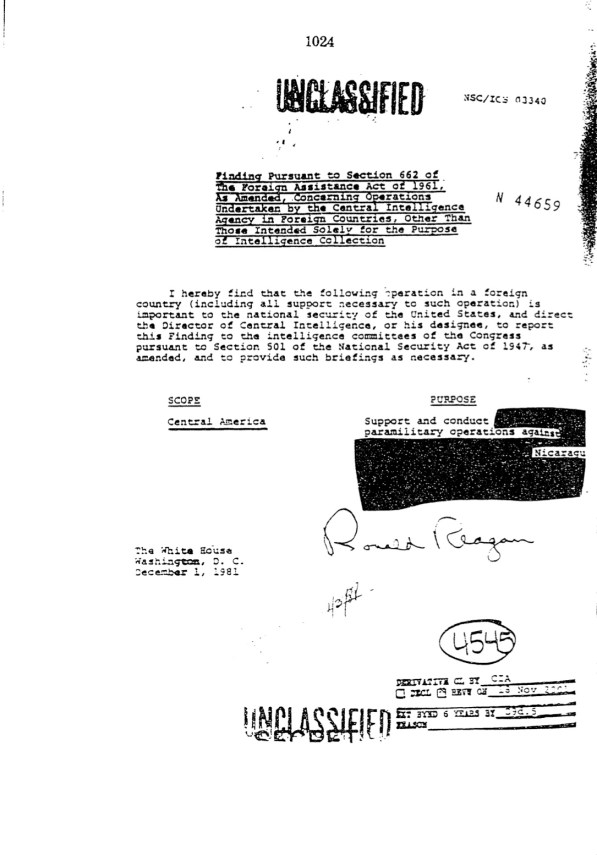
 Presidential Finding signed by President Reagan to authorize the CIA to conduct covert operations in Central America to aid the Contra rebels in their fight against the Communist-backed Sandinista government in Nicaraqua.
During the Vietnam War nearly every kind of intelligence operation you can think of was undertaken by the U.S. Intelligence Community. The four most heavily engaged agencies, starting with the most utilized first, were: the Central Intelligence Agency, Defense Intelligence Agency, National Security Agency, and the State Department’s Bureau of Intelligence and Research. As the War dragged on, with public, Congressional, and Presidential frustration mounting, increased pressure was applied on intelligence activities, especially the CIA, to help turn the War in a more positive direction.
Thomas Ahern, a CIA intelligence officer, who started his career in Southeast Asia during the Vietnam War, wrote an excellent book, “Vietnam Declassified,” about the CIA and the many types of intelligence operations undertaken in Vietnam. He cites an exasperating meeting about a problem with a certain pacification program led by the CIA, during which someone tossed out a new idea. William Colby (future CIA director), who was the CIA’s Saigon station chief at the time, replied that he was willing to try anything—if it would work. The mounting, across-the-board frustration, left the CIA and its cohort agencies, grasping at straws.
William Colby became the new Director of Central Intelligence (DCI) in September 1973, just a month after American combat activity ceased in Southeast Asia. Colby’s tenure would be a brief 2 ½ years. Before the year was over, allegations began to surface in the press about questionable intelligence activities during the War. Press allegations continued throughout 1974, and murmurings started-up in Congress about possible Intelligence Community improprieties. By time Colby left office he would arguably hold the distinction of testifying before Congress more than any other DCI. By January 1975 both the Senate, and House of Representatives, were conducting hearings about the impropriety allegations. Senator Frank Church chaired one committee, and Congressman Otis Pike chaired a similar investigation committee in the House.
All of this external attention on the Intelligence Community resulted in passage of several new laws to tighten-up accountability and oversight of certain critical, intelligence operations. For the most part, the type of operations that were closely looked at, and caused the most angst with Congress, were those in which the importance to U.S. National Security was ill-defined; in essence, justifying a direct benefit to the Unites States was a stretch, at best.
U.S. Foreign Policy has a range of options available to the President in order to achieve his goals. The low end of the scale espouses the use of diplomacy to achieve American goals overseas. At the opposite end of the spectrum from diplomacy is military intervention. Starting in the post-World War II era, and continuing to this day, foreign relations between countries have become so complex that often times using pure diplomacy is ineffective; but, military intervention is too much. The gray area between State Department diplomacy, and Defense Department military operations, is often the domain of the CIA using Covert Action to achieve American foreign policy goals. It is this genre of intelligence operations that garnered such a strong backlash from Congress and the public after Vietnam.
Regardless the type of intelligence operation being mounted, they all have an appropriate level of Operational Security – “OPSEC.” OPSEC is usually manifested in three categories:
• Clandestine operation: An operation sponsored or conducted by a U.S. government department or agency in such a way as to assure secrecy or concealment. Clandestine operations are the usual means of OPSEC for espionage and/or intelligence collection, which is the “bread n’ butter” spying conducted by the CIA’s National Clandestine Service. The biggest reason intelligence collection is conducted with clandestine OPSEC is most adversaries, upon detecting espionage activity, move quickly to render useless anything that was purloined. For example, clandestinely photographing an enemy’s communication code books. If the collection activity is discovered, the enemy will stop using the compromised codes, and the photographed code book has no further value. Being undetected is paramount in clandestine operation.
• Covert operation: An operation of the United States Government that is planned and executed to influence political, economic, or military conditions abroad, where it is intended that the role of the United States Government will not be apparent or acknowledged publicly (i.e.; plausible deniability).
• Clandestine and Covert operation: The operation must be undetected, and the sponsor’s identity is concealed.
By the very nature of clandestine operations, they tend to be low-key. Any sort of violence associated with the operation tends to cause the lack of detection to be tossed right out the window.
Covert operations conducted by the CIA, for example, are less concerned about remaining undetected during the operation, or afterwards. Of greater concern is running the operation so it cannot be traced back to the United States. In this sense, it is a fact-of-life that covert operations tend to have more violence attached, destroying property and/or killing enemy personnel to prevent them from reporting who or what they saw. As noted previously, when diplomacy fails, but, direct military intervention is too heavy handed, a plausibly deniable covert operation often becomes the tool-of-choice for resolving vexing problems. Up until Colby’s DCI tour, and the Church & Pike Committees, the CIA regularly conducted operations using all three OPSEC categories. Covert operations bears the majority of public and Congressional opposition. This led Congress to add language in Title 50 U.S. Code, requiring a documented Presidential Finding for covert operations.
Prior to the law being changed to require a Presidential Finding, an extremely sensitive covert operation was usually briefed to the President for his buy-in. The law was moot, however, on any formal requirement to seek the President’s buy-in, nor was there a requirement to document the Presidential Briefing in writing, nor to obtain an actual signature by the President, approving the covert action. Aside from the President’s buy-in, the law was also silent about informing key members of Congress about an impending covert action.
Once the law took effect, all covert actions had to be documented in a signed Presidential Finding, and it had to contain an explanation of why it was necessary to conduct the operation, including the identifiable foreign policy objectives of the United States, and the covert action’s importance to U.S. National Security. Lastly, the Presidential Finding must be presented to both Congressional intelligence committees.
Steve Miller, (c) Copyright 2016
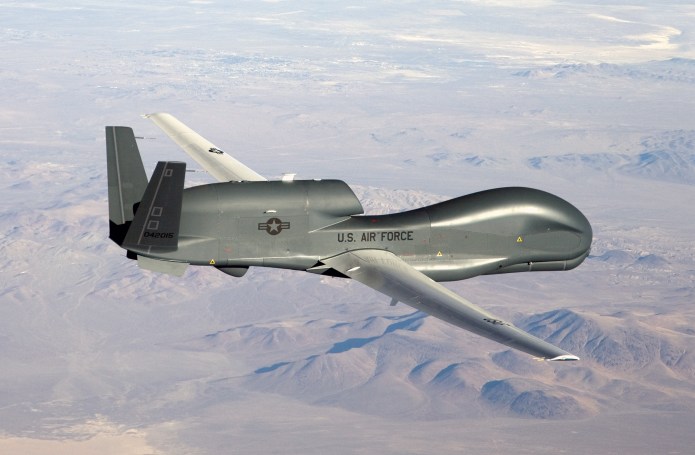 An RQ-4 Global Hawk UAV, high altitude reconnaissance aircraft. (U.S. Air Force photo/Bobbi Zapka)
 The REPORT on NATIONAL SECURITY KINETICS™