
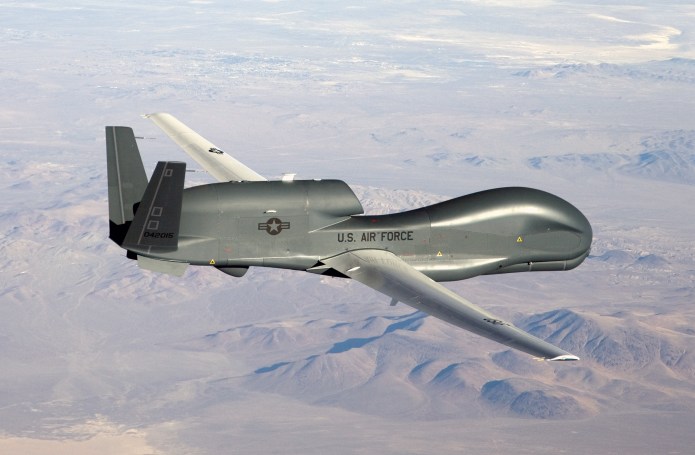
 An RQ-4 Global Hawk UAV, high altitude reconnaissance aircraft. (U.S. Air Force photo/Bobbi Zapka)
My USAF unit was the sole American military outfit that flew drone reconnaissance missions for 11 years during the Vietnam War in Southeast Asia . Occasionally our unit, the 100th Strategic Reconnaissance Wing (SRW), was asked by the secretive Studies and Observations Group (SOG) to launch and fly “Psy Ops” drone missions over North Vietnam. SOG was the unit reporting to the commander of the U.S. Military Assistance Command-Vietnam (MACV), that directed all of the covert military operations during the War. MACV-SOG’s Psy Ops department cooked-up quite a few propaganda leaflet campaigns for dissemination over North Vietnam and the Ho Chi Minh Trail supply route in eastern Laos. What follows here is drawn from our squadron’s experience and the operational challenges faced in flying leaflet dispensing sorties over territory that is denied airspace.
Keep in mind that any sort of written propaganda operation has to be well thought-out to realize even the slightest amount of perceived value. In any sort of Psy Ops program the greatest obstacle to success is the intended audience has been receiving a steady diet of propaganda manufactured by their own government. This was the case with Germany in WW II, North Vietnam, and definitely with current-day North Korea. In North Korea’s situation, their citizens have been subjected to a state-sponsored Psy Ops program for more than 60 years. A good Pys Ops program contains a high percentage of factual information that will carefully lead someone to believe the whole thing.
Airborne leaflet dispensing missions in denied airspace were/are extremely dangerous. To have any effect at all, the leaflets have to be distributed by the millions over a wide area. This means the air delivery vehicle has to be large enough to carry a heavy payload. None of the quad-copters or other commercially available drones would be suitable…their payloads would be a mere drop-in-the-bucket. Even the more common military drones, like the MQ-1 Predator, or the larger MQ-9 Reaper, would not have the sufficient payload, or ability to evade North Korean air defenses.
In Vietnam, leaflet dispensing missions conducted in the less dense air defense areas were undertaken with MC-130E Combat Talon aircraft from the 15th Special Operations Squadron. The MC-130s were specially equipped for flights through denied airspace. But, no one was foolhardy enough to tempt fate by trying to fly an MC-130 on a Pys Ops mission over the heavily defended capital of Hanoi, or the deep-water port of Haiphong. If a Psy Ops mission had to be conducted in those areas, our unit was asked to do it with a Ryan Aeronautical Model 147N jet-powered drone.
Our Model 147 drones (later given the DOD designator AN/AQM-34) were all purpose-built for a certain type of reconnaissance mission – photo imagery, signals intelligence, etc. Our unit became quite successful in flying high-speed reconnaissance drones over North Vietnam. Eventually, the military spooks from MACV-SOG and other MACV departments began asking our operating location (OL-20) at Bien Hoa Air Base, near Saigon, to fly other types of drone missions besides reconnaissance. One of the alternatives was for ECM (electronic counter-measures) missions to dump radar-defeating chaff. Chaff dispensers (ALE-2,4 or 5) had been carried on fighter jets, but, the missions were getting too dangerous for the aircrews. When OL-20 was asked to use Model 147 drones to fly chaff missions, they were not going to use the expensive versions crammed with intelligence collection gear; they had Ryan send over stripped-down versions with wing hard-points to upload the dispensers. After flying a few successful ECM chaff missions, MACV-SOG inquired whether the same drones & chaff dispensers could deliver propaganda leaflets over Hanoi. This was doable, and the slang term assigned to these birds/missions was “Bull_ _ _ _ Bomber.”
The photograph shown below is a Ryan Aeronautical RPV (remotely piloted vehicle). OL-20’s drone crew chiefs are uploading ALE-4 leaflet dispensers to a Model 147N prior to a Psy Ops leaflet mission. As you can see, the leaflet dispensers were large and very heavy. It was SOP in the drone maintenance manuals to upload the birds first to the launch aircraft – then the leaflet dispensers were attached last. Not wanting to take any chances, the technicians have temporarily installed a cargo strap under the drone as a safety measure.
These no-frills drones were flown on dispenser missions, expecting them to not make it back home. Ironically, however, quite a few managed to make it back to the recovery area in South Vietnam without being shot down!
Several people have asked me about drone operations in denied airspace. I hope that providing this information about American military exigencies in dealing with actual leaflet dispensing drone missions over North Vietnam will demonstrate what would have to occur to attempt something just as complex over North Korea.
Steve Miller, Copyright (c) 2016
 The REPORT on NATIONAL SECURITY KINETICS™