
Miscellaneous Topics

The Resurgence of Physician House Calls in the Wireless Age

Steve Miller, © Copyright 2016

QUESTION: “How many doctors in California perform house calls? I am considering launching an app that would allow patients to ‘order’ a doctor to their house, and want to know how many doctors in California already perform house calls.”

Greetings! Thanks for the opportunity to answer your question about the number of California doctors performing house calls. My research on the resurgent practice of physician house calls in the United States, in general, and California, in specific, reveals a fair amount of recent media coverage by such august institutions as the Wall Street Journal, New York Times, and U.S. News and World Report. Focusing on California, statistical data reveals an extremely shallow, statewide market penetration of 1,002 doctors making house calls out of 132,370 state-licensed physicians (per the 2015 report by the Medical Board of California). The comprehensive details listed below will give you a better picture of the all but abandoned service of home-based physician care and its comeback in the American healthcare industry.

BACKGROUND

For anyone interested in launching a business in the physician house calls market, it is an encouraging sign to see recent media coverage by some of the major outlets listed above. Aside from the fact their editors decided to run an introductory article on reinventing physician house calls, you will not learn much more than that. But, making a cursory overview of a topic is “journalism 101” for most media institutions with a large readership. It is almost like they are saying: “There…we ran something…next topic!” So, their skimpy reporting was not really a surprise. The next aspect uncovered during the research was somewhat surprising; but, it said a lot about the current marketplace for homed-based physician care.
Not expecting to find much from the likes of the Wall Street Journal, the research shifted to what was expected to be some fertile ground for information about the practice of physician house calls. An extensive search was conducted via some of the most highly regard U.S. institutions in the healthcare industry, to include: The U.S. Government’s National Center for Health Statistics (NCHS), American Medical Association (AMA), Medical Board of California (MBC), California Medical Association (CMA), Federation of State Medical Boards (FSMB), American Academy of Family Physicians (AAFP), Direct Primary Care Journal (DPCJ), and last, but not least, the American Academy of Home Care Medicine (AAHCM). Except for an above average article published in 2011 by the AAFP, entitled “House Calls,” and some useful content from AAHCM, the other organizations either had very little reference information or statistics about the physician house calls industry, or they had some fractional sub-topic coverage about one aspect of the industry, such as, volume 294 of the Journal of the American Medical Association from 2005, that featured an article entitled, “Trends in house calls to Medicare beneficiaries,” stemming from modifications in Medicare regulations that bumped a doctor’s fee reimbursements by 50% for home-based geriatric physician services. Attempting to locate a full-bodied treatment of the industry is quite elusive. There is no doubt the marketplace is gathering steam for expansion of the physician house calls business model; the timing is good for getting in on the ground-floor of this opportunity. If a doctor were to pursue this business model, however, he/she will need two things: 1.) Patience, and; 2.) Patients!

RESEARCH DETAILS

Looking at the data collected by the above healthcare institutions as recent as 2015, none have begun collecting or publishing statistical details on a regular basis about physician house calls. For example, the CMA, who is the flagship organization for medical professionals in California, lists their current focus issues as: Ensuring access to quality medical care; Strengthening public health; Promoting health education and advancing careers in health; Protecting the physician-patient relationship; Working to protect patients; Preserving economic stability, and Advancing new technologies. The resurgent physician house calls practice is not even on the CMA’s radar screen, yet. Similarly, both the FSMB and MBC conduct comprehensive, annual physician surveys, and they are yet to include any questions about physicians practicing home-based medical care. Not even the NCHS is reporting on home-based physician’s care.
Historians say that successfully moving forward in life, as a person, business or country, is never easy; but, it can be easier, if you pay attention to where you have been. The business of physician house calls can benefit from that wisdom. The 2011 AAFP article, House Calls, noted, “House calls were standard practice for physicians in 1930, when approximately 40% of patient encounters occurred in the patient’s home. By 1950, this had fallen to around 10%, and by 1980, only about 1% of patient encounters were house calls.” A 2008 AAFP nationwide survey reported that “the average family physician conducted fewer than one house call per week.” Statistically speaking, caring for patients in their homes has some wide-open possibilities.
There are a number of factors driving the resurgence of physician house calls. The AAHCM lists nationwide Medicare Part B-paid house calls from 1995 through 2014 – that’s 20 years of data – with a 76% increase over that timeframe. Prior to the improved Medicare payment model, home-based geriatric care was mostly for skilled nursing, hospice care, and other non-physician services. The CMA noted that physicians recognized the difficulties non-ambulatory geriatric patients had with making frequent healthcare provider office visits; however, Medicare Part B payments for house calls did not adequately compensate a physician for his/her services. But, the improved Medicare payment model does not tell the whole story when it comes to geriatric medicine. In 1995, even the oldest baby boomers were still in their early 50s, and a major component of the American workforce. Fast forward that by 20 years, according to the NCHS, we find that approximately 70% of the baby boomer generation is now retired. Baby boomers in their retirement years are another key contributor to the 76% increase in Medicare-paid physician house calls.
The enhanced financial upside in geriatric medicine for physician house calls is merely one component of the industry’s bounce back. There are a number of medically valid reasons for physician house calls. The AAFP House Calls article points out that even though there are legitimate reasons for a given patient to receive a physician house call, “The choice of location of care is [still] heavily dependent on the physician’s opinion.” More will be said on the medical benefits of house calls versus a physician’s preference in practicing medicine. The AAHCM says: “Lack of primary care access is one root cause in the genesis of higher health care costs… Instead of receiving appropriate primary medical care as chronic conditions destabilize or new problems develop, these persons get care in expensive ER’s and inpatient units. And who are these people? Everyone — upper and middle class Medicare recipients as well as the poor.” The Call Doctor Medical Group in California studied the cost difference between treating pneumonia in the home rather than the hospital [ER], using 2001 Medicare data. Average cost for hospital treatment was $5,159 while treatment at home cost $1,000. In 2016 dollars, this would be $6,954.26 and $1,345.38, respectively.
The AAHCM posted a Public Policy Statement on its website, vis-à-vis, their formal position on home-based medical care. The essence of the AAHCM statement is: The American healthcare industry needs a major, multi-institutional paradigm shift to make home-based medical care a workable business model for everyone. These institutions include: Federal, state and local government; insurance carriers and claims processing houses; hospitals & outpatient surgery centers; medical schools (i.e.; Johns Hopkins University, et al); pharmaceutical companies; doctors and group medical practices. Doctors and group medical practices were deliberately listed last to emphasize the point that the onus is on the other five industry groups to be the main forces-of-change in home-based medical care. Doctors alone, cannot be the catalyst for change.

ISSUES FOR THE PHYSICIAN

AAFP’s House Calls, said: “House calls can provide a unique perspective on a patient’s life that is not available in an office visit or during hospitalization. A house call can foster the physician-patient relationship, and enhance the physician’s understanding of the patient’s environment and support systems.” Circling back to the comment about physicians strongly influencing the choice of location for practicing medicine, many of them, metaphorically speaking, subscribe to the time-honored philosophy of, “you can lead a horse to water, but, you cannot make them drink.” The vast majority of physicians tend to be pragmatic in their work, especially those in private practice, or a small professional group. The molding of a physician’s philosophy on practicing medicine is a slow, methodical process; it starts before they enter college. The FSMB’s Journal of Medical Regulation in 2015 stated, “Across the period of time representing the continuum of medical education, from baccalaureate to graduate medical education, it typically takes more than nine years after entering college to successfully become a licensed physician in the United States.” During their decade of schooling, the educational institutions they attend are largely responsible for the medical practice philosophy absorbed by students-turned-physicians. The philosophical molding cannot be overstated. Research uncovered several instances of medical school deans stating on-the-record their professional lack of regard for home-based medical care. To create an industry paradigm shift that supports physician house calls, it needs to start during primary medical training at the universities. But, if a school’s dean does not subscribe to the house calls business model, how likely is it that his/her school is going to adopt it as part of the curriculum?
In a June 2014 article from DPCJ, entitled, “Trend: The house call makes a comeback,” it featured Dr. Michael Farzam, who converted exclusively to physician house calls in 2001. The primary focus of the article is to demonstrate to the reader some of the fundamental methods a physician needs to adopt in order to make physician house calls a workable business model. One of the primary advantages Farzam has is: He is his own boss. Whether a particular facet of his physician house calls practice works or not, is entirely on him. A key factor in his success is he embraced the electronic age early in his practice. The DPCJ article states, in part, “…he speaks with patients on the phone before making the trek in LA traffic to their home.” Taking advantage of technology puts Farzam ahead of the power curve for adopting a cell phone-based mobile application to quickly connect patients and physicians on a near real-time basis.
But, what about physicians who currently do not make physician house calls; can anyone simply make the leap? In June 2015, the AAFP published some key information that is essential to anyone interested in moving into the physician house calls industry; this includes the technology providers of the mobile application, and the physicians. For the most part, physicians are not positioned to simply make the switch to doing house calls as their new business model, regardless of utilizing a mobile phone application. The AAFP information indicates that 83% of American physicians are not the sole owner of their medical practice. Of the 83%, ¾ of those physicians have no ownership stake at all. The crux of the situation is: Even if a physician wants to convert to the house calls business model, regardless of using a mobile phone application for booking business or not, he/she is not the sole decision maker, if at all. So, any business plan to capitalize on the physician house calls resurgence has to include how to sway multi-owner medical practices, or those with a CEO or managing partner who makes the heavy business decisions.

CALCULATING CALIFORNIA’S CURRENT PHYSICIAN HOUSE CALLS POPULATION

It would be nice if one or more of the previously noted institutions had already undertaken to determine California’s market penetration for physician house calls; unfortunately, they have not. The net result is: It requires pulling together statistics from multiple sources, and making some assumptions. A testament to how small the market penetration is, is looking at AAHCM’s provider directory. Considering that AAHCM is the main standard bearer for the physician house calls industry, it would make sense to check their database of member/providers. Even if we make the assumption that the vast majority of the American population in any profession is not keen on voluntarily joining anything, then transfer that caveat to temper membership expectations of the AAHCM, and that California has the highest population of licensed physicians in the country (which is 55% greater than 2nd place New York, and nearly double the physician headcount of 3rd place Texas), anyone would be shocked to find AAHCM lists only 22 member/providers in California! By anyone’s measure, there’s a lot of opportunity for business in California.
When evaluating the physician specialties most likely to make physician house calls, it would be general/family practitioners, and internal medicine specialists; these were used in the following calculations. The MBC’s 2014-2015 annual report says there are 10,115 licensed physicians in the state practicing general/family medicine. The report lists 28,415 physicians practicing internal medicine. Again, this is out of a total California-licensed physician population of 132,370.
AAFP’s June 2015 published data indicates that nearly 84% of the physicians surveyed, work in an office or standalone clinic. The bulk of the remaining 16% work in hospitals, urgent care facilities, and residential institutions. The balance of the population, 2.6%, do not see their patients in any of these settings. If you combine together the general/family practitioners and internal medicine specialists, you derive the results below:

2.6% x (10,115 + 28,415) = ~ 1,002 licensed physicians practicing medicine outside of any sort of “brick n’ mortar” healthcare location. This is the broadest population possible of physicians practicing medicine in a home-based setting in California.

Let’s compare some findings from the new start-up physician house calls company in Southern California, “Heal, Inc,” whose practice is currently centered in Los Angeles County and Orange County. Heal uses the mobile application for connecting patients to their cadre of physicians. MBC data indicates that 29% of California physicians practice general/family or internal medicine. MBC states there are 38,974 physicians of all specialties practicing in the two counties. If we apply the 29% state population of GPs and internists to the two-county total physician population of 38,974, it equals 11,344 GP/internists in L.A. and Orange County. Referring back to AAFP’s 2.6% of physicians not practicing in a traditional healthcare setting, the following calculation results:

11,344 x 2.6% = 295 GP/internists not practicing in any traditional setting. Compare the headcount of 295 in L.A. and Orange County to Heal’s current practice cadre of 18 physicians, and we find a lot of room for growth in adopting the cell phone mobile physician house calls model. Even if Heal’s cadre were quadrupled to account for unknown mobile application physician/competitors, it would still be less than a 25% market penetration. There’s plenty of room for growth in just a portion of this large metropolitan area!

CONCLUDING COMMENTS

The U.S. marketplace, in general, and California, in specific, has a huge potential for expansion of the physician house calls industry. Likewise, there is even greater opportunity for incorporating a cell phone-based mobile application for connecting patients with healthcare providers specializing in home-based care. Quick action, however, is paramount in developing a viable business plan for both physician house calls practice adoption, and for the mobile application to connect market participants (i.e.; patients and physicians). Heal, Inc., for example, is expanding to 15 new markets in the next year.

Steve Miller, © Copyright 2016
Standard
National Security

Presidential Findings and Their Impact on U.S. National Security

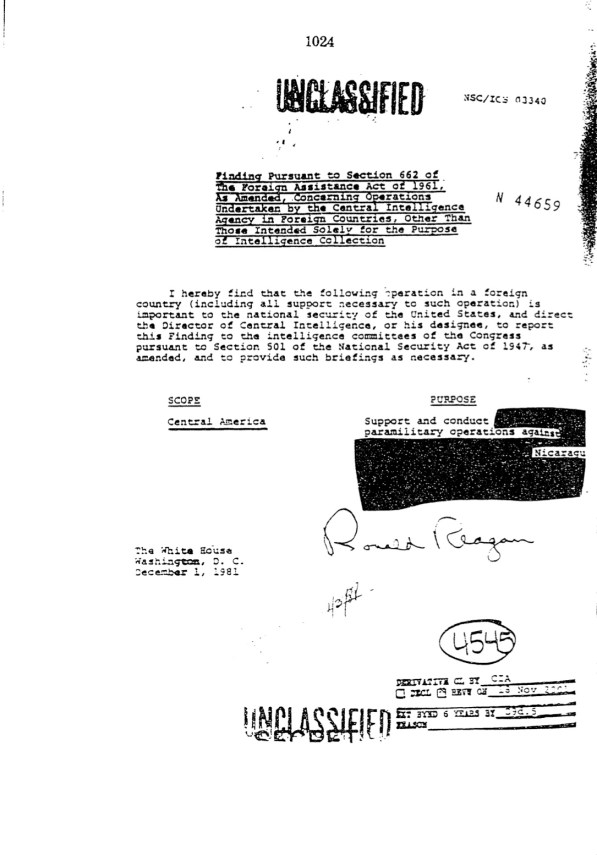
reagan-presidential-finding-nicaragua_dec1981Presidential Finding signed by President Reagan to authorize the CIA to conduct covert operations in Central America to aid the Contra rebels in their fight against the Communist-backed Sandinista government in Nicaraqua.

During the Vietnam War nearly every kind of intelligence operation you can think of was undertaken by the U.S. Intelligence Community.  The four most heavily engaged agencies, starting with the most utilized first, were: the Central Intelligence Agency, Defense Intelligence Agency, National Security Agency, and the State Department’s Bureau of Intelligence and Research.  As the War dragged on, with public, Congressional, and Presidential frustration mounting, increased pressure was applied on intelligence activities, especially the CIA, to help turn the War in a more positive direction.

Thomas Ahern, a CIA intelligence officer, who started his career in Southeast Asia during the Vietnam War, wrote an excellent book, “Vietnam Declassified,” about the CIA and the many types of intelligence operations undertaken in Vietnam.  He cites an exasperating meeting about a problem with a certain pacification program led by the CIA, during which someone tossed out a new idea. William Colby (future CIA director), who was the CIA’s Saigon station chief at the time, replied that he was willing to try anything—if it would work.  The mounting, across-the-board frustration, left the CIA and its cohort agencies, grasping at straws.

William Colby became the new Director of Central Intelligence (DCI) in September 1973, just a month after American combat activity ceased in Southeast Asia.  Colby’s tenure would be a brief 2 ½ years.  Before the year was over, allegations began to surface in the press about questionable intelligence activities during the War.  Press allegations continued throughout 1974, and murmurings started-up in Congress about possible Intelligence Community improprieties.   By time Colby left office he would arguably hold the distinction of testifying before Congress more than any other DCI.  By January 1975 both the Senate, and House of Representatives, were conducting hearings about the impropriety allegations.  Senator Frank Church chaired one committee, and Congressman Otis Pike chaired a similar investigation committee in the House.

All of this external attention on the Intelligence Community resulted in passage of several new laws to tighten-up accountability and oversight of certain critical, intelligence operations.  For the most part, the type of operations that were closely looked at, and caused the most angst with Congress, were those in which the importance to U.S. National Security was ill-defined; in essence, justifying a direct benefit to the Unites States was a stretch, at best.

U.S. Foreign Policy has a range of options available to the President in order to achieve his goals.  The low end of the scale espouses the use of diplomacy to achieve American goals overseas.  At the opposite end of the spectrum from diplomacy is military intervention.  Starting in the post-World War II era, and continuing to this day, foreign relations between countries have become so complex that often times using pure diplomacy is ineffective; but, military intervention is too much.  The gray area between State Department diplomacy, and Defense Department military operations, is often the domain of the CIA using Covert Action to achieve American foreign policy goals.  It is this genre of intelligence operations that garnered such a strong backlash from Congress and the public after Vietnam.

Regardless the type of intelligence operation being mounted, they all have an appropriate level of Operational Security – “OPSEC.”  OPSEC is usually manifested in three categories:

Clandestine operation:  An operation sponsored or conducted by  a U.S. government department or agency in such a way as to assure secrecy or concealment.  Clandestine operations are the usual means of OPSEC for espionage and/or intelligence collection, which is the “bread n’ butter” spying conducted by the CIA’s National Clandestine Service.  The biggest reason intelligence collection is conducted with clandestine OPSEC is most adversaries, upon detecting espionage activity, move quickly to render useless anything that was purloined.  For example, clandestinely photographing an enemy’s communication code books.  If the collection activity is discovered, the enemy will stop using the compromised codes, and the photographed code book has no further value.  Being undetected is paramount in clandestine operation.

Covert operation: An operation of the United States Government that is planned and executed to influence political, economic, or military conditions abroad, where it is intended that the role of the United States Government will not be apparent or acknowledged publicly (i.e.; plausible deniability).

Clandestine and Covert operation:  The operation must be undetected, and the sponsor’s identity is concealed.

By the very nature of clandestine operations, they tend to be low-key.  Any sort of violence associated with the operation tends to cause the lack of detection to be tossed right out the window.

Covert operations conducted by the CIA, for example, are less concerned about remaining undetected during the operation, or afterwards.  Of greater concern is running the operation so it cannot be traced back to the United States.  In this sense, it is a fact-of-life that covert operations tend to have more violence attached, destroying property and/or killing enemy personnel to prevent them from reporting who or what they saw.  As noted previously, when diplomacy fails, but, direct military intervention is too heavy handed, a plausibly deniable covert operation often becomes the tool-of-choice for resolving vexing problems.  Up until Colby’s DCI tour, and the Church & Pike Committees, the CIA regularly conducted operations using all three OPSEC categories.  Covert operations bears the majority of public and Congressional opposition.  This led Congress to add language in Title 50 U.S. Code, requiring a documented Presidential Finding for covert operations.

Prior to the law being changed to require a Presidential Finding, an extremely sensitive covert operation was usually briefed to the President for his buy-in.  The law was moot, however, on any formal requirement to seek the President’s buy-in, nor was there a requirement to document the Presidential Briefing in writing, nor to obtain an actual signature by the President, approving the covert action.  Aside from the President’s buy-in, the law was also silent about informing key members of Congress about an impending covert action.

Once the law took effect, all covert actions had to be documented in a signed Presidential Finding, and it had to contain an explanation of why it was necessary to conduct the operation, including the identifiable foreign policy objectives of the United States, and the covert action’s importance to U.S. National Security.  Lastly, the Presidential Finding must be presented to both Congressional intelligence committees.

Steve Miller, (c) Copyright 2016

Standard
Military Operations, History & Cyber Warfare

Understanding why U.S. Psychological Warfare Operations do not use drones to infiltrate propaganda into North Korea.

Global Hawk flying environmental mapping missions in Latin America, Caribbean An RQ-4 Global Hawk UAV, high altitude reconnaissance aircraft.   (U.S. Air Force photo/Bobbi Zapka)
     My USAF unit was the sole American military outfit that flew drone reconnaissance missions for 11 years during the Vietnam War in Southeast Asia .  Occasionally our unit, the 100th Strategic Reconnaissance Wing (SRW), was asked by the secretive Studies and Observations Group (SOG) to launch and fly “Psy Ops” drone missions over North Vietnam.  SOG was the unit reporting to the commander of the U.S. Military Assistance Command-Vietnam (MACV), that directed all of the covert military operations during the War.  MACV-SOG’s Psy Ops department cooked-up quite a few propaganda leaflet campaigns for dissemination over North Vietnam and the Ho Chi Minh Trail supply route in eastern Laos.  What follows here is drawn from our squadron’s experience and the operational challenges faced in flying leaflet dispensing sorties over territory that is denied airspace.

     Keep in mind that any sort of written propaganda operation has to be well thought-out to realize even the slightest amount of perceived value.  In any sort of Psy Ops program the greatest obstacle to success is the intended audience has been receiving a steady diet of propaganda manufactured by their own government.  This was the case with Germany in WW II, North Vietnam, and definitely with current-day North Korea.  In North Korea’s situation, their citizens have been subjected to a state-sponsored Psy Ops program for more than 60 years.  A good Pys Ops program contains a high percentage of factual information that will carefully lead someone to believe the whole thing.

     Airborne leaflet dispensing missions in denied airspace were/are extremely dangerous.  To have any effect at all, the leaflets have to be distributed by the millions over a wide area.  This means the air delivery vehicle has to be large enough to carry a heavy payload.  None of the quad-copters or other commercially available drones would be suitable…their payloads would be a mere drop-in-the-bucket.  Even the more common military drones, like the MQ-1 Predator, or the larger MQ-9 Reaper, would not have the sufficient payload, or ability to evade North Korean air defenses.

     In Vietnam, leaflet dispensing missions conducted in the less dense air defense areas were undertaken with MC-130E Combat Talon aircraft from the 15th Special Operations Squadron.  The MC-130s were specially equipped for flights through denied airspace.  But, no one was foolhardy enough to tempt fate by trying to fly an MC-130 on a Pys Ops mission over the heavily defended capital of Hanoi, or the deep-water port of Haiphong.  If a Psy Ops mission had to be conducted in those areas, our unit was asked to do it with a Ryan Aeronautical Model 147N jet-powered drone.

     Our Model 147 drones (later given the DOD designator AN/AQM-34) were all purpose-built for a certain type of reconnaissance mission – photo imagery, signals intelligence, etc.  Our unit became quite successful in flying high-speed reconnaissance drones over North Vietnam.  Eventually, the military spooks from MACV-SOG and other MACV departments began asking our operating location (OL-20) at Bien Hoa Air Base, near Saigon, to fly other types of drone missions besides reconnaissance.  One of the alternatives was for ECM (electronic counter-measures) missions to dump radar-defeating chaff.  Chaff dispensers (ALE-2,4 or 5) had been carried on fighter jets, but, the missions were getting too dangerous for the aircrews.  When OL-20 was asked to use Model 147 drones to fly chaff missions, they were not going to use the expensive versions crammed with intelligence collection gear; they had Ryan send over stripped-down versions with wing hard-points to upload the dispensers.  After flying a few successful ECM chaff missions, MACV-SOG inquired whether the same drones & chaff dispensers could deliver propaganda leaflets over Hanoi.  This was doable, and the slang term assigned to these birds/missions was “Bull_ _ _ _ Bomber.”

     The photograph shown below is a Ryan Aeronautical RPV (remotely piloted vehicle). OL-20’s drone crew chiefs are uploading ALE-4 leaflet dispensers to a Model 147N prior to a Psy Ops leaflet mission.  As you can see, the leaflet dispensers were large and very heavy.  It was SOP in the drone maintenance manuals to upload the birds first to the launch aircraft – then the leaflet dispensers were attached last.  Not wanting to take any chances, the technicians have temporarily installed a cargo strap under the drone as a safety measure.

     These no-frills drones were flown on dispenser missions, expecting them to not make it back home.  Ironically, however, quite a few managed to make it back to the recovery area in South Vietnam without being shot down!

     Several people have asked me about drone operations in denied airspace.  I hope that providing this information about American military exigencies in dealing with actual leaflet dispensing drone missions over North Vietnam will demonstrate what would have to occur to attempt something just as complex over North Korea.

                                                     Steve Miller, Copyright (c) 2016

Standard
National Security

National Security Letters: What Are They, How Are They Managed & Implemented, and What is Their Impact on U.S. National Security Policy?

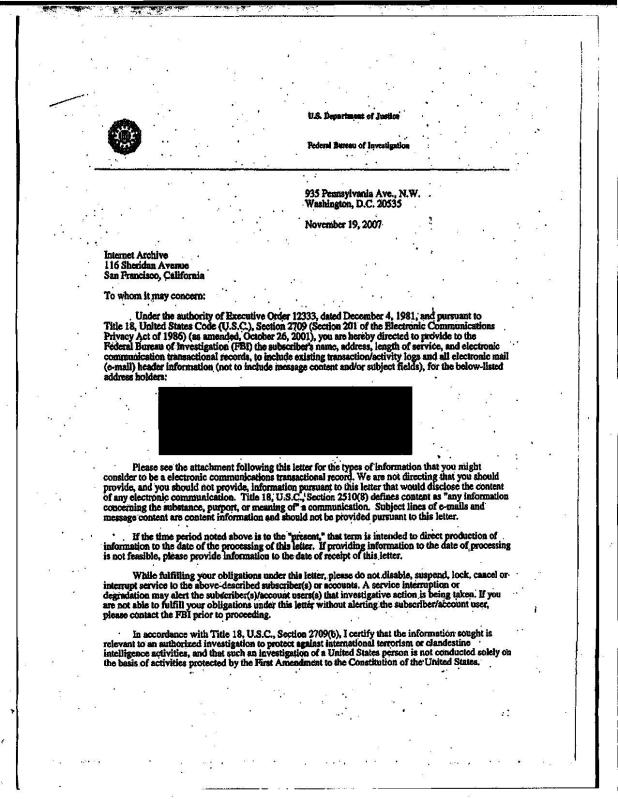
national_security_letter-sample_nov2007

A National Security Letter issued to the Internet Archive by the FBI in November 2007.

A national security letter (NSL) is a type of subpoena that can be issued by designated U.S. intelligence & security establishments, and does not require approval by a federal court judge. The Right to Financial Privacy Act, Stored Communications Act and Fair Credit Reporting Act, all contain provisions that allow the USG to request & obtain information relevant to an approved national security investigation. Previously, there was no uniform statute implementing NSL procedures; so, a law to do so was enacted.  The two primary concerns voiced in opposition to the NSL’s usage is:  an NSL does not require a court order (i.e.; signed by a federal court judge), and NSL’s normally contain language directing the NSL recipient to not publicly disclose any aspect of the NSL, including the simple fact of acknowledging receipt of an NSL.

There are several federal court cases concerning the legality of the NSL Law.  It will likely end up in the Supreme Court’s hands because the two sides to the issue are not backing down based on lower court rulings thus far.  It doesn’t mean the Supreme Court will necessarily have to take the case; they could decline and let a lower court ruling stand as is.  The Law currently states an NSL can only request non-content information, for example: recorded transactions, dialed phone numbers, and e-mail addresses. Since the above statutes pertain to legal entities, such as a real person or a company, their names are not protected information.  Although organizations such as the phone company or an internet e-mail provider that receives an NSL are barred by the Law from disclosing the content of e-mails or phone calls, the names of the parties involved are releasable.

Steve Miller, (c) Copyright 2016

Standard
Foreign Policy Research & Analysis

Formulating a country’s Foreign Policy choices: What is the basic framework most commonly used?

foreign-policy-word-cloud

     Without regard to making judgments about a country’s Foreign Policy process, lack of process, or flawed process (at least for now), the basic way a nation-state goes about determining their Foreign Policy choices is pretty much the same.  Emphasizing a non-judgmental approach to this, all country’s Foreign Policies touch on, to one degree or another: 1.) Goals & objectives a country is looking to achieve abroad; 2.) The principles or ideals that led a country to those goals; 3.) The means or methods to achieve them.  Complicating matters, it has become all too prevalent in the past 20 years for non-state actors to start civil wars, insurgencies, and promulgate acts of terrorism.  Disruptive non-state actors create infrastructure havoc; often rendering a government unable to develop and pursue legitimate Foreign Policy goals.  A sampling of states-in-crisis unable to promulgate a viable foreign policy agenda include: South Sudan, Somalia, Nigeria, Iraq, Syria, Afghanistan, Yemen, and Chad, to name a few.

     In 1962 a German-American political scientist, Arnold Wolfers, PhD, wrote a seminal work entitled, “Discord and Collaboration Essays on International Politics.”  In his book, Wolfers was quoted as saying, “decisions and actions in the international arena can be understood, predicted, and manipulated, only in so far as the factors influencing the decisions can be identified.”  This is, indeed, the case with many countries in the 21st Century, simply stated, “Why do/did they do that?”

     James N. Rosenau was a well-known political scientist, author and academician as a Professor of International Affairs at the George Washington University until he passed away in 2011 at the age of 86.  Rosenau developed a theory and method of explanation in 1966 to the question, “Why are the values and goals behind American Foreign Policy resistant to change?”  The “Funnel of Causality” to be discussed below is the basis for Rosenau’s theory.

     The Constitution makes it clear the President of the United States has the lead role in Foreign Policy development and implementation.  The evolutionary nature of American Foreign Policy, however, has developed over the past two centuries into a very pragmatic institution.  Those Americans ascending to the Presidency soon find out the pragmatism of the Foreign Policy machine is far more resilient than they ever imagined.  As it has been said over and over again, “the Presidency is a lot harder than it looks.”

     All American Presidents ponder before, during and after their term-in-office, about their legacy – “what is the mark I made on history?”  Whereas, many Presidents thought the country, in general, and the Presidency, in specific, were broken – in need of a major overhaul – they soon found out the Oval Office itself, had equal or greater control over the actions of a Presidential administration than any one occupant.

     The phenomenon of “Oval Office precedence” may explain why Democratic Party leaders found President Carter, once in office, to be much less liberal than they hoped for.  Or, why was Ronald Reagan a less conservative leader than Republicans thought they were getting?  Bill Clinton has been variously described as either “the most conservative liberal” the pundits had ever seen, or, “the most liberal conservative” they ever came across.

     These comments and questions are the essence of what Rosenau intended to explain about American Foreign Policy.  As it turned out, Rosenau’s concept also served to better understand the Foreign Policy choices of other nations, too.

     Rosenau utilized the concept of a funnel to control the flow of what goes into the large opening, and comes out of the small opening…this is the “Funnel-of-Causality.”  All external factors, problems and opportunities are part of the funnel opening, labeled “External Sources.”  The important thing to remember about the External Sources is they all have the potential of being recognized at the front-end of the Foreign Policy Process before any strategic shaping occurs.  Those personnel within a government institution charged with monitoring the outside world, or sometimes it is someone who is not a part of any government, yet, still monitors external sources, like the media, for example, can make a preliminary analysis to decide if the discovery warrants further attention.  Whether someone is a formal, global analyst or not, there are far more reasons a discovered external issue stalls or never makes it any farther than simple recognition that “it” is out there.

     The key to any external issue getting to the next level, “Societal Sources,” is if those conducting surveillance of the external landscape come across something either good or bad, that they know has some interest to a portion of society in the country under review.  If the external issue, however, does not have enough public interest warranting the expenditure of time and resources to vet it further, it is going to remain shelved in the Societal Sources section until something changes.

     If an external issue is deemed important enough by a country’s society (i.e.; the court-of-public-opinion), “Government Sources,” who are formally charged with deep dive research & analysis, are now going to strategically and tactically pick apart the issue with potential Foreign Policy implications.  The inputs and efforts by those individuals and institutions in this source category, as might be expected, have the longest throughput time, if done correctly.

     When a Government research analyst engages their “deep dive,” they are going to vet every possible aspect of the who, what, why, when, where, how, and an estimate of the cost & resources to do something about the issue at hand.  A third and fourth aspect in this category is any past precedent, and vetting for possible legal constraints.

     Legal constraints in a country like the United States can present a formidable challenge to forward movement of a Foreign Policy issue.  Not only are the U.S. Constitution, and codified law taken into consideration, but, case law (i.e.; Supreme Court decisions), Executive Orders, Presidential Findings (authority to take covert and/or clandestine action by the Intelligence Community), and treaties must figure into a decision to stop or delay forward progress of a Foreign Policy issue.

     The Role Sources category is comprised of those positions, or jobs within any government whereby a person’s role can affect the outcome of a Foreign Policy decision.  A governmental role may be similarly defined based on a legal, or other pre-existing requirement, and precedence.  The constraints of a role-based source include those placed on the President, the National Security Council, the Director of National Intelligence, the Secretary of State, and the DOD Secretary, to name a few.  As much as a role player has their own personal feelings about a Foreign Policy issue, they may have certain role-based constraints that tend to shape the official policy position, and there is no room for personal preference.

     An example of this occurred during the Vietnam War.  As President Nixon’s administration was managing the Vietnamization process, Congress felt it was taking too long to exit the War.  It seemed like each time the Vietnamization process took two steps forward, an evolving situation, like North Vietnam’s invasion of the South in March 1972, caused the exit efforts to take one, large step backwards.  This “backsliding” scenario, as Congress saw it, was derailing the Vietnamization program.  To prevent more issues from stalling the exit strategy, Congress began writing laws to cutoff funds for American combat operations in Southeast Asia.  The Nixon White House kept finding the money elsewhere to continue combat support operations for South Vietnam.  Eventually, Congress enacted further legislation to completely outlaw in the region, U.S. military expenditure of any sort of ordnance or munitions.  In the case of each new law, Nixon vetoed the bill; but, Congress mustered the two-thirds “super-majority” and overturned each veto.

     The Nixon/Vietnam example shows that the Foreign Policy choices of Nixon were within the role-based privileges afforded the President of the United States as the military’s Commander-in-Chief.  Congress, taking one-step-at-a-time, enacted legislation to remove the President’s role-based options.  Regardless how much Nixon (or Gerald Ford, later on) wanted to promulgate U.S. military support for South Vietnam, they were constrained by laws placed on the Presidential role of Commander-in-Chief. What either President wanted to do, personally, in this Foreign Policy situation was rendered immaterial.

     The final segment of the Foreign Policy funnel is the influence of individual people on how the final, developed Foreign Policy position is put-into-play.  A good example of an individual source of influence on a U.S. Foreign Policy position, was that of using military force during the unfolding debacle of the Balkan states – Kosovo, Bosnia, Serbia, etc. – and the actual choices of intervention and/or support made by President Clinton.  Not only did Clinton, as the President, have the authority as Commander-in-Chief to deploy American ground combat troops to the region, he also had bi-partisan support of both houses of Congress.  Clinton chose to only engage the military for air combat; no ground troops were sent.

     Why did Clinton make the choice that he did?  Many experts felt Clinton was uncomfortable about the possibility of the Balkans War becoming like another Vietnam.  It was Clinton’s age group who took the brunt of ground combat and death in Vietnam; Clinton, however, avoided it by not serving in the military.  Since he never served in the military, he did not want the label of “talking-the-talk,” but not walking-the-walk.  Again, this is supposition by political scientists.

     It is easy to see why U.S. Foreign Policy positions change so slowly.  The funneling process forces decisions to move carefully.  American Foreign Policy outputs take the pragmatic approach, as well as, the “if it ain’t broke, don’t fix it,” philosophy.

     A five segmented Foreign Policy Process Funnel is typical, and well understood by western democracies.  But, what about governments based on traditional monarchies, dictatorships, religion-based governments, or socialism-based (Communist) governments?  The “Funnel” is still applicable, but can be significantly different than the five segment funnel process common to democracies.

     For example: A Foreign Policy issue has been identified as something requiring action by the head-of-government in a dictatorship.  Since the very presence of a dictator indicates there is a less likely regard for the “rule-of-law,” a Foreign Policy choice often does not go much beyond the Dictator’s personal preference.  The Foreign Policy net result is: “whatever the Dictator says it is, is what it is!”

     In any form of non-democratic government there is always a possibility of the traditional five-segment Foreign Policy Funnel having one or more levels completely removed, truncated, or otherwise corrupted.  Making decisions based on inadequate professional due diligence can result.

     It is worth mentioning here, a few comments about the Foreign Policy practices exercised by the Nazi government of Germany from 1933 to 1945.  Before going any further, note that Nazi Germany’s Foreign Minister from 1938 to 1945, was Joachim von Ribbentrop.  Keep in mind that prior to joining the Nazi Party in 1932, Ribbentrop’s Foreign Policy “experience” was solely based on frequent global travel as a businessman, period.  He had no academic standing as a trained foreign policy specialist, nor had he ever held any type of position as a government employee, except as a German soldier in World War I.

     Ribbentrop first became useful to Adolf Hitler in 1932 as a secret, backdoor, go-between with the top democratically-elected leaders of the German government.  This only occurred due to Ribbentrop’s personal friendship with a couple of the politicians.  Ribbentrop’s character traits were probably the worst ones to have as he began mixing it up with career politicians and the Nazis.  He was the quintessential “yes man,” or, using a more modern label, a “suck-up.”  Ribbentrop was also an opportunist, an inveterate intriguer, and an upwardly mobile wannabe.  Ribbentrop’s dislike was nearly universal among the top Nazi leaders, such as Josef Goebbels, Herman Goering, etc.  He was intensely disliked by Germany’s professionally trained and experienced military leaders.

     Ironically, looking at the outcome of World War II, the Allies benefited, to a certain degree, by a cadre of German Nazi leaders like, Hitler, Ribbentrop, Himmler, et al, who lacked the education and professional credentials to be in the offices they held.  With Germany being one of the most well educated, technologically & socially advanced countries in the World, if the cream-of-the-crop rose to the top across the entire government instead Hitler & his cronies, the World might have looked vastly different today.  To be sure, the likes of Joaquim von Ribbentrop induced the Nazi government to be far more extreme than what might have occurred without someone fanning-the-flames. In an interview after the War, a Ribbentrop aide said: “When Hitler said ‘Grey’, Ribbentrop said ‘Black, black, black’. He always said it three times more, and he was always more radical [than Hitler].”  It was not a case of Ribbentrop holding more radical personal beliefs than Hitler and other top Nazis.  Ribbentrop’s approach was to take whatever idea Hitler expressed, and turn it into a “BIG idea.”

     The results of the Hitler/Ribbentrop-led German Foreign Policy apparatus gave Ribbentrop all of the notoriety & recognition he could ever want: He was tried and convicted at the Nuremberg War Crimes Tribunal after the War.  Many top Nazis committed suicide at the end of the War, including: Hitler, Goebbels, Goering and Himmler.  Ribbentrop, however, was convicted in a court-of-law, and was one of the few remaining top Nazis who were actually executed for their crimes.

     I have discussed all of this to illustrate what often happens to a country’s Foreign Policy apparatus in the hands of an illegally-formed government.  Policies, practices, pragmatism and rule-of-law are thrown out the window.  In a toxic political climate like this, a disciplined Foreign Policy apparatus is often dismantled, circumvented, or poisoned.  It is no longer based on “the will of the people,” but, a misshaped viewpoint of the few.  As much as a careful, pragmatic Foreign Policy process may frustrate some people, the number of correct choices far outweigh the gaffs.  This then, illustrates how far off-kilter a country’s Foreign Policies can become without some sort of structure and rigor-of-process.

     In summary, by using the Policy Funnel in any country, it smooths-out the rough political, legal, ethical and moral edges via a conservative path that makes decisions with greater insight & care.  It is far less likely for a head-of-government to promulgate a poor (read: bad) Foreign Policy choice when Rosenau’s Funnel, or something like it, is the basis of the process.

Steve Miller, Copyright (c) 2016

Standard