Nowadays the DOD uses a security clearance processing system that uses predictive modeling to gage the possibility of a security clearance denial. An actual clearance denial, or revocation of an existing clearance, are significant black marks on a person’s record. Obviously, the subject person wants to avoid a black mark; but, so does the DOD.
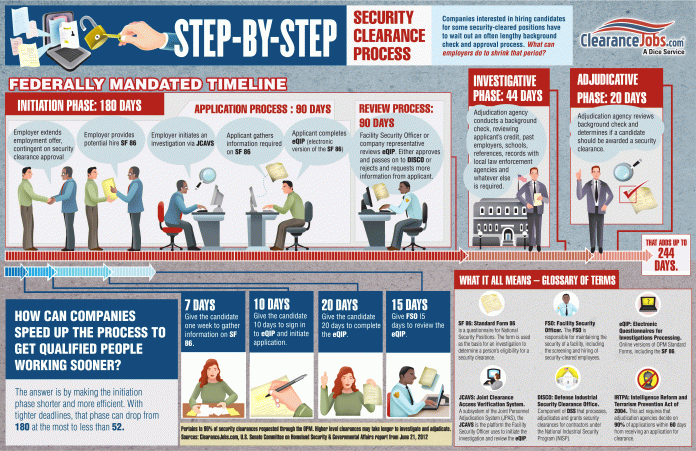
In the majority of situations, whether you are a uniformed member, a DOD civilian, or a contractor’s employee, security clearances are not required prior to stepping into a new, security cleared job. For any security clearance job, the starting place is the U.S. Gov’ts security questionnaire known as a form “SF-86.” The SF-86 is completed on-line in a DOD internet application known as “e-QIP.” The assigned security officer handling your case is the person who sets-up your e-QIP access, and administers the process on your behalf.
Since even a Secret clearance for a recently enlisted 18 year old will take several months to 100% process and reach a final decision, the e-QIP system contains the predictive modeling software. Based on your form SF-86 answers, e-QIP has the ability to assess key factors and within a few minutes it can issue an “Interim Secret” clearance. Final hiring decisions are made based on a candidates ability to obtain an Interim Secret. If e-QIP is unable to grant an Interim Secret clearance, it is NOT considered a denial. Your application simply lacks enough pre-verifiable info. Your SF-86 will have to take the usual, laborious route of manual verification by a DOD security officer. If the officer is unable to grant the clearance, this is considered a denial.
Steve Miller, (c) Copyright 2016
 The REPORT on NATIONAL SECURITY KINETICS™