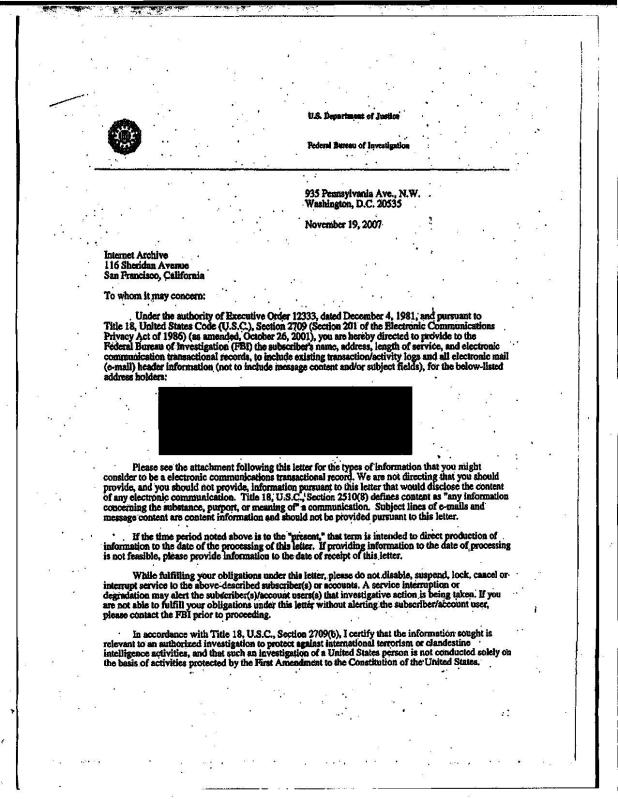
A National Security Letter issued to the Internet Archive by the FBI in November 2007.
A national security letter (NSL) is a type of subpoena that can be issued by designated U.S. intelligence & security establishments, and does not require approval by a federal court judge. The Right to Financial Privacy Act, Stored Communications Act and Fair Credit Reporting Act, all contain provisions that allow the USG to request & obtain information relevant to an approved national security investigation. Previously, there was no uniform statute implementing NSL procedures; so, a law to do so was enacted. The two primary concerns voiced in opposition to the NSL’s usage is: an NSL does not require a court order (i.e.; signed by a federal court judge), and NSL’s normally contain language directing the NSL recipient to not publicly disclose any aspect of the NSL, including the simple fact of acknowledging receipt of an NSL.
There are several federal court cases concerning the legality of the NSL Law. It will likely end up in the Supreme Court’s hands because the two sides to the issue are not backing down based on lower court rulings thus far. It doesn’t mean the Supreme Court will necessarily have to take the case; they could decline and let a lower court ruling stand as is. The Law currently states an NSL can only request non-content information, for example: recorded transactions, dialed phone numbers, and e-mail addresses. Since the above statutes pertain to legal entities, such as a real person or a company, their names are not protected information. Although organizations such as the phone company or an internet e-mail provider that receives an NSL are barred by the Law from disclosing the content of e-mails or phone calls, the names of the parties involved are releasable.
Steve Miller, (c) Copyright 2016
 The REPORT on NATIONAL SECURITY KINETICS™