
Without regard to making judgments about a country’s Foreign Policy process, lack of process, or flawed process (at least for now), the basic way a nation-state goes about determining their Foreign Policy choices is pretty much the same. Emphasizing a non-judgmental approach to this, all country’s Foreign Policies touch on, to one degree or another: 1.) Goals & objectives a country is looking to achieve abroad; 2.) The principles or ideals that led a country to those goals; 3.) The means or methods to achieve them. Complicating matters, it has become all too prevalent in the past 20 years for non-state actors to start civil wars, insurgencies, and promulgate acts of terrorism. Disruptive non-state actors create infrastructure havoc; often rendering a government unable to develop and pursue legitimate Foreign Policy goals. A sampling of states-in-crisis unable to promulgate a viable foreign policy agenda include: South Sudan, Somalia, Nigeria, Iraq, Syria, Afghanistan, Yemen, and Chad, to name a few.
In 1962 a German-American political scientist, Arnold Wolfers, PhD, wrote a seminal work entitled, “Discord and Collaboration Essays on International Politics.” In his book, Wolfers was quoted as saying, “decisions and actions in the international arena can be understood, predicted, and manipulated, only in so far as the factors influencing the decisions can be identified.” This is, indeed, the case with many countries in the 21st Century, simply stated, “Why do/did they do that?”
James N. Rosenau was a well-known political scientist, author and academician as a Professor of International Affairs at the George Washington University until he passed away in 2011 at the age of 86. Rosenau developed a theory and method of explanation in 1966 to the question, “Why are the values and goals behind American Foreign Policy resistant to change?” The “Funnel of Causality” to be discussed below is the basis for Rosenau’s theory.
The Constitution makes it clear the President of the United States has the lead role in Foreign Policy development and implementation. The evolutionary nature of American Foreign Policy, however, has developed over the past two centuries into a very pragmatic institution. Those Americans ascending to the Presidency soon find out the pragmatism of the Foreign Policy machine is far more resilient than they ever imagined. As it has been said over and over again, “the Presidency is a lot harder than it looks.”
All American Presidents ponder before, during and after their term-in-office, about their legacy – “what is the mark I made on history?” Whereas, many Presidents thought the country, in general, and the Presidency, in specific, were broken – in need of a major overhaul – they soon found out the Oval Office itself, had equal or greater control over the actions of a Presidential administration than any one occupant.
The phenomenon of “Oval Office precedence” may explain why Democratic Party leaders found President Carter, once in office, to be much less liberal than they hoped for. Or, why was Ronald Reagan a less conservative leader than Republicans thought they were getting? Bill Clinton has been variously described as either “the most conservative liberal” the pundits had ever seen, or, “the most liberal conservative” they ever came across.
These comments and questions are the essence of what Rosenau intended to explain about American Foreign Policy. As it turned out, Rosenau’s concept also served to better understand the Foreign Policy choices of other nations, too.
Rosenau utilized the concept of a funnel to control the flow of what goes into the large opening, and comes out of the small opening…this is the “Funnel-of-Causality.” All external factors, problems and opportunities are part of the funnel opening, labeled “External Sources.” The important thing to remember about the External Sources is they all have the potential of being recognized at the front-end of the Foreign Policy Process before any strategic shaping occurs. Those personnel within a government institution charged with monitoring the outside world, or sometimes it is someone who is not a part of any government, yet, still monitors external sources, like the media, for example, can make a preliminary analysis to decide if the discovery warrants further attention. Whether someone is a formal, global analyst or not, there are far more reasons a discovered external issue stalls or never makes it any farther than simple recognition that “it” is out there.

The key to any external issue getting to the next level, “Societal Sources,” is if those conducting surveillance of the external landscape come across something either good or bad, that they know has some interest to a portion of society in the country under review. If the external issue, however, does not have enough public interest warranting the expenditure of time and resources to vet it further, it is going to remain shelved in the Societal Sources section until something changes.
If an external issue is deemed important enough by a country’s society (i.e.; the court-of-public-opinion), “Government Sources,” who are formally charged with deep dive research & analysis, are now going to strategically and tactically pick apart the issue with potential Foreign Policy implications. The inputs and efforts by those individuals and institutions in this source category, as might be expected, have the longest throughput time, if done correctly.
When a Government research analyst engages their “deep dive,” they are going to vet every possible aspect of the who, what, why, when, where, how, and an estimate of the cost & resources to do something about the issue at hand. A third and fourth aspect in this category is any past precedent, and vetting for possible legal constraints.
Legal constraints in a country like the United States can present a formidable challenge to forward movement of a Foreign Policy issue. Not only are the U.S. Constitution, and codified law taken into consideration, but, case law (i.e.; Supreme Court decisions), Executive Orders, Presidential Findings (authority to take covert and/or clandestine action by the Intelligence Community), and treaties must figure into a decision to stop or delay forward progress of a Foreign Policy issue.
The Role Sources category is comprised of those positions, or jobs within any government whereby a person’s role can affect the outcome of a Foreign Policy decision. A governmental role may be similarly defined based on a legal, or other pre-existing requirement, and precedence. The constraints of a role-based source include those placed on the President, the National Security Council, the Director of National Intelligence, the Secretary of State, and the DOD Secretary, to name a few. As much as a role player has their own personal feelings about a Foreign Policy issue, they may have certain role-based constraints that tend to shape the official policy position, and there is no room for personal preference.
An example of this occurred during the Vietnam War. As President Nixon’s administration was managing the Vietnamization process, Congress felt it was taking too long to exit the War. It seemed like each time the Vietnamization process took two steps forward, an evolving situation, like North Vietnam’s invasion of the South in March 1972, caused the exit efforts to take one, large step backwards. This “backsliding” scenario, as Congress saw it, was derailing the Vietnamization program. To prevent more issues from stalling the exit strategy, Congress began writing laws to cutoff funds for American combat operations in Southeast Asia. The Nixon White House kept finding the money elsewhere to continue combat support operations for South Vietnam. Eventually, Congress enacted further legislation to completely outlaw in the region, U.S. military expenditure of any sort of ordnance or munitions. In the case of each new law, Nixon vetoed the bill; but, Congress mustered the two-thirds “super-majority” and overturned each veto.
The Nixon/Vietnam example shows that the Foreign Policy choices of Nixon were within the role-based privileges afforded the President of the United States as the military’s Commander-in-Chief. Congress, taking one-step-at-a-time, enacted legislation to remove the President’s role-based options. Regardless how much Nixon (or Gerald Ford, later on) wanted to promulgate U.S. military support for South Vietnam, they were constrained by laws placed on the Presidential role of Commander-in-Chief. What either President wanted to do, personally, in this Foreign Policy situation was rendered immaterial.
The final segment of the Foreign Policy funnel is the influence of individual people on how the final, developed Foreign Policy position is put-into-play. A good example of an individual source of influence on a U.S. Foreign Policy position, was that of using military force during the unfolding debacle of the Balkan states – Kosovo, Bosnia, Serbia, etc. – and the actual choices of intervention and/or support made by President Clinton. Not only did Clinton, as the President, have the authority as Commander-in-Chief to deploy American ground combat troops to the region, he also had bi-partisan support of both houses of Congress. Clinton chose to only engage the military for air combat; no ground troops were sent.
Why did Clinton make the choice that he did? Many experts felt Clinton was uncomfortable about the possibility of the Balkans War becoming like another Vietnam. It was Clinton’s age group who took the brunt of ground combat and death in Vietnam; Clinton, however, avoided it by not serving in the military. Since he never served in the military, he did not want the label of “talking-the-talk,” but not walking-the-walk. Again, this is supposition by political scientists.
It is easy to see why U.S. Foreign Policy positions change so slowly. The funneling process forces decisions to move carefully. American Foreign Policy outputs take the pragmatic approach, as well as, the “if it ain’t broke, don’t fix it,” philosophy.
A five segmented Foreign Policy Process Funnel is typical, and well understood by western democracies. But, what about governments based on traditional monarchies, dictatorships, religion-based governments, or socialism-based (Communist) governments? The “Funnel” is still applicable, but can be significantly different than the five segment funnel process common to democracies.
For example: A Foreign Policy issue has been identified as something requiring action by the head-of-government in a dictatorship. Since the very presence of a dictator indicates there is a less likely regard for the “rule-of-law,” a Foreign Policy choice often does not go much beyond the Dictator’s personal preference. The Foreign Policy net result is: “whatever the Dictator says it is, is what it is!”
In any form of non-democratic government there is always a possibility of the traditional five-segment Foreign Policy Funnel having one or more levels completely removed, truncated, or otherwise corrupted. Making decisions based on inadequate professional due diligence can result.
It is worth mentioning here, a few comments about the Foreign Policy practices exercised by the Nazi government of Germany from 1933 to 1945. Before going any further, note that Nazi Germany’s Foreign Minister from 1938 to 1945, was Joachim von Ribbentrop. Keep in mind that prior to joining the Nazi Party in 1932, Ribbentrop’s Foreign Policy “experience” was solely based on frequent global travel as a businessman, period. He had no academic standing as a trained foreign policy specialist, nor had he ever held any type of position as a government employee, except as a German soldier in World War I.
Ribbentrop first became useful to Adolf Hitler in 1932 as a secret, backdoor, go-between with the top democratically-elected leaders of the German government. This only occurred due to Ribbentrop’s personal friendship with a couple of the politicians. Ribbentrop’s character traits were probably the worst ones to have as he began mixing it up with career politicians and the Nazis. He was the quintessential “yes man,” or, using a more modern label, a “suck-up.” Ribbentrop was also an opportunist, an inveterate intriguer, and an upwardly mobile wannabe. Ribbentrop’s dislike was nearly universal among the top Nazi leaders, such as Josef Goebbels, Herman Goering, etc. He was intensely disliked by Germany’s professionally trained and experienced military leaders.
Ironically, looking at the outcome of World War II, the Allies benefited, to a certain degree, by a cadre of German Nazi leaders like, Hitler, Ribbentrop, Himmler, et al, who lacked the education and professional credentials to be in the offices they held. With Germany being one of the most well educated, technologically & socially advanced countries in the World, if the cream-of-the-crop rose to the top across the entire government instead Hitler & his cronies, the World might have looked vastly different today. To be sure, the likes of Joaquim von Ribbentrop induced the Nazi government to be far more extreme than what might have occurred without someone fanning-the-flames. In an interview after the War, a Ribbentrop aide said: “When Hitler said ‘Grey’, Ribbentrop said ‘Black, black, black’. He always said it three times more, and he was always more radical [than Hitler].” It was not a case of Ribbentrop holding more radical personal beliefs than Hitler and other top Nazis. Ribbentrop’s approach was to take whatever idea Hitler expressed, and turn it into a “BIG idea.”
The results of the Hitler/Ribbentrop-led German Foreign Policy apparatus gave Ribbentrop all of the notoriety & recognition he could ever want: He was tried and convicted at the Nuremberg War Crimes Tribunal after the War. Many top Nazis committed suicide at the end of the War, including: Hitler, Goebbels, Goering and Himmler. Ribbentrop, however, was convicted in a court-of-law, and was one of the few remaining top Nazis who were actually executed for their crimes.
I have discussed all of this to illustrate what often happens to a country’s Foreign Policy apparatus in the hands of an illegally-formed government. Policies, practices, pragmatism and rule-of-law are thrown out the window. In a toxic political climate like this, a disciplined Foreign Policy apparatus is often dismantled, circumvented, or poisoned. It is no longer based on “the will of the people,” but, a misshaped viewpoint of the few. As much as a careful, pragmatic Foreign Policy process may frustrate some people, the number of correct choices far outweigh the gaffs. This then, illustrates how far off-kilter a country’s Foreign Policies can become without some sort of structure and rigor-of-process.
In summary, by using the Policy Funnel in any country, it smooths-out the rough political, legal, ethical and moral edges via a conservative path that makes decisions with greater insight & care. It is far less likely for a head-of-government to promulgate a poor (read: bad) Foreign Policy choice when Rosenau’s Funnel, or something like it, is the basis of the process.
Steve Miller, Copyright (c) 2016

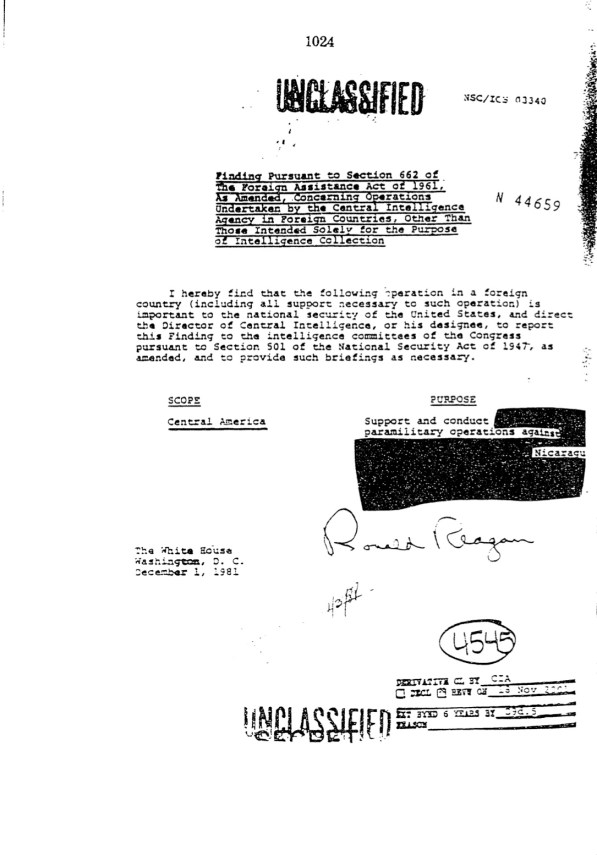 Presidential Finding signed by President Reagan to authorize the CIA to conduct covert operations in Central America to aid the Contra rebels in their fight against the Communist-backed Sandinista government in Nicaraqua.

 The REPORT on NATIONAL SECURITY KINETICS™