Miscellaneous Topics, National Security, Terrorism Information

RNSK Vol 2, Edition 2


United States Supreme Court Decision:                             U.S. v Abu Zubaydah         Published March 3, 2022

An Important Decision In Protecting Classified National Security Information


Introduction

The Zubaydah case has significant National Security implications, and the Court ruled in favor of the United States.  For most people, court cases can be pretty boring, and even more so at the Supreme Court level; unless, of course, you are fascinated by legal proceedings like me.

In the Zubaydah case, a common court procedure, “discovery,” became a critical issue that could have had a major effect on national security.  In criminal cases, it sometimes becomes important for the prosecution or defense to prove or disprove the physical presence of a person involved in the case in order to establish a defendant’s guilt or innocence.  However, a person’s physical presence at a certain location, or their whereabouts, is not always material to the case; this includes the location of someone when evidentiary information was obtained from them.  For example, if a murderer confesses to a murder while in the back of the patrol car heading to jail, the fact that it occurred in the car makes no difference to its admissibility than if the defendant confessed to it in a police station interrogation room.  In Zubaydah’s case, one of the attorneys-of-record decided to file a motion for discovery to determine Zubaydah’s physical presence at a certain location where his testimony/confession had been disclosed.  This discovery motion is what stirred up national security concerns.

Background of the Case

Zubaydah is currently a detainee at the Guantanamo Bay Detention Facility. Zubaydah was a senior Al Qaeda lieutenant who was sought in connection with the World Trade Center Attack in September 2001.  He was ultimately caught in 2002 and remanded to U.S. custody.  During Zubaydah‘s detention in 2010, he filed a lawsuit against the USG, alleging that in 2002-2003 he was held by the CIA at a “black site” in Poland.  His lawsuit complained that he was unlawfully detained at the black site, citing the Supreme Court decision that enhanced interrogation techniques were illegal, as well as, unlawful detention, which prejudiced his criminal arrest warrant for conspiracy in the 9-11 attacks, and therefore any information which may have been obtained from Zubaydah was inadmissible; ergo his case ought to be dismissed.

Zubaydah had/has multiple criminal charges pending, with some relying on the confession/testimony he alleged came from his black site detention.  Although Zubaydah’s black site claim might get the charges dropped that relied on information obtained at the black site, it would not affect other pending charges that did not rely on that information.  Sometimes a key factor in a criminal case is proving/disproving the defendant was/was not physically present at the location(s) where events of the case may have occurred.  In the case of Zubaydah, the information he revealed at the alleged Polish black site had been confirmed by the USG as valid, but that was not as important as the alleged location where information was obtained. 

U.S. District Court Activities

When the district court considered the defense’s discovery motion, which requested the CIA disclose the location where the defendant’s confession/testimony was obtained, the prosecutors declined to confirm/deny anything about a Polish black site, citing that CIA methods & trade craft are classified information that may harm U.S. national security if revealed.  Prosecutors stated that it was common practice by the USG that when the public requested information, or asked for corroboration of certain information already in the public domain, which may or may not have classified national security implications, the USG may choose to reply that they cannot confirm or deny what was being asked for.  Prosecutors further stated that there was no statute or case law that compelled the USG to declassify and disclose classified national security information based on a formal or informal request, regardless if the requestor alleges the information is already public knowledge.  The prosecution moved to dismiss the discovery motion.  The District Court judge concurred with the CIA, dismissing Zubaydah’s discovery motion, as well as dismissing the defense’s lawsuit against the CIA.  None of these proceedings had any immediate affect one way or the other on pending criminal charges against Zubaydah, and other defendants, that stemmed from the alleged Zubaydah black site interrogation.

U.S. Court of Appeals Activities

Zubaydah’s attorneys appealed the lower court decision to dismiss the discovery motion, and the lawsuit, to the 9th Circuit Court of Appeals.  Zubaydah’s attorney’s submitted that once classified information is found in the public domain, which was alleged to be the case about the black site’s existence, it was no longer sensitive, national security-classified information.  In layman’s terms, it was like “the-cat-was-already-out-of-the-bag,” so what’s the big deal?  The Appeals Court agreed with the defendant, and reversed the District Court’s ruling, agreeing that once the information was in the public domain, it was moot to retain a national security classification.  Reversing the lower court’s dismissal of the discovery motion, and lawsuit, meant the USG could be compelled to acknowledge the black site’s existence in Court, and any details about it.  The case was remanded back to the District Court, where Zubaydah’s attorneys would compel the CIA to reveal the black site’s existence, and therefore move to dismiss criminal case(s) based on the Supreme Court’s prior ruling that black site detention locations and enhanced interrogation techniques were unconstitutional.

U.S. Supreme Court Activities

Before the District Court judge could rule on reversing the dismissal of the discovery motion, and lawsuit, based on Appeals Court guidance, CIA lawyers sought an injunction from the Supreme Court until they could rule on the merits of the motion-to-dismiss.  The injunction was granted, allowing time for the case to be heard by The Supreme Court.  After the prosecution and defense argued their cases in front of the Court, the Court issued a ruling in favor of the CIA.  The Court opinion noted that it has been standard USG practice that if any sort of classified information has been disclosed to the public, the USG is not required to confirm or deny anything about the alleged classified information, since it was classified by the USG in the first place. 

Basically, just because alleged classified information has been leaked to the public, the U.S. Government is not required to comment or corroborate the leaked information.  This would be a kin to releasing photos to the public of a man standing on the sidewalk near a bank that was being robbed, with the photo clearly showing he was looking right at the robbers as they exited the bank to leave in their getaway car.  Speculation was rampant on social media that the man in the photo was a well-known baseball player, but the picture was grainy, and no one was 100% positive it was him.  If a discovery motion was filed by the prosecution to compel the baseball player to admit it was him in the picture, and thereby subpoena him to testify against the robbers, but the player is not being charged or investigated for wrongdoing, there’s no statute or case law that says he is required to confirm his identity.

The concept here that applies to national security information is that if it is leaked to the public, the USG cannot be compelled to publicly acknowledge the veracity of the information, nor whether it carries a national security classification, if any.  Had the Supreme Court allowed that any alleged USG privileged information that was compromised to the public, could compel the USG to confirm or deny it, if so requested, could cause unintended harm to others.  This would mean that such information as might appear on Wikileaks, for example, anyone could submit a formal request to USG compelling them to disclose the veracity of the information. 

Aftermath of the Supreme Court Ruling

In the Zubaydah case, the defense attorneys were quite shrewd.  By filing a discovery motion seeking to compel the USG to confirm or deny the site, whatever the outcome, the cases stemming from the information obtained at the black site would end up being dismissed.  If the CIA confirmed the black site’s existence and the information obtained there, those cases would be dismissed, BUT more importantly, it would have damaged the Polish government in the court of public opinion for allowing the black site operation, as well as, destroy any trust between the two governments.  Alternatively, if the CIA denied the black site’s existence, they would be committing perjury, which has no statute of limitations.  Poland’s reputation would remain intact, and Zubaydah would likely have been convicted of the crimes stemming from the black site-obtained information.  The third option, which was allowed by the Supreme Court, gave the CIA the ability to use the standard reply in these situations – that the information could not be confirmed or denied.  This kept Poland’s reputation intact, and did not require the USG to corroborate classified information in the public domain.  Unfortunately, the third option meant the District Court’s dismissal of the defense’s discovery motion might create doubt as to the validity of the information if it were utilized in a jury trial.  The defense would show the jury that the prosecution could not testify as to where or how the incriminating information was obtained, thereby casting suspicion on the veracity of it.  The jury would learn the USG was hiding something, and be unlikely to convict someone using evidence that may have been obtained illegally.  So, rather than chase down that rabbit hole, the prosecution had no choice but to concur with the judge’s ruling to dismiss the case(s) using the black site information.  Zubaydah still had many other charges pending based on other evidence, but the defense attorney’s very shrewdly got rid of a sizable chunk of the court cases against Zubaydah.  Other defendants implicated in Zubaydah’s black site testimony also had some charges dropped.

The moral to this story is that a democratic form of government has a lot more plusses than minuses.  In order to have the benefit of all of the favorable aspects of living in the United States, there are going to be times that you have no choice but to accept the bad.  No one really doubted Zubaydah’s guilt; he would be convicted on other charges stemming from different information sources.  But to get a conviction (a good outcome of democracy) on Zubaydah’s black site confession, it would have required representatives of the U.S. Government to lie under oath (a bad choice), which is not how a democracy works.  Zubaydah and his attorneys relied on the fact America’s democratic-based legal system would get him off-the-hook.

Ciao,

Steve Miller, IAPWE – Certified & Member
Managing Editor
The Report on National Security Kinetics™
Seattle, WA. USA
vietvetsteve@millermgmtsys.com
Standard
Foreign Policy Research & Analysis, National Security, Terrorism Information

What is the legal definition of “National Security” established by the US Courts?

To get the full treatment on the topic of National Security from the U.S. point of view, take a look at my series of general FAQs I wrote for Quora at the following link:

https://www.quora.com/topic/National-Security/faq

One of the FAQs provides the U.S. Government definition of National Security, as follows:

Within the context of how the United States defines National Security, it was developed and promulgated via Joint Publication #1 by the Department of Defense, Joint-Chiefs-of-Staff. The meaning is: A collective term encompassing both national defense and foreign relations of the United States with the purpose of gaining: a. A military or defense advantage over any foreign nation or group of nations; b. A favorable foreign relations position; or c. A defense posture capable of successfully resisting hostile or destructive action from within or without, overt or covert.

In terms of a “legal” definition of National Security either in the U.S. Code of Federal Regulations (CFRs), or anything based on a Federal District, Appeals or Supreme Court ruling that might create “case law,” you will not find anything. The reason why is the term, by its very nature, is too broad, and any level in the U.S. court system would be committing “judicial suicide” if they attempted to render a felony trial verdict based on an attempt to fully encapsulate a definition of National Security.

Not trying to be flippant, but, attempting to create a single, legally binding definition of National Security that could hold up to an ultimate determination by the U.S. Supreme Court, would be just as difficult as to pin down as legally defining the term “Chocolate Donut.”

Seriously, take a look at my National Security FAQs. Part of the problem with trying to pin down a legally binding definition of National Security is simply that it is a moving target that is constantly evolving. My FAQs denote some of the more recent developments that now pose a National Security threat that no one would have dreamed of 50–60 years ago. Here are a few examples of what I mean:

  1. Global Climate Change;
  2. Trans-National Crime;
  3. A Global Disease Pandemic;
  4. Cyber-based Infrastructure Threats;
  5. Space-borne Threats. And this is not just “Star Wars” stuff with killer satellites and lasers. The U.S. is the ONLY country in the World to track the tens of thousands of pieces of space junk, defunct satellites, micro-meteorites, et al, that could potentially enter the earth’s atmosphere, or possibly collide accidentally with an important spacecraft up there. A burned-out Russian satellite has already collided with an American in-use satellite that before the collision, there were just two objects, and now the debris has made thousands of objects.

If you go back to the 1930s, not only were the threats listed above either unknown, or considered non-threatening, but, no one had an inkling about a nuclear holocaust being a National Security threat either.

These are just some of the things we have added to the National Security threat list since World War II. I am sure there is more to come, and our understanding of what constitutes National Security will continue to evolve, too.

Standard
National Security

Presidential Findings and Their Impact on U.S. National Security

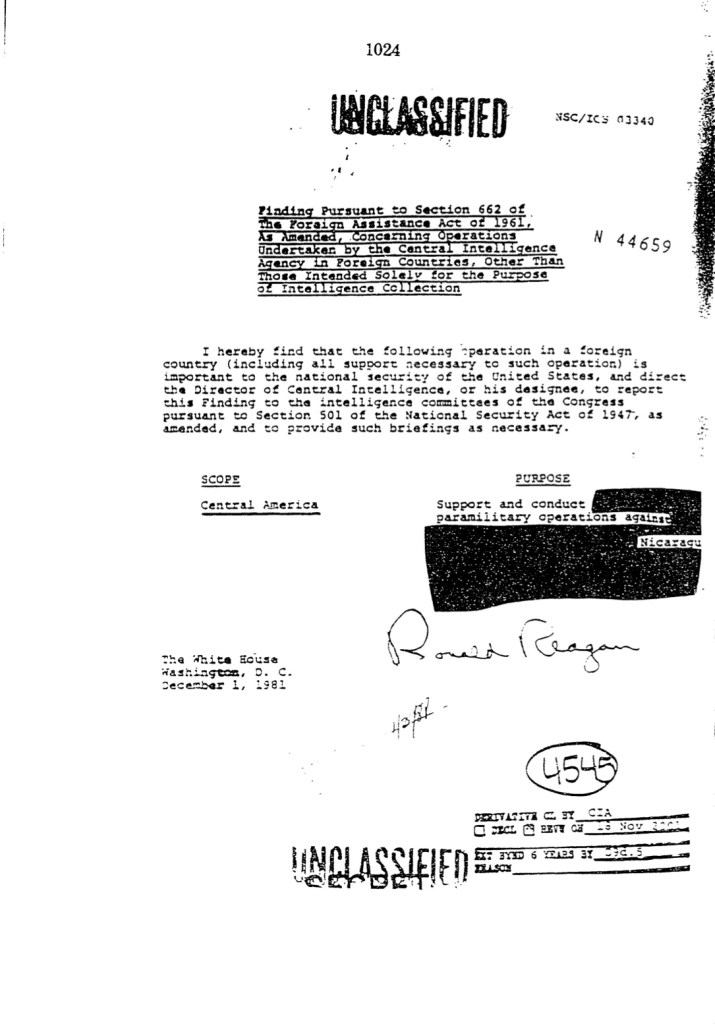
reagan-presidential-finding-nicaragua_dec1981Presidential Finding signed by President Reagan to authorize the CIA to conduct covert operations in Central America to aid the Contra rebels in their fight against the Communist-backed Sandinista government in Nicaraqua.
During the Vietnam War nearly every kind of intelligence operation you can think of was undertaken by the U.S. Intelligence Community.  The four most heavily engaged agencies, starting with the most utilized first, were: the Central Intelligence Agency, Defense Intelligence Agency, National Security Agency, and the State Department’s Bureau of Intelligence and Research.  As the War dragged on, with public, Congressional, and Presidential frustration mounting, increased pressure was applied on intelligence activities, especially the CIA, to help turn the War in a more positive direction.

Thomas Ahern, a CIA intelligence officer, who started his career in Southeast Asia during the Vietnam War, wrote an excellent book, “Vietnam Declassified,” about the CIA and the many types of intelligence operations undertaken in Vietnam.  He cites an exasperating meeting about a problem with a certain pacification program led by the CIA, during which someone tossed out a new idea. William Colby (future CIA director), who was the CIA’s Saigon station chief at the time, replied that he was willing to try anything—if it would work.  The mounting, across-the-board frustration, left the CIA and its cohort agencies, grasping at straws.

William Colby became the new Director of Central Intelligence (DCI) in September 1973, just a month after American combat activity ceased in Southeast Asia.  Colby’s tenure would be a brief 2 ½ years.  Before the year was over, allegations began to surface in the press about questionable intelligence activities during the War.  Press allegations continued throughout 1974, and murmurings started-up in Congress about possible Intelligence Community improprieties.   By time Colby left office he would arguably hold the distinction of testifying before Congress more than any other DCI.  By January 1975 both the Senate, and House of Representatives, were conducting hearings about the impropriety allegations.  Senator Frank Church chaired one committee, and Congressman Otis Pike chaired a similar investigation committee in the House.

All of this external attention on the Intelligence Community resulted in passage of several new laws to tighten-up accountability and oversight of certain critical, intelligence operations.  For the most part, the type of operations that were closely looked at, and caused the most angst with Congress, were those in which the importance to U.S. National Security was ill-defined; in essence, justifying a direct benefit to the Unites States was a stretch, at best.

U.S. Foreign Policy has a range of options available to the President in order to achieve his goals.  The low end of the scale espouses the use of diplomacy to achieve American goals overseas.  At the opposite end of the spectrum from diplomacy is military intervention.  Starting in the post-World War II era, and continuing to this day, foreign relations between countries have become so complex that often times using pure diplomacy is ineffective; but, military intervention is too much.  The gray area between State Department diplomacy, and Defense Department military operations, is often the domain of the CIA using Covert Action to achieve American foreign policy goals.  It is this genre of intelligence operations that garnered such a strong backlash from Congress and the public after Vietnam.

Regardless the type of intelligence operation being mounted, they all have an appropriate level of Operational Security – “OPSEC.”  OPSEC is usually manifested in three categories:

Clandestine operation:  An operation sponsored or conducted by  a U.S. government department or agency in such a way as to assure secrecy or concealment.  Clandestine operations are the usual means of OPSEC for espionage and/or intelligence collection, which is the “bread n’ butter” spying conducted by the CIA’s National Clandestine Service.  The biggest reason intelligence collection is conducted with clandestine OPSEC is most adversaries, upon detecting espionage activity, move quickly to render useless anything that was purloined.  For example, clandestinely photographing an enemy’s communication code books.  If the collection activity is discovered, the enemy will stop using the compromised codes, and the photographed code book has no further value.  Being undetected is paramount in clandestine operation.

Covert operation: An operation of the United States Government that is planned and executed to influence political, economic, or military conditions abroad, where it is intended that the role of the United States Government will not be apparent or acknowledged publicly (i.e.; plausible deniability).

Clandestine and Covert operation:  The operation must be undetected, and the sponsor’s identity is concealed.

By the very nature of clandestine operations, they tend to be low-key.  Any sort of violence associated with the operation tends to cause the lack of detection to be tossed right out the window.

Covert operations conducted by the CIA, for example, are less concerned about remaining undetected during the operation, or afterwards.  Of greater concern is running the operation so it cannot be traced back to the United States.  In this sense, it is a fact-of-life that covert operations tend to have more violence attached, destroying property and/or killing enemy personnel to prevent them from reporting who or what they saw.  As noted previously, when diplomacy fails, but, direct military intervention is too heavy handed, a plausibly deniable covert operation often becomes the tool-of-choice for resolving vexing problems.  Up until Colby’s DCI tour, and the Church & Pike Committees, the CIA regularly conducted operations using all three OPSEC categories.  Covert operations bears the majority of public and Congressional opposition.  This led Congress to add language in Title 50 U.S. Code, requiring a documented Presidential Finding for covert operations.

Prior to the law being changed to require a Presidential Finding, an extremely sensitive covert operation was usually briefed to the President for his buy-in.  The law was moot, however, on any formal requirement to seek the President’s buy-in, nor was there a requirement to document the Presidential Briefing in writing, nor to obtain an actual signature by the President, approving the covert action.  Aside from the President’s buy-in, the law was also silent about informing key members of Congress about an impending covert action.

Once the law took effect, all covert actions had to be documented in a signed Presidential Finding, and it had to contain an explanation of why it was necessary to conduct the operation, including the identifiable foreign policy objectives of the United States, and the covert action’s importance to U.S. National Security.  Lastly, the Presidential Finding must be presented to both Congressional intelligence committees.

Steve Miller, (c) Copyright 2016

Standard
National Security

National Security Letters: What Are They, How Are They Managed & Implemented, and What is Their Impact on U.S. National Security Policy?

national_security_letter-sample_nov2007

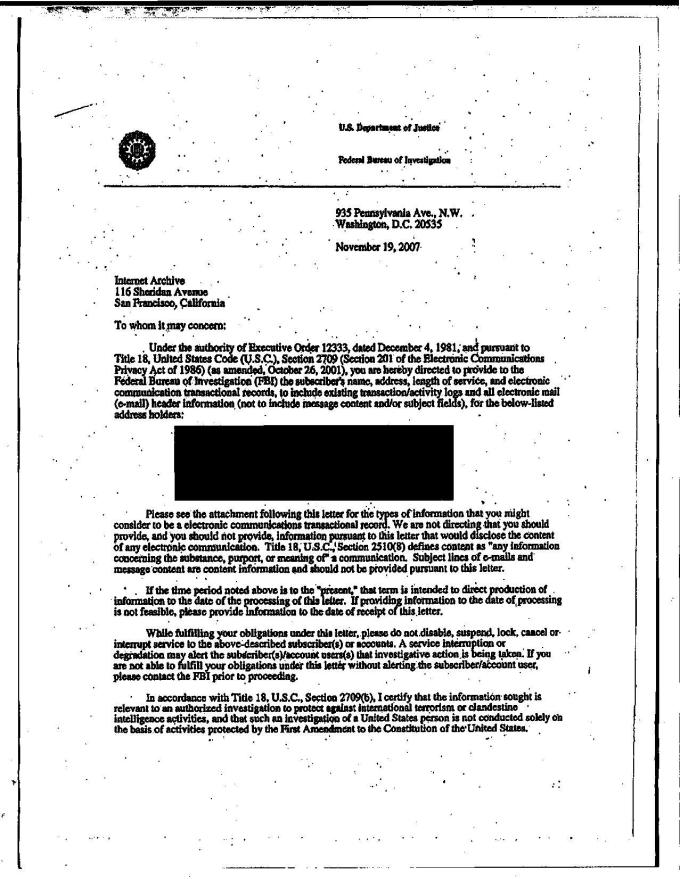
A National Security Letter issued to the Internet Archive by the FBI in November 2007.

A national security letter (NSL) is a type of subpoena that can be issued by designated U.S. intelligence & security establishments, and does not require approval by a federal court judge. The Right to Financial Privacy Act, Stored Communications Act and Fair Credit Reporting Act, all contain provisions that allow the USG to request & obtain information relevant to an approved national security investigation. Previously, there was no uniform statute implementing NSL procedures; so, a law to do so was enacted.  The two primary concerns voiced in opposition to the NSL’s usage is:  an NSL does not require a court order (i.e.; signed by a federal court judge), and NSL’s normally contain language directing the NSL recipient to not publicly disclose any aspect of the NSL, including the simple fact of acknowledging receipt of an NSL.

There are several federal court cases concerning the legality of the NSL Law.  It will likely end up in the Supreme Court’s hands because the two sides to the issue are not backing down based on lower court rulings thus far.  It doesn’t mean the Supreme Court will necessarily have to take the case; they could decline and let a lower court ruling stand as is.  The Law currently states an NSL can only request non-content information, for example: recorded transactions, dialed phone numbers, and e-mail addresses. Since the above statutes pertain to legal entities, such as a real person or a company, their names are not protected information.  Although organizations such as the phone company or an internet e-mail provider that receives an NSL are barred by the Law from disclosing the content of e-mails or phone calls, the names of the parties involved are releasable.

Steve Miller, (c) Copyright 2016

Standard
National Security

Academically speaking, what is “Security” in This Day and Age?

national-security-graphic_oct2016

The first factor to consider in discussing “Security,” or as it’s more commonly known, “National Security,” is some basic definitions applicable to any country.  These “basics” are not all inclusive, but, they represent the most common National Security factors that are intrinsic to any country’s sovereignty.

  1. Citizen protection, health & well being;
  2. Protecting a country’s strategic infrastructure;
  3. Physical protection of a country’s sovereign territory;
  4. Ensure the security of a country’s natural resources;
  5. Ensuring the political stability of the country’s governmental institutions (i.e.; executive branch, legislature, and judiciary);
  6. Maintain a country’s free access to adjacent international waters and airspace.

Every country has the right to at least the preceding National Security measures without encroachment by any other state actor, non-state actor, or by externally encouraged insurrection.

Most third world countries are incapable of looking beyond these six basic National Security factors.  The truth be told, many third world nations are challenged to the hilt just trying to keep their basic factors from encroachment.  In a general sense, third world countries are so self-absorbed just trying to get the six basics right, that there’s little means, opportunity or time to concern themselves with a crisis brewing in a far off land, and whether that other country’s strife could somehow effect their own country.  An example of this might be a country like Laos, and the ISIS conflict raging in Syria and Iraq.  It is unlikely the ISIS conflict has any direct or even indirect affect on Laotian National Security.  And if the ISIS conflict did have an impact on Laos, what could Laos do about it? Nothing.

But, could the same be said for ISIS’ impact on Great Britain?  No, it could not.  The larger the economy, the greater the infrastructure, the increased sophistication of a country’s society or industry, a higher degree of advanced education systems (i.e.; colleges, trade schools, etc), the higher per capita worker earnings, and Gross Domestic Product means a country like Great Britain has more tactical and strategic interest of problems brewing in other countries.  Great Britain may have a great need for Middle-eastern oil, or they have significant business interests in foreign countries, etc.  In a nutshell, a world economic and military power like Great Britain would not be able to maintain the security and prosperity it has attained by only concerning itself with the “basic six.”

The U.S. Congress enacted legislation over six years ago, requiring the President to publish every five years, a National Security Strategy.  I have pasted a hyperlink below, so you can review the 2015 NSS yourself.  Two definitions pasted below are the U.S. Government’s official position:

Security: 1. Measures taken by a military unit, activity, or installation to protect itself against all acts designed to, or which may, impair its effectiveness.  2. A condition that results from the establishment and maintenance of protective measures that ensure a state of inviolability from hostile acts or influences. 3. With respect to classified matter, the condition that prevents unauthorized persons from having access to official information that is safeguarded in the interests of national security.

National Security: A collective term encompassing both national defense and foreign relations of the United States with the purpose of gaining: a. A military or defense advantage over any foreign nation or group of nations; b. A favorable foreign relations position; or c. A defense posture capable of successfully resisting hostile or destructive action from within or without, overt or covert.

The 2015 NSS did not change the 2010 U.S. National Enduring Interests that form the backbone of the current NSS:

  1. The security of the United States, its citizens, and U.S. allies and partners;
  2. A strong, innovative, and growing U.S. economy in an open international economic system that promotes opportunity and prosperity;
  3. Respect for universal values at home and around the world, and;
  4. A rules-based international order advanced by U.S. leadership that promotes peace, security, and opportunity through stronger cooperation to meet global challenges.

The 2015 NSS listed the following top strategic risks to U.S. interests:

  1. Catastrophic attack on the U.S. homeland or critical infrastructure;
  2. Threats or attacks against U.S. citizens abroad and our allies;
  3. Global economic crisis or widespread economic slowdown;
  4. Proliferation and/or use of weapons of mass destruction;
  5. Severe global infectious disease outbreaks;
  6. Climate change;
  7. Major energy market disruptions, and;
  8. Significant security consequences associated with weak or failing states (including mass atrocities, regional spillover, and transnational organized crime).

The United States learned 115 years ago under the leadership of President Theodore Roosevelt, that America no longer had the ability to remain isolated; the relationship to other countries, was now of strategic interest to American prosperity.  This is why the U.S. Armed Forces are deployed globally to ensure a number of issues do not affect the United States.  The 9/11 terrorist attacks demonstrated what can and will happen on U.S. soil, if the U.S. fails to project their security interests worldwide.  The U.S. can no longer remain insulated and expect the problems overseas to remain there.  Problems & crises elsewhere will come to our shores if our National Security interests do not go beyond the basic six.

http://www.dtic.mil/doctrine/doc…

     Steve Miller, Copyright (c) 2016


Standard