Miscellaneous Topics, National Security

RNSK Vol I, Edition 7

August 9, 2021


A Tale of Two “Skits”


It has been a wild ride in America since March 2020 when the COVID-19 pandemic hit.  No one I’ve spoken to can recall a time when there was so much unrest in society.  Even all the unrest in the 1960s related to civil rights, the Cold War, and the Vietnam War, pale in comparison to 2020.  In 2020-2021, we’ve had police brutality, rioting, extensive destruction of government & personal property, multiple crime waves, subversion, racism, inner-city murders on an unprecedented scale, assault & battery in broad daylight, and hate crimes of every type.  In fact, who would have thought that one of the most security-conscious environments, passenger airliners, would see so many on-board fights & unruly passengers?  It was a chaotic year that surprised and disturbed most of us.  I saw things that I never dreamed I would see in my lifetime.

Back in 1970 I was a junior in high school.  I had always been interested in the behind-the-scenes stuff that it took to make movies & T.V. shows.  So, I took an elective that year in school called “Technical Theater.”  We learned all about building sets, lighting, filming, script supervision, etc.  The Technical Theater class served as the production crew for any school plays or concerts.

One day we were gathered in the school’s theater waiting for a beginner’s acting class to finish before we could start some set construction.  The beginners were doing improvised, satirical skits, so we casually watched the last two.

In the first skit the teens all lined-up facing the audience.  When the teacher called, “action,” the students all started acting like little kids who were standing in a line.  They fidgeted, whispered to each other, and jabbed elbows into their neighbor.  Typical little kids with ants-in-their-pants.  One kid took a step forward and said, “the first grade class of Mary Louise Phillips Elementary School will now say the Pledge of Allegiance to the Flag.” The kid got back in line and told the others, “right hand over your heart, ready…begin…”

As they started to say the pledge, some elbowing got out of hand and two boys shoved each other.  Finally, one of them was knocked to the ground, and the other kid kicked him.  At this point the Pledge stopped, and all of the kids in the line ran up to the kid on the ground.  Rather than helping him up, they jumped-in with the bully who started it, and pretended to give this kid a class “A” beat-down!  When they were done, they got back in line.  The kid on the ground was now “dead.”  After the kids were lined-up again, they cleared their throats and said “…with liberty and justice for all.”

It was supposed to be satirical and we all chuckled mildly.  At the time I thought, “well, that was pretty far-fetched…ha!…like that would ever happen in real life.”

The second skit had the students laying on the stage as if they were relaxing under some trees in the park.  One kid declared, “it’s a nice day.”  Another said rather laconically, “yep, it’s a nice day.”  A third kid apparently thought the second kid was being mockingly sarcastic, so he ran over to the second one and loudly yelled in his face, IT’S A NICE DAY!!!”  The rest of the kids started chanting, “it’s a nice day…it’s a nice day…it’s a nice day,” as they closed-in on the second kid.  The second kid tried to leave, but the group shoved him to the ground and beat the living daylights out of him!  Once the second kid acted like he was knocked-out, the others laid down to relax on the grass again.  The very first kid who made the nice day comment piped-up and said, “you know, it REALLY is a nice day.”

Hmmm…So, what is the tale of the two skits?  In a Vietnam Era, American high school, I saw two skits with ridiculously weird outcomes.  There’s no way that either scenario could occur in real life, right?  A group of ordinary people could never be so unbalanced that they would assault another person for no apparent reason.  I held this belief over the past 50 years; there was NO tale to tell about the two skits…they were just part of a scriptwriter’s imagination.

Then 2020 came around and changed how I felt about the Tale of the Two Skits.  The screwy circumstances in the skits were no longer implausible.  We are in an era of contempt by many toward our national symbols…The Pledge of Allegiance, The National Anthem, and the U.S. Flag.  And the contempt for these symbols has now transcended the average citizen to public institutions and elected officials.  What used to be symbols of unity, are now lightning rods of divisiveness.

What about the kids in the first skit symbolizing what is normally a benign gathering…saying the Pledge of Allegiance?  Kids and adults will both act out sometimes, and the level of behavior used to be more commensurate to the situation.  We were taught that if you need to argue, do it behind closed doors, or take it outside if it is really heated.  Nowadays people seem determined that whatever might occur between two people is not taken off-line; it is going down right where they stand in the grocery line, in the bleachers at a ball game, or a local park while kids play on the nearby jungle gym.  What used to be two people discussing differing viewpoints, is now an open disagreement.  An open disagreement is now a serious argument.  A serious argument is now a shoving match.  A shoving match is now physical assault.  Physical assault is now battery with the intent to do serious physical harm.  The intent to do serious physical harm has now escalated into the use of weapons for defensive self-protection.  And finally, defensively brandishing a weapon to break-free from a fight is now using a weapon to permanently stop an altercation with someone, by killing them.

In the second skit, the teenager who took exception to what the second kid said, did so by simply reacting and immediately passing judgment.  No wisdom or discernment was applied…just react and judge.  American society is experiencing an unprecedented wave of public reaction & judgment.  Wisdom, discernment and cooler heads prevailing, seems lacking in 2020 America.

In today’s world, the Tale of Two Skits from 50 years ago would still be considered satirical.  But, do the two scenarios, or something similar, still seem like an absurd piece of fiction in 2021?  The underlying human behavior (not actual school kids or teens in a park) and the outcomes seem quite plausible to me.  If the American Dream could be compared to a sunny day, I would say the sun is still there…it just does not rise as high as it used to.

I feel certain that someday American society will exceed the fiction of The Tale of Two Skits…sigh…

Ciao,

Steve Miller, IAPWE – Certified & Member
Managing Editor
The Report on National Security Kinetics™
Seattle, WA. USA
vietvetsteve@millermgmtsys.com

Standard
Military Operations, History & Cyber Warfare, National Security, Weapon Systems

RNSK Vol I, Edition 6

September 29, 2020

America’s Strategic Reserves-Part I

IMG_0756   photo courtesy of the Defense Logistics Agency 

Introduction

During the recent COVID-19 Pandemic, there was much discussion about the materials, products and equipment contained in the Strategic National Stockpile (SNS).  People wondered what was in the SNS, who decided what to put into it,  how much is stored in it, where the SNS is located, the policies & procedures for replenishing it, and the logistics for accessing the stockpile for use.  It seems appropriate at this time to educate everyone about America’s strategic reserves.  The fact is: there is more than one type of reserve stockpile, with different governing statutes for each one of them.  These four reserves are in chronological order, with the longest tenured reserve listed first:

  • The National Defense Stockpile (DNS)
  • The Strategic Petroleum Reserve (SPR)
  • The Strategic National Stockpile (SNS)
  • The National Veterinary Stockpile (NVS)

The Strategic National Stockpile is the program that has been so heavily covered by the news media throughout the COVID-19 Pandemic.  For purposes of our discussion here, the National Defense Stockpile will be discussed first.  The NDS came into existence 35 years before the Strategic Petroleum Reserve; much of the institutional learning, best practices, and the do’s & don’ts of managing such a huge undertaking, became the blueprint for the three follow-on programs.  The DNS will be discussed first to set the table.  Subsequent editions of the RNSK will cover each stockpile type separately.

The National Defense Stockpile (NDS)

The NDS first came into being in 1939 when the U.S. Congress passed the Strategic and Critical Materials Stock Piling Act.  President Franklin D. Roosevelt pressed for the law, but, it was no easy feat.  Starting in 1934, and continuing through 1939, Congress passed a series of increasingly stringent neutrality laws.  The laws were intended to minimize the chance of America getting dragged into another foreign war, such as World War I.  The possibility of another large scale conflict was a legitimate concern throughout the 1930s.  When the first neutrality law was passed in 1934, Hitler and the Nazis had been in power over a year, and Japan had invaded and occupied the northern region of China, known as Manchuria, in 1931.  When President Roosevelt championed the Stock Piling Act, many members of Congress thought it was just another indication of the country heading to war.  Fortunately, there were enough Senators and Representatives who recognized the need to stockpile critical resources, regardless of any future war, and got the stockpile law passed.

The NDS statutes are contained in Title 50, Chapter 98, United States Code, and have been amended from time-to-time.  The law provides for the acquisition and retention of certain strategic and critical materials to reduce and mitigate U.S. dependence on foreign sources or single points of failure in the strategic materials supply chain in times of national emergency. These materials are purchased and stored, forming what is known as the National Defense Stockpile.

The NDS Manager is the Secretary of Defense, however, he does not manage the stockpile directly.  The NDS falls under the Assistant Secretary of Defense for Sustainment. The actual managing organization is the Defense Logistics Agency, led by a three-star Admiral or General, in Ft. Belvoir, VA.  A civil service manager runs the Strategic Materials Directorate, also at Ft. Belvoir.  In addition to the noted Defense Department organization just discussed, Title 50, Chapter 98, USC, also assigns certain limited duties to the Interior Department and the Agriculture Department.  Although the Defense Department manages the actual stockpile operations, and is charged with acquiring the designated strategic materials listed in the statutes, the other two executive departments have NDS duties related to the research, development and contingency plans of domestic sources of supply.  For example, the Interior Department’s U.S. Geological Survey is responsible for strategic preparedness in a national emergency for various NDS metals and minerals that can be exploited domestically.  Similarly, the Agriculture Department utilizes its Agricultural Research Service and U.S. Forest Service to conduct R&D and contingency plans to capitalize on agricultural products that could be diverted for alternative uses to supplement possible NDS shortfalls in a national emergency.

The List of NDS Strategic Materials

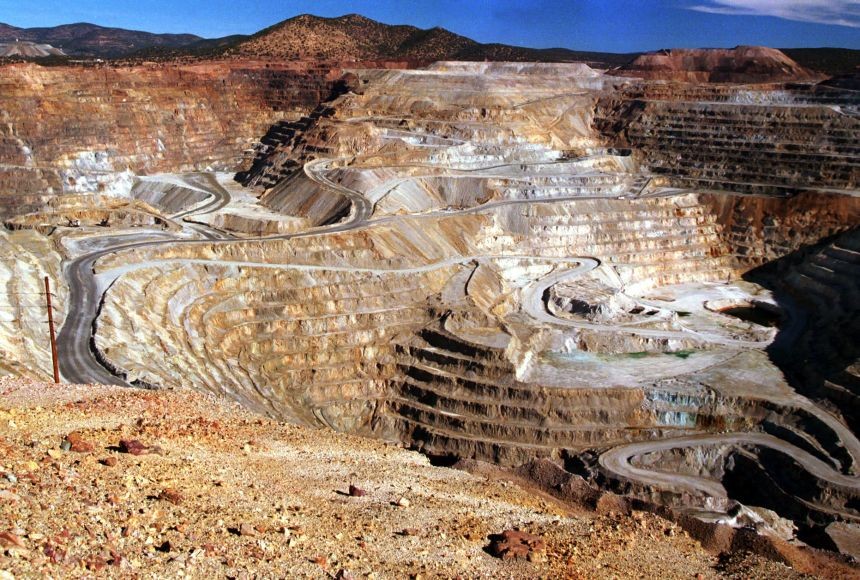
The NDS statutes currently list 64 strategic materials in four major categories: Compounds, Metals, Non-Metals, and Rare Earth Elements.  As a point of clarification, Rare Earth Elements are often mistaken for precious metals, such as gold, silver and platinum, assuming a high value metal is synonymous with the term “Rare.”  In actuality, “Rare Earth” refers to the fact that these elements are “rarely” found in nature in their pure form; they are mixed-in with other kinds of ore, making the mining and pure element extraction process difficult and expensive.  The list of materials below are managed directly by the NDS at their several depot locations.

Aluminum (Al/13) Graphite/Carbon (C/6) Quartz Crystal
Antimony (Sb/51) Hafnium (Hf/72) Rhenium (Re/75)
Arsenic (As/33) Holmium (Ho/67) Samarium (Sm/62)
Barium Sulfate (BaSO4) Indium (In/49) Scandium (Sc/21)
Beryllium (Be/4) Iridium (Ir/77) Selenium (Se/34)
Bismuth (Bi/83) Lanthanum (La/57) Silicon (Si/14)
Boron (B/5) Lead (Pb/82) Strontium (Sr/38)
Cadmium (Cd/48) Lithium (Li/3) Tantalum (Ta/73)
Calcium Fluoride (CaF2) Lutetium (Lu/71) Tellurium (Te/52)
Cerium (Ce/58) Magnesium (Mg/12) Terbium (Tb/65)
Chromium (Cr/24) Manganese (Mn/25) Thulium (Tm/69)
Cobalt (Co/27) Mercury (Hg/80) Tin (Sn/50)
Copper (Cu/29) Molybdenum (Mo/42) Titanium (Ti/22)
Dysprosium (Dy/66) Neodymium (Nd/60) Tungsten (W/74)
Erbium (Er/68) Nickel (Ni/28) Vanadium (V/23)
Europium (Eu/63) Niobium (Nb/41) Ytterbium (Yb/70)
Gadolinium (Gd/64) Palladium (Pd/46) Yttrium (Y/39)
Gallium (Ga/31) Platinum (Pt/78) Zinc (Zn/30)
Germanium (Ge/32) Praseodymium (Pr/59) Zirconium (Zr/40)

The following seven materials are managed directly by the Interior Department on behalf of the NDS.

Cesium (Cs/55)
Helium (He/2)
Natural Rubber
Potash (potassium compounds)
Rubidium (Rb/37)
Silver (Ag/47)
Uranium (U/92)

The NDS Management Process & Locations

NDS materials are stored at 6 locations throughout the U.S. and have a current market value of approximately $1.1 billion.  These material depots are located on U.S. Government property managed by the Defense Logistics Agency, and are used for many other DoD programs, including equipment repair & storage, weapons & munitions magazines, surplus equipment disposal, and others.  Although the NDS does not publicly disclose how much material they have on-hand, or what is stored in each location, there is no need to make their whereabouts classified information.  The NDS depots are already located on heavily guarded military installations, and even if a major theft were to occur, the items in storage are industrial grade materials that would be extremely difficult to sell on the black market without getting caught.  All six depots are extremely large, multi-building installations that are located well inside the country’s international boundaries.  An enemy attack by air or ground forces would be a high risk, one-way mission by those involved.  Since individual NDS materials are each stored at multiple locations, it would be nearly impossible to launch six massive raids in a coordinated, simultaneous attack.  About the only way an adversary could deliver a knockout blow to the NDS would be by nuclear weapons at all six depots at once.  It would be no easy task.

Locations

  • Hammond, IN
  • Hawthorne, NV
  • Lordstown, OH
  • Pt. Pleasant, WV
  • Scotia, NY
  • Wenden, AZ

Historical Perspective of the National Defense Stockpile

The average person, American or otherwise, has only a cursory understanding of the depths and implications of a worldwide war, such as World War I from 1914-1918, and World War II from 1939-1945.  Wars conducted since 1945 have all been regionalized, and primarily affected just the engaged belligerent nations.  In terms of economic impact, human sacrifice and other privations of war, the most seriously affected are the nations where the heaviest combat operations occurred.  For belligerents in a regional conflict who had no actual combat operations on their own soil, such as the United States during the Vietnam War, daily life at home was virtually unaffected for 95% of the population.

Global warfare, however, is much different.  It is not just a clash of opposing military forces, but, creates hardships and sacrifice in all walks of life.  As the name implies, global warfare has few geographic, economic, or human boundaries…all aspects of global life are “fair game.”

In most wars, global or regional, they begin with a clash of military forces from opposing sides.  Naval warships are attacked and possibly sunk; military aircraft bomb adversary forces and installations; adversaries shoot down each other’s planes, and adversary armies engage each other.  These force-on-force confrontations, known as tactical warfare, are what the average person thinks of in terms of what war is.

But, when wars spread into other countries, become protracted, and consume ever greater amounts of manpower and materials, tactical warfare becomes less able to bring victory to one adversary versus another.  At this point both sides continue to engage in tactical warfare to essentially keep the pressure on, but, now strategic warfare enters the picture.  The essence of strategic warfare is to disable an adversary’s means and will to wage war.  This can take many forms, including: information warfare, espionage, sabotage, clandestine intelligence operations, infrastructure destruction, and commerce or trade warfare.  The NDS’s primary role is to deter or mitigate an adversary’s efforts to disrupt commerce by denying the U.S.’s ability to obtain the raw materials necessary to wage war.

In both world wars, after the opening rounds of force-on-force combat engagements on the sea, in the air, and on the ground, the major combatants began commerce warfare.  This was most evident in the Atlantic Ocean where submarines of the German Kreigsmarine waged unrestricted warfare on all Allied merchant shipping.  Submarines of the American Navy waged unrestricted submarine warfare in the Pacific Ocean on all Japanese merchant shipping.  By the end of the war, American submarines had destroyed or sunk 75% of all Japanese merchant vessels.  This choked-off Japan’s ability to obtain oil, rubber, and many critical metals needed to produce aircraft, ships and weapons.  The NDS program is designed to counter the effects of strategic commerce warfare stemming from a major military conflict, or an embargo imposed by an unfriendly nation.  The United States uses embargoes and sanctions against certain countries quite effectively.  This is especially true when a country does not have a robust strategic national stockpile program that covers multiple categories of raw material, oil, equipment, medical supplies, etc.

Implications of Commerce Warfare, Embargoes and Sanctions in 2020

In today’s terms, the United Nations Conference on Trade and Development (UNCTAD) estimates that roughly 80 percent of all global trade – by rail, truck, ship and plane – is transported by sea. Of the total global trade volume by all means, 34% of it passes through the South China Sea by ship!

south-china-sea

Country % Share of World GDP Trade Value through South China Sea (USD billions) South China Sea Trade As % of All Trade in Goods
United States 24.5 208 5.72
China 14.8 1470 39.5

The United States and China represent the two largest shares of the world’s total Gross Domestic Product (GDP).  Of the top 10 countries with goods transiting the South China Sea, nearly 40% of Chinese goods transported by all means moves by ship through the South China Sea.  By comparison, India and Brazil at 30% & 23%, respectively, are the next highest behind China.  Of the other top 10 South China Sea users, The United States is ninth, and Canada is tenth at less than 3%.  The vast majority of ocean trade bound for the United States heads directly into the Pacific Ocean bound for Seattle/Tacoma, San Francisco Bay or Los Angeles/Long Beach.

It is quite clear that the South China Sea is a critical trade route for China.  Most traffic takes the shortest route through the Malacca Straight between Indonesia and Malaysia.  Alternative routes are not only more expensive and time consuming, but, also pose a greater security risk for China.  This is why China has spent the past 15+ years claiming islands and building military bases in the South China Sea.  These moves have been heavily disputed in international court by Vietnam, The Philippines and Taiwan.  Thus far, court cases have ruled against China, but, they refuse to recognize these decisions.  The United States’ strategic partnering with The Philippines and Vietnam has taken on greater importance in the past decade.  The U.S. Navy continues to sail its ships through the South China Sea based on freedom of navigation under international maritime law.  China heavily disputes America’s presence.  Strategic military analysts have stated for nearly 20 years that if a large scale war was to break out somewhere, it would likely be in the South China Sea.  This situation has led to China’s massive shipbuilding program, putting its Navy on a par with the U.S. Navy in terms of the number of vessels.

Analyzing the Most Critical NDS Materials

Whereas, China’s greatest strategic concern is the risk of moving materials through the South China Sea, America’s risks are more diverse.  Some of the risk stems from large coastlines on three major oceans, and many critical NDS materials are not easily sourced in the U.S.  The NDS sources a number of critical materials from countries such as China, and some of the less stable third-world countries in Asia and Africa.  Any of these states could experience a supply chain disruption due to political instability, military actions, or disagreements over trade.  In most cases the NDS has sourcing alternatives in-place for the more risky material acquisitions. The following list of materials are some of the most challenging in terms of acquiring sufficient quantities for emergency stockpile use.

  • Barium Sulfate (BaSO4)  More than 90% of this compound sold in the US is used as a weighting agent in fluids used in the drilling of oil and natural gas wells.  Substitute materials have thus far not been commercially viable. Although Barium Sulfate resources exist in the U.S., they have never been commercially developed.  The greatest risk with this material is that everything is imported from four major sources, with China being number one at 58%, and then India, 17%; Morocco, 12%; Mexico, 11%.
  • Cadmium (Cd/48)   Cadmium is generally recovered from zinc ores, and most of the world’s primary cadmium metal is produced in Asia, and leading global producers are China, the Republic of Korea, and Japan. The U.S. has negligible Cadmium resources and imports come from: China, 25%; Australia, 22%; Canada, 21%; Peru, 10%; and other, 22%.
  • Cesium (Cs/55)   The metal ignites spontaneously in the presence of air and reacts explosively in water. Because of this reactivity, cesium is classed as a hazardous material and must be stored and transported in isolation from possible reactants. The U.S. only uses a 6,000-7,000 lbs of cesium per year. There are no domestic sources of cesium, so everything is imported.  The NDS does not publish cesium import statistics, but, Canada is believed to be the primary supplier.  Cesium is an uncommon element that can be mined in only a few places in the world.  Canada accounts for more than two-thirds of world reserves.
  • Gallium (Ga/31)   Gallium is used primarily in integrated circuits (cell phones, especially smart phones, wireless internet); optoelectronic devices (laser diodes, LEDs, photo-detectors, and solar cells).  Gallium-based ICs are used in many defense-related electronics, and no effective substitutes exist for Gallium in these applications. It is not produced in the U.S., and demand is satisfied solely by imports from China, 50%; United Kingdom, 18%; Germany, 10%; Ukraine, 9%; and several lesser sources.  China’s Gallium resources, and the U.S.’s lack of resources, poses a national security risk to the United States.
  • Tungsten (W/74)  Tungsten is a heavy, hard metal that is stronger than any other known element.  It is very expensive, and due to its mechanical properties it is used in wear-resistant alloys, in nickel super-alloys for high-temperature sections of jet engines, armor penetrating projectiles, aircraft weights and counterweights, and small arms ammunition. China ranks first in the world in terms of tungsten resources and reserves and has some of the largest deposits. Canada, Kazakhstan, Russia, and the U.S. also have significant tungsten resources.  The U.S., however, has not had an operating tungsten mine since 2015.  All tungsten is imported from the following countries: China, 31%; Bolivia, 10%; Germany, 9%; Spain, 6%; and all others, 44%.
  • Arsenic (As/33)  When the average person hears the word “arsenic,” their first thought is, “oh, that’s a poison.”  It is a fact that arsenic is used in pesticides and herbicides.  In terms of being a critical NDS material, however, arsenic has a very important usage in the production of Gallium-Arsenide (GaAs) semiconductors for solar cells, space research, and telecommunications.  It is also used for specialty optical products, and in electronic components for short-wave infrared technology.  Many defense-related electronic products would be hard pressed to meet their performance specifications without GaAs components.  Arsenic is rarely found as a pure element, and is often found in copper, gold and lead deposits.  When these metals are refined into their purest form, the by-product is set aside for further extraction of any remaining elements, like arsenic, if economically feasible.  The easiest ore to recover arsenic from is arsenic trioxide, but, it has only been found in China and Morocco. Morocco does not have the ability to refine the material, so, they sell it for export.  Several other countries have arsenic refining capability.  China, on the other hand, has an extensive arsenic trioxide refining capacity, and accounts for 93% of refined arsenic sold worldwide.  This poses a national security threat to the U.S. because the other countries that can refine arsenic have only a small fraction of China’s processing capacity.  The US is 100% import reliant for its arsenic needs.
  • Germanium (Ge/32)  Germanium is mainly a byproduct of zinc ore processing. Germanium is a semiconductor, with electrical properties between those of a metal and an insulator.  Other than electronic components, germanium is used in telecommunication fiber optics, lenses for infrared (IR) devices in military applications, and solar cells.  Fiber-optic cable manufacturing accounts for about one-third of global germanium consumption.  Although China remains the leading global producer of germanium, the U.S. has substantial reserves of recoverable germanium contained in zinc deposits in Alaska and Tennessee. The U.S. imports refined germanium from the following countries: China, 59%; Belgium, 22%; Germany, 9%; Russia, 7%; and others, 3%.
  • Rare earth elements – Cerium (Ce/58), Dysprosium (Dy/66), Erbium (Er/68), Europium (Eu/63), Gadolinium (Gd/64), Holmium (Ho/67), Lanthanum (La/57), Lutetium (Lu/71), Neodymium (Nd/60), Praseodymium (Pr/59), Scandium (Sc/21), Terbium (Tb/65), Thulium (Tm/69), Ytterbium (Yb/70), and Yttrium (Y/39).  Rare earths are relatively abundant in the Earth’s crust, but minable concentrations are less common than for most other ores.  Nearly all countries have rare earth elements, but, because extraction and processing costs are high, most countries do not invest their time or money to develop the industry.  China accounts for 80% rare earth materials mined and sold worldwide.  Other producers include: Estonia, Japan, Malaysia, Brazil, Australia, and India.  The U.S. has not made much effort to mine and produce rare earth materials on its own; they are 100% reliant on imports.  The estimated distribution of rare earths by end use are as follows: catalysts, 75%; metallurgical applications and alloys, 5%; ceramics and glass, 5%; polishing, 5%; and others, 10%.

Wrapping It Up

The Congress of the United States has authorized the NDS to sell commodities that are excess to Department of Defense needs.  Sales of excess NDS materials produce revenue for the Treasury General Fund and a variety of defense programs such as the Foreign Military Sales program, military personnel benefits, and the buy-back of broadband frequencies for military use. The sales revenue also funds NDS operations to make it a self-sustaining organization.  Because of the broad portfolio of materials held by the NDS, there is no private sector company in the world that sells this wide range of commodities and materials.

Approximately 35% of the 64 types of material held by the NDS are traded on the open commodities markets.  Examples include copper traded on the London Metals Exchange, platinum traded on the New York Mercantile Exchange, and rubber on the Tokyo Commodities Exchange.  Because the NDS purchases these traded commodities in such high volume, they buy them directly from the exchanges, and not from individual private sector companies or sellers.  This means NDS staff members involved in these transactions have to hold commodities broker licenses.

Since the NDS is a U.S. Government agency, everything they buy and sell is done via announced solicitations.  This allows qualified contractors to submit sealed bids for the purchase of commodities from the NDS.  In October 2019, for example, the NDS announced that at various dates to be determined in FY2020, there may be potential sales of the following materials from NDS inventory: Beryllium, Chromium, Germanium Scrap, Manganese, Nickel Alloys, Platinum, Iridium, Tantalum Carbide Powder, Titanium Based Alloys,  Tungsten Metal Powder, and Zinc.  The October 2019 announcement also indicated the maximum amount the NDS planned to sell of each material.

The NDS also announces every October their potential fiscal year material purchases and the maximum amount they might buy.  The FY2020 potential purchases included: Antimony, Boron, Carbon Fiber, Cerium, Cadmium Zinc Tellurium (CZT), Electrolytic Manganese, Lanthanum, various explosives, Silicon Carbide Fibers, Tantalum, Tin, and Tungsten-Rhenium Alloy.

Aside from the buying, selling and storage of strategic and critical materials, NDS staff members also hold top secret security clearances for the work they do.  Part of their job is to analyze open source intelligence, as well as, clandestinely collected intelligence, so, they can stay ahead of any developing issues that could constrain American access to materials contained in the NDS.  For example, Indonesia is the largest seller of rubber to the United States.  If there was a movement afoot to nationalize the rubber industry by the Indonesian government, this could disrupt the supply chain and impact DoD requirements for rubber.  The NDS may determine the situation in Indonesia requires implementing a contingency plan to protect America’s supply chain of rubber.

Ciao,

Steve Miller, IAPWE – Certified & Member
Managing Editor
The Report on National Security Kinetics™
Seattle, WA. USA
vietvetsteve@millermgmtsys.com

Photo by Pixabay on Pexels.com
Standard
Foreign Policy Research & Analysis, Intelligence Collection, Analysis & Estimates, National Security, Terrorism Information

RNSK Vol I, Edition 5

September 3, 2020

Transnational Organized Crime: What Makes It An American National Security Interest?  

NGO: Transnational Organized Crime Groups Make US$ 2.2 trillion a Year   photo courtesy of Global Financial Integrity

Introduction

The expanding size, scope, and influence of transnational organized crime and its impact on U.S. and international security and governance represents one of the most important challenges to nearly every country. During the past 20 years, technological innovation and globalization have proven to be an overwhelming force for good. However, transnational criminal organizations have taken advantage of our increasingly interconnected world to expand their illicit enterprises.

Threat Risks From Transnational Organized Crime

• Penetration of Foreign Government Institutions, Corruption, and Threats to Their Governance. Developing countries with weak rule of law can be particularly susceptible to Transnational Organized Crime (TOC) penetration. TOC penetration of states is deepening, leading to co-option in a few cases and further weakening of governance in many others. The apparent growing nexus in some states among TOC groups and elements of government—including intelligence services—and high-level business figures represents a significant threat to economic growth and democratic institutions.

• Threats to the Economy, U.S. Competitiveness, and Strategic Markets. Transnational Organized Crime threatens U.S. economic interests and can cause significant damage to the world financial system through its subversion, exploitation, and distortion of legitimate markets and economic activity. U.S. business leaders worry that U.S. firms are being put at a competitive disadvantage by Transnational Organized Crime and corruption, particularly in emerging markets where many perceive that rule of law is less reliable. The World Bank estimates over $1 trillion is spent each year to bribe public officials, causing an array of economic distortions and damage to legitimate economic activity. The price of doing business in countries affected by Transnational Organized Crime is also rising as companies budget for additional security costs, adversely impacting foreign direct investment in many parts of the world.

• Crime-Terror-Insurgency Nexus. Terrorists and insurgents increasingly are turning to Transnational Organized Crime to generate funding and acquire logistical support to carry out their violent acts. The Department of Justice maintains a classified report known as the Consolidated Priority Organization Targets (CPOT) list. The last time CPOT was declassified via a FOIA request was 2015.  That edition of the CPOT listed a total of 63 organizations, 29 of which, are significant international drug trafficking organizations (DTOs) that threaten the United States, AND have links to terrorist groups. Involvement in the drug trade by the Taliban and the Revolutionary Armed Forces of Colombia (FARC) has been critical to the ability of these groups to fund terrorist activity. The U.S. Law Enforcement and  Intelligence Community is concerned about Hezbollah’s drug and criminal activities, as well as indications of links between al-Qaeda in the Lands of the Islamic Maghreb and the drug trade. Further, the terrorist organization al-Shabaab has engaged in criminal activities such as kidnapping for ransom and extortion, and may derive limited fees from extortion or protection of pirates to generate funding for its operations.  ISIS has also been very active in the TOC arena.

• Expansion of Drug Trafficking. Despite demonstrable counter-drug successes in the past 8-9 years, particularly against the cocaine trade, illicit drugs remain a serious threat to the health, safety, security, and financial well-being of Americans. The demand for illicit drugs, both in the United States and abroad, fuels the power, impunity, and violence of criminal organizations around the globe. Mexican DTOs have escalated their violence to consolidate their market share in the Western Hemisphere, protect their operations in Mexico, and expand their reach into the United States. In West Africa, Latin American cartels are exploiting local criminal organizations to move cocaine to Western Europe and the Middle East. Kenya, in Eastern Africa, has become a major distribution hub for heroin coming from Afghan DTOs to Europe and the United States. Many of the well-established organized criminal groups that had not been involved in drug trafficking—including those in Russia, China, Italy, and the Balkans—have now established ties to drug producers to develop their own distribution networks and markets.

• Human Smuggling/Trafficking. Human smuggling is the facilitation, transportation, attempted transportation, or illegal entry of a person or persons across an international border, in violation of one or more country’s laws, either clandestinely or through deception, whether with the use of fraudulent documents or through the evasion of legitimate border controls. It is a criminal commercial transaction between willing parties who go their separate ways once they have procured illegal entry into a country. The vast majority of people who are assisted in illegally entering the United States and other countries are smuggled, rather than trafficked. International human smuggling networks are linked to other transnational crimes including drug trafficking and the corruption of government officials.  In the past few years trafficking in children has begun to pick-up.

• Weapons Trafficking. Criminal networks and illicit arms dealers also play important roles in the black markets from which terrorists and drug traffickers procure some of their weapons. As detailed in the 2010 UN Organization on Drugs & Crime report, The Globalization of Crime (Note: this report was a massive undertaking and cannot be replicated yearly, however a new one was in preparation for 2020 before the COVID-19 Pandemic, so it is unlikely to be published this year), the value of the documented global authorized trade in small arms (i.e.; handguns, rifles, shotguns, machine guns) has been estimated at approximately $2.08 billion in 2010, with unrecorded but legal transactions making up another $120 million or so. The most commonly cited estimate for the size of the illicit market is approximately 20% of the legal market. According to the head of UNODC, these “illicit arms fuel the violence that undermines security, development and justice” worldwide. U.S. Federal law enforcement agencies have intercepted large numbers of weapons or related items being smuggled to China, Russia, Mexico, the Philippines, Somalia, Myanmar, Mali, Somalia, Turkmenistan, Syria and Yemen.  It is important to note this discussion does NOT include heavier weaponry, such as: Rocket Propelled Grenades, anti-tank rockets, heavy barrel machine guns (like the U.S. M2 .50 caliber machine gun, for example), fragmentation grenades, 40mm grenade launchers, mortars & field artillery.

• Intellectual Property Theft. TOC networks are engaged in the theft of critical U.S. intellectual property, including through intrusions into corporate and proprietary computer networks. Theft of intellectual property ranges from movies, music, and video games to imitations of popular and trusted brand names, to proprietary designs of high-tech devices and manufacturing processes. This intellectual property theft causes significant business losses, erodes U.S. competitiveness in the world marketplace, and in many cases threatens public health and safety. Between FY 2003 and FY 2010, the yearly domestic value of customs seizures at U.S. port and mail facilities related to intellectual property right (IPR) violations leaped from $94 million to $188 million. Products originating in China accounted for 66% of these IPR seizures in FY 2010.  Estimates for 2020 are in excess of $450 million, and China still leads the pack.

• Cybercrime. TOC networks are now significantly involved in cybercrime, as it has become increasingly difficult to launder money, and/or defeat institutional security systems which are controlled by networked computer systems.  Cybercrime costs consumers tens of billions of dollars annually, threatens sensitive corporate and government computer networks, and undermines worldwide confidence in the international financial system. Through cybercrime, transnational criminal organizations pose a significant threat to financial and trust systems—banking, stock markets, e-currency, and value and credit card services—on which the world economy depends. For example, some estimates indicate that online frauds perpetrated by Central European cybercrime networks have defrauded U.S. citizens or entities of more than $1 billion in a single year. According to the U.S. Secret Service, which investigates cybercrimes through its 31 Electronic Crimes Task Forces, financial crimes facilitated by anonymous online criminal elements, result in billions of dollars in losses to the Nation’s financial infrastructure. The National Cyber Investigative Joint Task Force, led by the Federal Bureau of Investigation (FBI), functions as a domestic focal point for 18 federal departments or agencies to coordinate, integrate, and share information related to cyber threat investigations, as well as make the Internet safer by pursuing terrorists, spies, and criminals who seek to exploit U.S. system.

Information Warfare. The 2016 Presidential Election demonstrated that shadowy foreign government agencies, in concert with private TOC groups, have a significant capability of committing Information Warfare by exploiting America’s open society and means of mass communication.  Common social media platforms, such as YouTube, Twitter, Instagram, TikTok, SnapChat, Facebook, Google, and others, have been infiltrated to influence public thinking.  Other aspects of criminal information warfare include developing misleading documents, such as the now debunked dossier procured by the Democratic National Committee that attempted to implicate the Trump Campaign in colluding with Russia to rig the election.  This dossier was actually used as evidence by the FBI to get a warrant to tap the phones of a Trump Campaign staffer.  We are seeing just the tip of the iceberg in TOC involvement in information warfare.  The allure of adversary governments using TOCs for these activities is simple:  TOCs are adept at working in the shadows, below the radar, because getting caught is not as big of a problem as losing tens or even hundreds of millions of dollars in the process.  TOCs could care less about their operatives going to jail; they are not happy about losing money.  Adversary governments and terrorist groups are more than willing to pay for access to a TOCs well-developed network of money launderers, cyber criminals, black bag experts, etc.  At this juncture, no one really knows how much money TOCs are pulling-in to facilitate information warfare projects.  It now appears that some of these same shadowy TOCs are acting as conduits for money, planning and organizing insurrection and subversive activities in the U.S.

Ciao,

Steve Miller, IAPWE – Certified & Member
Managing Editor
The Report on National Security Kinetics™
Seattle, WA. USA
vietvetsteve@millermgmtsys.com

Standard
u.s. constitution, U.S. Presidency

RNSK Vol I, Edition 4

The American Presidency:

Is Success Predictable?
    

President of the United States - Wikipedia

Introduction

Predicting presidential success…a conundrum for the ages.  Here we are in 2020, and about to conduct our 58th American Presidential Election.  In the 57 preceding contests, there was just one that Americans were absolutely sure of electing a successful president: The first in 1788 when George Washington became the first President of the United States.  Every subsequent presidential election was clouded with a certain amount of trepidation; this includes Washington’s second term in office.

Starting with the second presidential election in 1792, politicians, academia, pundits, political strategists, historians and the American public, have tried to figure out what it takes to predict a successful presidency.  The first problem, however, is simply the fact that what it takes to get nominated, then get elected, and finally succeeding in the Presidency, are three different things entirely.  In a very real sense, each of these three processes are largely done on a standalone basis, with different factors & people, wanted & unwanted, that shape the man and the results throughout his journey.

Some Presidents have really applied themselves at times along the way; at other times they were the unexpected beneficiary of good fortune; some were the architect of their own disaster, and  sometimes they were the unwitting recipient of poor timing or bad luck.  For some Presidents, the office became like hell-on-earth, though they themselves were not ill-intentioned.  Some Presidents acknowledged the poor choices they made, like Ulysses Grant did in his final address to Congress regarding his choice of several cabinet secretaries who turned out to be dishonest.  Other Presidents worked hard, but, died in office, and only after their death did the public learn of scandal, turning the man’s presidency into a hell-of-a-mess.  As the saying goes: “sometimes the road to hell is paved with good intentions.”

As you will see in the following discussion, predicting Presidential Success is not a tried n’ true process, or there would have been a lot more successful men in the Oval Office.  The processes of finding, developing and electing Presidents have changed quite a bit.  But, none of those things have improved the odds of Presidential success after the inauguration is over!

Factors and Traits of Presidents Prior to Taking Office

For this part of the discussion, see the Chart of the Presidents below.  Since the first Presidential Election in 1788, George Washington set the bar for positive factors and traits the public could look for in choosing, hopefully, a successful President.  But, are these things really valid in determining Presidential success?  If you think about it, a positive public image, significant public service time, and being a military veteran, are things that George Washington’s admirers seized upon in trumpeting their support of his Presidential candidacy.  In the Presidential Elections of 1788 and 1792, John Adams and Thomas Jefferson were Washington’s competitors.  Although neither man served in the military, their contributions in forming the United States of America were highly regarded, and easily eclipsed everyone else except Washington.  In either man’s case, however, they did not risk life & limb on the battlefield, nor suffer the privations of war like George Washington.  The fact did not escape anyone’s attention that the American Revolution had to be won on the battlefield against the greatest army in the world, not by diplomacy or politics.  Washington clearly had all of the boxes checked for winning two Presidential Elections.

Washington’s successful Presidency was aided by the three characteristics mentioned above, but, they were not the real story.  Additional one-time factors in Washington’s success were: he was the first President, setting the precedent for defining success, and; he was America’s symbol of a new nation that was not led by a monarchy.  Subsequent Presidents would not have the luxury of these one-time positive characteristics.

Although the public seized upon Washington’s popularity, prior public service and war hero status, they were all extrinsic factors that were no guarantee of success.  Rather, Washington’s intrinsic abilities, such as leadership, a shrewd judge of character and clear thinking under pressure, benefited him far more than what was on public display.

The Top-Rated Presidents

In the historical rating of Presidential success, Washington and nine other men have rated above average, including: Thomas Jefferson, Andrew Jackson, Abraham Lincoln, Theodore Roosevelt, Woodrow Wilson, Franklin D. Roosevelt, Harry S. Truman, Dwight D. Eisenhower, and Ronald Reagan.  Of these nine Presidents, only Andrew Jackson, Theodore Roosevelt and Ronald Reagan, had all three of Washington’s pre-election characteristics of public image, public service and military service.  Were any of these factors clearly more important to voters at election time?  In the case of Jackson and Roosevelt, they were both war heroes, and Reagan cashed-in on his movie star fame.  But, none of the three pre-election positive characteristics made them successful Presidents.  Let’s take a look at the nine Presidents who rated above average like George Washington.

  • Thomas Jefferson.  No one expected Jefferson to be any less of a success than Washington, and he did not disappoint.  Did his popularity and public office experience help his success?  Those extrinsic factors may have helped indirectly, but, Jefferson’s intrinsic traits of intelligence, leadership and innate critical thinking skills carried the day.  His greatest achievements included the massive Louisiana Purchase of land, projected American power overseas with the U.S. Navy, and recalibrated the economy by shrinking the Federal Government & National Debt.
  • Andrew Jackson.  Jackson’s war hero status made him popular with the working-class.  He was the first President not from Virginia or Massachusetts; he hailed from rural Nashville, TN.  Jackson was a controversial President, with plenty of detractors.  He did, however, provide another critical recalibration of American society & government, similar to Jefferson.  His strong moral compass guided his success by pushing to payoff the National Debt, and slow the enrichment of east coast bankers and their wealthy clientele.  Jackson’s sense of right & wrong would be sorely tested throughout his eight years in office.
  • Ronald Reagan.  Reagan’s communication skills are probably better than any other President in American history.  These skills, however, go far beyond just writing and speaking.  He understood how to develop a plot, a story, how to act your way through a scene, such that, he had no disbelievers, especially the Soviets.  Reagan sensed the timing was right to push Soviet Communism over the cliff of economic disaster.  He did this by a massive increase in defense spending that accomplished two goals: It pulled the American economy out of a deep recession, and it forced the Soviets to spend huge amounts of money they did not have on a military build up.

The other above average Presidents had varying degrees of George Washington’s pre-election characteristics, including one President with only one of the traits, and another man who had none of them!  It really demonstrates that whatever characteristics a President had or did not have prior to election, did not necessarily guarantee success.  For example, except for Abraham Lincoln’s two years of military service in the 1840s, he was not elected based on popularity, and he had limited public office experience.  Lincoln was clearly a once-in-a-millenium leader who unexpectedly rose to the occasion, surprising millions.  Woodrow Wilson never served in the military, had just two years of experience as Governor of New Jersey, and was clearly not the most popular presidential candidate.  Had Theodore Roosevelt not split the Republican vote by trying to reenter politics against the popular President William Howard Taft, Wilson would not have won the election.  In spite of having none of the pre-election appeal of Taft or Roosevelt, and a belief that his intelligence was superior to everyone, Wilson did well in handling the enactment of child labor laws, creation of the Federal Reserve System, Women’s Suffrage, and keeping America out of the First World War for the first three out of four years.

Three of the remaining four Presidents, Theodore Roosevelt, Franklin Roosevelt and Harry Truman were successful, and often at odds with their own political party.  Both Roosevelts graduated from Harvard and the Columbia Law School, but, Truman dropped out of college after one year.  Theodore Roosevelt’s greatest successes include going up against his own contemporaries, like J.P. Morgan, to enact legislation and push through the courts the break-up of some of the world’s largest business trusts and monopolies.  Roosevelt also revamped the Interior Department by creating the National Park Service and the U.S. Forest Service.  Roosevelt was the first president to push for conservation of natural resources during an era when little regard was paid to deforestation and animal extinction.  Franklin Roosevelt also eschewed his wealthy upbringing by lifting-up the country through numerous measures to vanquish the Great Depression.  He also successfully led the free world to victory in World War II.  And Harry Truman, a no nonsense, mid-westerner from Missouri, first became a local politician through a big-time Democratic Party boss in Kansas City.  It eventually led Truman to the U.S. Senate, where he proved he was his own man, not a puppet Democratic Party hack.  While President, he took ownership for some of the toughest decisions ever made in the Oval Office, such as: dropping the atomic bomb on Japan, and firing 5-star general, Douglas MacArthur, for insubordination during the Korean War.

Dwight Eisenhower is the final President with a successful rating.  Just like Donald Trump, Eisenhower had never held a political office.  His strong organizational skills as 5-star Army general carried him throughout his eight years.  Eisenhower made solid cabinet selections who were fiercely loyal to him.  His cabinet turnover in eight years is less than what Jimmy Carter and George H.W. Bush had in just four-year terms.

The Least Successful Presidents

The Presidents who consistently rate poorly are mostly justified.  They all had reasonably good credentials prior to taking office, but, none of it helped them in avoiding an unsuccessful Presidency.  Some like William Henry Harrison and Zachary Taylor, were extremely popular Army generals and war heroes, but, had the misfortune of dying after a short time in office.

President John Tyler, has been rated poorly when he really should not be.  Tyler was Vice President and took over the Presidency from Harrison after dying of pneumonia only 30 days into his term.  Tyler was the first Vice President to exercise the Constitution’s provision of Presidential Succession.  The Constitution did not specify what should happen after Tyler took office, and this created a crisis in Congress.  Tyler took the step, and thereby set the precedent, that the Constitution said he was supposed to be the President, and with no further clarification, that was that.  Congressional leaders were outraged, and excoriated Tyler at every opportunity.  In retrospect, Tyler did all of us a favor by setting the example of how a Vice President should conduct himself after replacing the person the public really wanted in the Oval Office.

The Tyler scenario would happen again when Millard Fillmore took over for the deceased Zachary Taylor.  Fillmore also collared a poor rating.  Franklin Pierce and James Buchanan received poor ratings for doing nothing to prevent the Civil War.  And Lincoln’s replacement, Andrew Johnson, is always rated poorly for his mishandling of Reconstruction following the Civil War.

Warren G. Harding was elected in 1920 and was wildly popular, but, died two and a half years after taking office.  Up to that point he had performed well.  After Harding died, however, and thus unable to deal with any future problems, it came to light that several of his Cabinet members had defrauded the Government while in office.  It also came out that Harding had fathered two illegitimate children, and the mothers were being paid ongoing hush money by political operatives to remain quiet.  There is no evidence that Harding knew about his dishonest cabinet secretaries, or that the two women he had affairs with were being paid-off.  In either case, Harding’s Presidency was tainted and rated poorly ever since.

The last President with a poor rating is Donald Trump.  Trump shares the dubious distinction with Woodrow Wilson of having none of George Washington’s pre-election favorable characteristics.  Wilson made those characteristics a non-factor in his Presidency, even when his lack of likability persisted throughout his time in office, and has never really changed.  It is difficult to say whether Trump’s Presidential legacy will be judged unsuccessful or not…time will tell.

Does the Perspective of Time Change Things?

Of all the men who have been President of the United States, only five have seen any change in their success rating.  Three have improved, and two have worsened.  Just like having some, or all three of Washington’s pre-election favorable characteristics were not very helpful in predicting Presidential success, neither has the passage of time, nor a better informed populace, changed a President’s success rating from when they first left office.

The three Presidents who have seen some minor improvement from poor to below average are: Zachary Taylor, Ulysses S. Grant, and George W. Bush.  Taylor’s slight improvement is due to historians looking at his 18 months of service and concluding he actually accomplished some good, and should not be collared with a poor rating just because he had the misfortune of dying in office.  In Grant’s case, he had a poor rating for more than 120 years.  He has inched-up in the past 30 years after historians decided that his numerous dishonest cabinet appointees that pulled him down, should not completely outweigh Grant’s success in resolving the headaches of Reconstruction.

When George Bush left office, he had a low approval rating and graded-out poorly in terms of success, largely due to the ongoing wars in Iraq and Afghanistan.  President Obama took office on a campaign promise to finish the job in both countries and bring the troops home.  Neither war zone was mopped-up as planned, even after Obama sent in more troops.  When Obama’s team ran into problems with the Iraqi government in negotiating a new SOFA (status of forces agreement), the President ordered American forces to pack-up and leave.  As a result of America’s departure, ISIS filled the void, and it took three years and the virtual destruction of Iraq’s second largest city, Mosul, to eradicate the insurgency.  In terms of President Obama’s success rating, it would be difficult to rate his Presidency as level two average, but, leave Bush at level four poor, for the Iraqi and Afghan quagmires, when his successor did no better.  So, it only seems fair that Bush has moved upward from poor to below average.

The two Presidents who’s ratings dropped were two term President Grover Cleveland, and Herbert Hoover.  Cleveland served during the 1880-1890 timeframe.  For more than 100 years, Cleveland’s success rating had been level two average.  Over the past 20 years, however, Cleveland’s rating has slipped to below average.  Similarly, Herbert Hoover, who served from 1929 to 1933, had his success rating drop from below average to poor.  Why would these two Presidents see their ratings drop?  In simple terms, they presided over an economic collapse.  I will further explain below.

Well respected historians have an unwritten professional code:  You research history, analyze history, and write about history, but, you do not make history.  Historians enjoy finding new pieces of information about a previously well covered topic.  They are careful, however, in putting the new information in the proper context of preexisting information.  It is one thing to enhance or flesh-out an existing story, but, historians are loathe to be revisionists for the sake of stirring-up controversy, or self-aggrandizement.  This is why 39 out of 44 American Presidents have largely retained their success rating from the time they left office, until present day.

Understanding historical context is critical to evaluating events from a bygone era.  Presidential success ratings were assigned within the context of what historians and the public living in that era witnessed themselves.  We have the benefit of hindsight; they did not.  Here are a few examples to illustrate the point.  It was known then, and it is well documented now, that George Washington and Thomas Jefferson owned slaves.  In modern times someone might conclude that Washington and Jefferson were racists.  But, within the context of the times and locale they lived in, was that a universally accepted definition?  No, it was not.  It stands to reason that neither President’s success rating should be lowered based on a modern day definition.

We can also look at the opposite circumstance where a modern day definition of a successful Presidency could elevate a rating.  Take James K. Polk, for example, who served one term in the 1840s.  Polk had previously served as the Speaker of the House of Representatives, but, in the 1844 election, he was completely out of politics.  Polk was nominated at the Democratic Convention as a compromise candidate after several dozen rounds of voting failed to select a candidate.  Polk’s nomination & candidacy is what spawned the now famous phrase of being a “dark horse candidate.  When Polk accepted the nomination, he promised to only serve one term, and he did just that.  Polk, however, accomplished something that no other President before or since has ever done: He successfully completed all four of his four major campaign promises.  By modern day standards, that is considered nothing short of a miracle.  But, by 1840’s standards, Polk was merely seen as having done the job he was elected to do.  Polk’s level two average rating has never been elevated to the top level.

The foregoing examples demonstrate the reluctance of modern day historians and political scientists to alter a past President’s original success rating, with only a few exceptions.  Circling back to Grover Cleveland and Herbert Hoover, what caused a shift in their ratings?  In Cleveland’s case he is the only President to serve two non-consecutive terms.  He served from 1885-1889, and 1893-1897, with President Benjamin Harrison sandwiched in between.  By time the 1892 election came around, the economic and financial changes occurring during Harrison’s tenure were perceived as needing a President “who knew what he was doing.”  This led to Cleveland’s reelection.  However, politicians at the time, and well into the 1930s, knew little about economics, big business and the financial markets.  There was still a strong belief that financial problems were cyclical and had a way of working themselves out.  When the Panic of 1893 hit, Cleveland failed to take the right actions to fix things, and the economic plunge persisted for his entire second term.  Likewise, Herbert Hoover was at the helm when the stock market crashed in 1929, leading to the Great Depression.  Hoover was not aggressive enough in taking government action, thinking like Cleveland that the economy and financial markets would self-correct; they did not.

Cleveland and Hoover did not take all of the blame for the two economic disasters.  Cleveland, for more than 100 years, was rated level two average, and Hoover was rated level three below average.  Two subsequent financial meltdowns seem to have changed historical sentiment for both men.  Jimmy Carter supervised a huge recession with double digit inflation, and double digit unemployment, from 1977-1981, and made no headway is resolving the crisis.  In 2008, President Bush was in the Oval Office when the mortgage banking industry collapsed.  After witnessing the events of 1977-1981, and the 2008 collapse, historians, politicians and the public decided that President’s actually had the power and responsibility to either reduce the likelihood of a financial collapse, or step-in to lead a recovery.  So, while revisionists were addressing Carter’s failure, and ensuring Bush took the appropriate blame, eyes were cast back to Cleveland and Hoover’s economic supervision during their tenure.  Revisionists have decided that both Presidents were really “asleep at the switch,” and could have done far more to cushion the collapse.  Cleveland’s Presidential success has been lowered to level three below average, and Hoover’s has dropped to level four poor.

Summary

A President’s pre-election traits and skills are rarely a good barometer of Presidential Success.  Success is normally attributable to a President’s intrinsic capabilities, and how he applies, or fails to apply them.  Success ratings pinned on a President as he leaves office, normally remain unchanged regardless the passage of time, even when things are better understood later on.  If a success rating is changed, the evidence to do so must be clear, and universally convincing.  One thing that does change after a President leaves office is: For better or worse, a departing President is no longer the same man he was when he first entered the White House; things will never be the same for him.  As the 1940s author, Thomas Wolfe said: “you can never go home again.”

Ciao,

Steve Miller
Editor
The Report on National Security Kinetics™
Seattle, WA. USA
vietvetsteve@millermgmtsys.comPresidents

Standard
National Security, Terrorism Information, The Judiciary, u.s. constitution, U.S. Presidency

RNSK Vol I, Edition 3

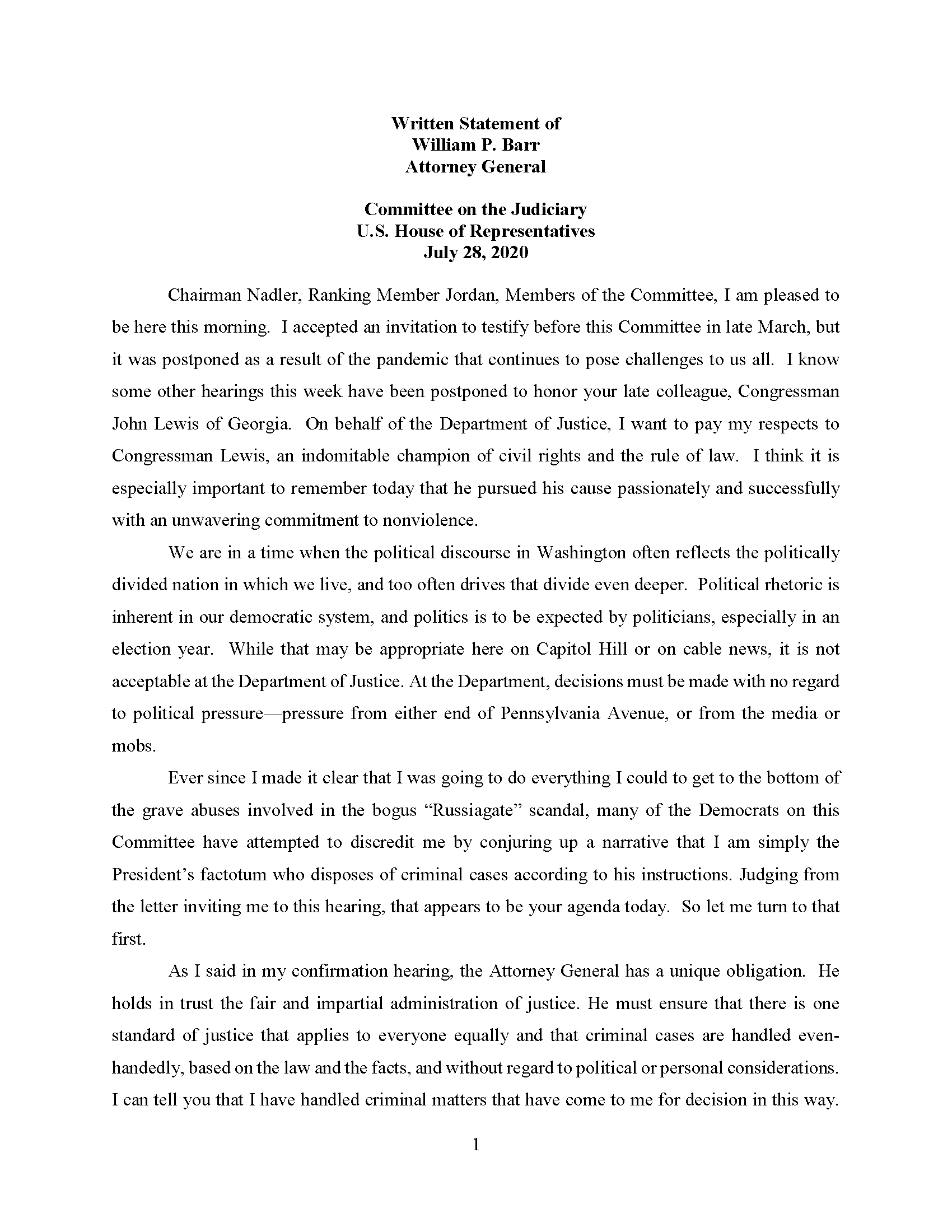
Written Statement of
William P. Barr
Attorney General

Committee on the Judiciary
U.S. House of Representatives
July 28, 2020


https://upload.wikimedia.org/wikipedia/commons/4/45/William_Barr.jpg


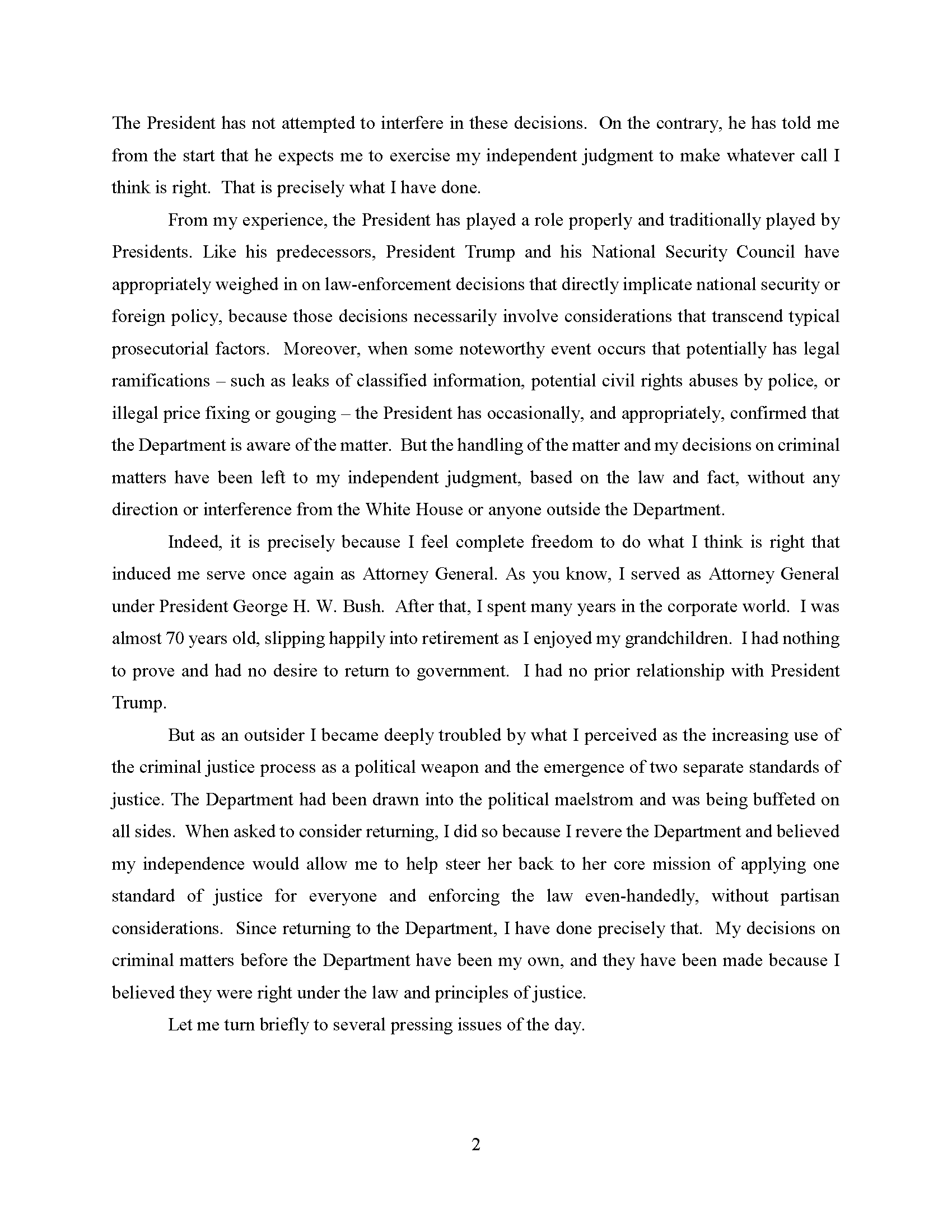
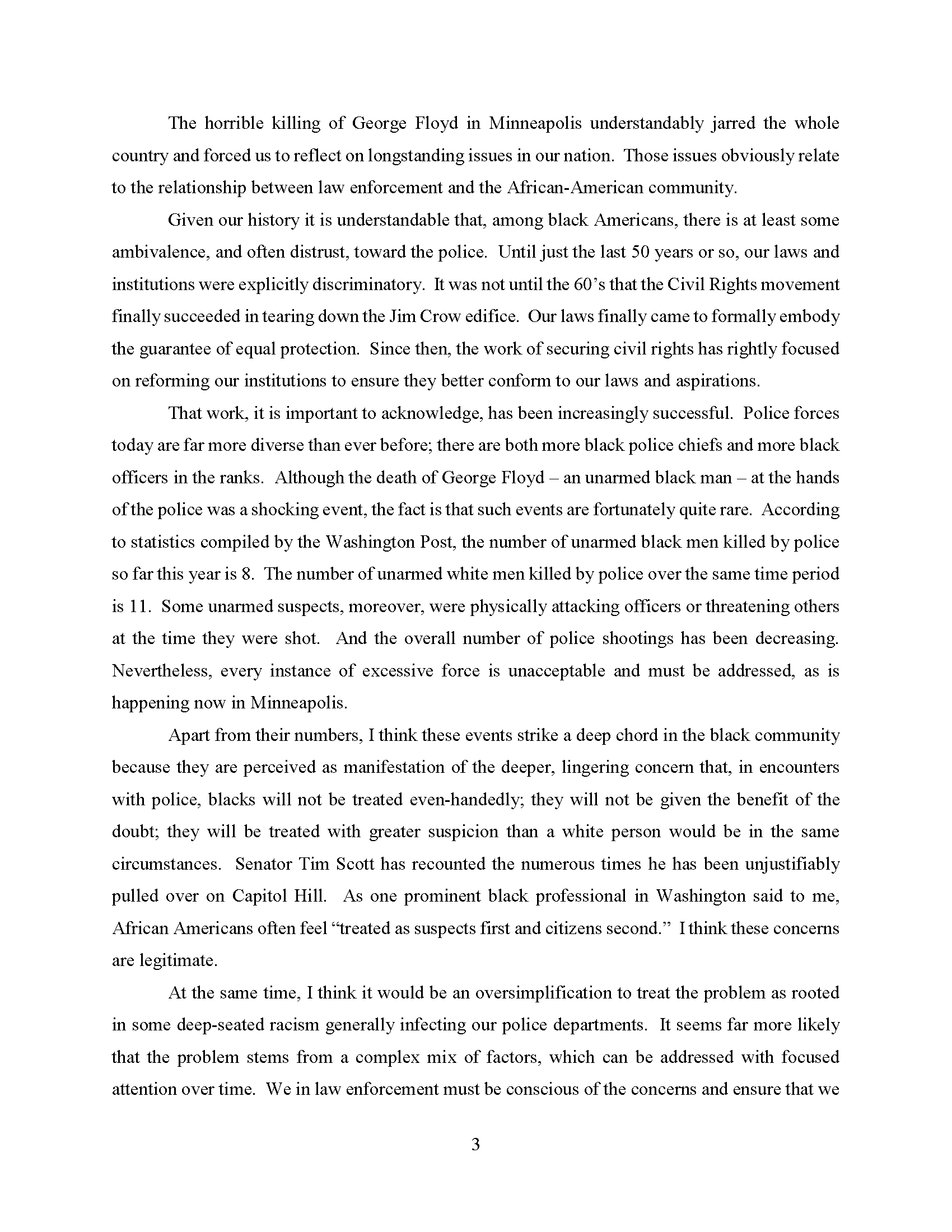
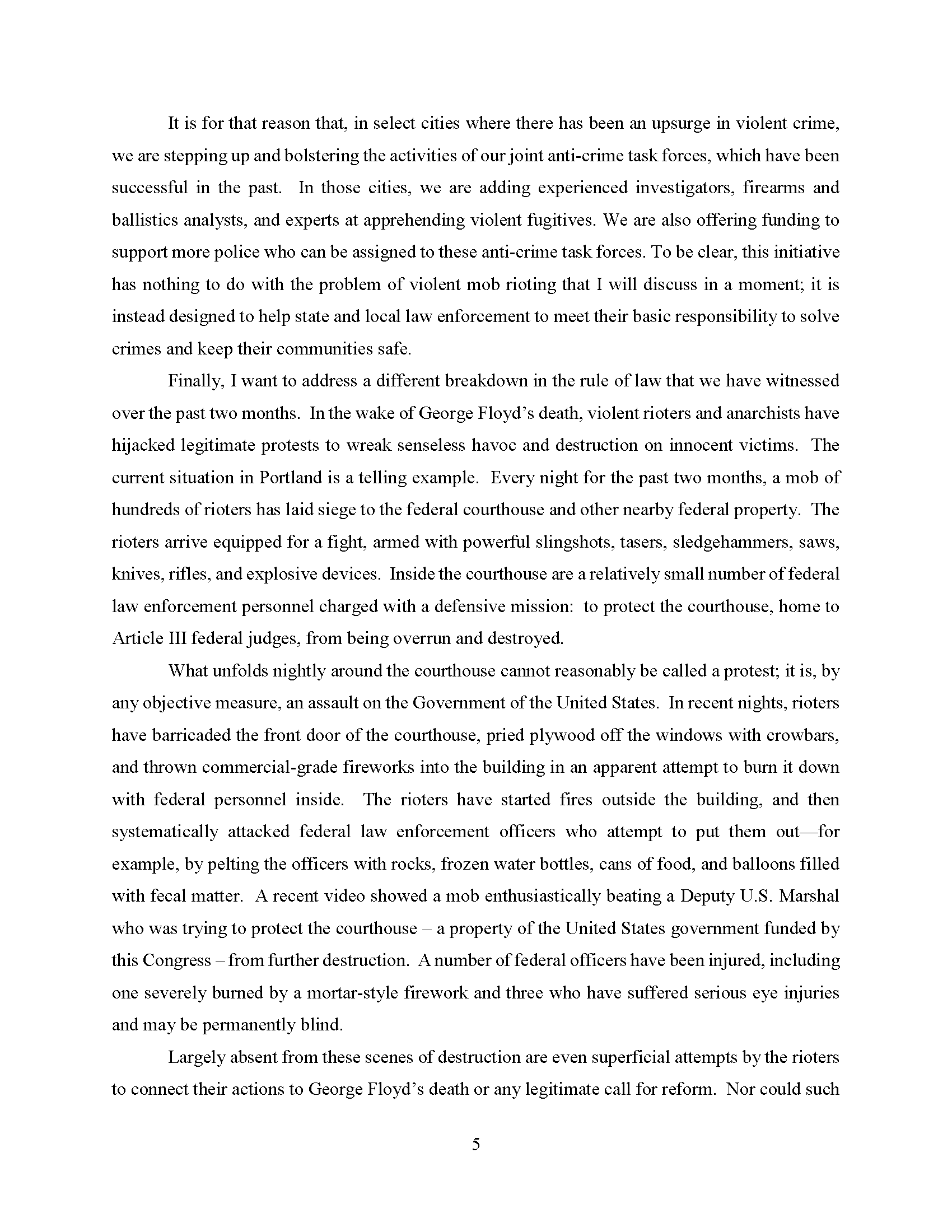
On July 28, 2020, United States Attorney General, William Barr, will testify in front of the Judiciary Committee of the U.S. House of Representatives.  I want to call your attention to Attorney General Barr’s prepared statement released today, July 27th, and will be read into the Judiciary Committee’s proceedings by Barr.  The unabridged content of AG Barr’s statement is shown below.

My purpose in bringing this statement to your attention is simply due to the near identical wording in his statement about the current spate of domestic violence issues, and the outcome of that violence, in comparison to my words cited in last weeks RNSK Volume I, Edition 2.  It is important to me that my readers recognize that what I write is factual, and correctly analyzed.  It is not a fanciful opinion of little value to the discerning public.

Here are some excerpts from Barr’s Statement:

“I want to address a different breakdown in the rule of law that we have witnessed over the past two months. In the wake of George Floyd’s death, violent rioters and anarchists have hijacked legitimate protests to wreak senseless havoc and destruction on innocent victims. The current situation in Portland is a telling example. Every night for the past two months, a mob of hundreds of rioters has laid siege to the federal courthouse and other nearby federal property.

What unfolds nightly around the courthouse cannot reasonably be called a protest; it is, by any objective measure, an assault on the Government of the United States.

Largely absent from these scenes of destruction are even superficial attempts by the rioters to connect their actions to George Floyd’s death or any legitimate call for reform.

Nor could such brazen acts of lawlessness plausibly be justified by a concern that police officers in Minnesota or elsewhere defied the law.

Remarkably, the response from many in the media and local elected offices to this organized assault has been to blame the federal government. To state what should be obvious, peaceful protesters do not throw explosives into federal courthouses, tear down plywood with crowbars, or launch fecal matter at federal officers. Such acts are in fact federal crimes under statutes enacted by this Congress.”

I invite you to read the rest of AG Barr’s prepared statement, and watch his Congressional testimony on July 28th at 10am EDT.  Most major television news outlets will carry the proceedings live.

Ciao,

Steve Miller
Editor
The Report on National Security Kinetics™
Seattle, WA. USA
vietvetsteve@millermgmtsys.com

470621233-Written-Statement-of-AG-Barr-HJC-07-28-20_Page_1470621233-Written-Statement-of-AG-Barr-HJC-07-28-20_Page_2470621233-Written-Statement-of-AG-Barr-HJC-07-28-20_Page_3470621233-Written-Statement-of-AG-Barr-HJC-07-28-20_Page_4470621233-Written-Statement-of-AG-Barr-HJC-07-28-20_Page_5470621233-Written-Statement-of-AG-Barr-HJC-07-28-20_Page_6


Standard