Foreign Policy Research & Analysis, Intelligence Collection, Analysis & Estimates, Israel, Middleeast, Military Operations, History & Cyber Warfare, National Security, The Islamic Republic of Iran

Is the Islamic Regime’s Refusal to Capitulate Unreasonable?

Introduction 

The catchphrase, “beauty is in the eyes of the beholder,” sets the tone for examining the term, “unreasonable.” What seems as unreasonable to one person (organization), may appear reasonable to someone else, and vice versa. 

As of March 11, 2026, the U.S. Navy and Air Force, along with the Israeli Air Force, have flown more than 6,000 strike sorties against 16,000 targets inside Iran’s Islamic Republic, as well as, key maritime targets. With Iran being on the receiving end of Operation EPIC FURY’s bombing campaign, the Islamic Regime’s refusal to capitulate seems unreasonable to the global community. 

As duplicitous as the Islamic Regime is known to be, it’s refusal to surrender should not be seen as a patriotic or religious act; it’s merely buying time to concoct a plan of further retaliation. The Islamic Regime cares nothing about being reasonable or unreasonable; neither state enters into their calculus. 

America has seen this sort of rigid defiance before by the Japanese and Germans in World War II, and by the Vietnamese Communists in Hanoi during the Vietnam War. All three of these foes were seen by Washington, D.C. leadership as being unreasonable. How America and her allies responded in the face of seemingly unreasonable behavior, varied for each of the three countries. In Germany, as long as Adolf Hitler was in-charge, unconditional surrender was off the table. Even after removal of Japan’s military government leaders, they were still hesitant to surrender unconditionally. The hardliner Hanoi Communists refused to accept any sort of capitulation, and were unreasonable during the Paris Peace Conference. They were forced back to the bargaining table as a result of America’s Christmas Bombing Offensive known as Operation LINEBACKER II. But, Hanoi never surrendered anything. 

The Utility of Declaring an Entity Reasonable or Unreasonable

Unless both parties in a dispute have the same or similar value system, determining reasonability is a zero sum game. As long as Party A chooses to label Party B as unreasonable, Party A has three choices: keep doing the same thing, hoping Party B will someday become reasonable, or change tactics to something that resolves the impasse, or reassess whether the situation is even worth pursuing, and walk away if it’s not. A real-life, high stakes unreasonableness situation is worth discussing here as an example.

In my book, The 99th Strategic Reconnaissance Squadron: The Air Force’s Story of Unmanned Reconnaissance in the Vietnam War,” I covered a situation involving reasonableness vs. unreasonableness in the run-up to the Vietnam War. 

In 1961, President John F. Kennedy issued National Security Action Memorandum (NSAM) 55, which directed the Joint Chiefs of Staff to conduct their duties as “more than military men,” by taking-in the geopolitical realities underlying national security issues.  NSAM 55 remained actionable throughout the Vietnam War, and was applicable if the three Vietnam Era Presidents (Johnson, Nixon, Ford), wanted to use it. As it turned out, each President did as he pleased, and NSAM 55 remained on the shelf, unused. Although NSAM 55 implied a standard of reasonableness, each President judged it by his own barometer. 

Maxwell Taylor, Chairman of the Joint Chiefs of Staff from 1960-1964, was the first senior military officer to put NSAM 55 to the test. He demonstrated good political chops, and easily navigated the halls of power in Washington, D.C., and the Pentagon. Simply put, Taylor fit well with NSAM 55.  

On the Eve of the Vietnam War 

In early 1964, the National Command Authority (President Johnson, Defense Secretary Robert McNamara, and General Taylor ) were receiving a steady stream of reports from Henry Cabot Lodge, U.S. Ambassador in Saigon, and his military counterpart in-charge of America’s local military assistance command, that the Saigon government and its military forces were struggling under a multitude of self-inflicted problems. 

Throughout 1964, U.S. military presence in and around South Vietnam numbered about 25,000 personnel representing the Navy, Army and Air Force. The vast majority of these G.I.s were special operation forces working as advisors to the South Vietnamese military. They were not conducting independent combat operations, but they accompanied their Vietnamese counterparts on offensive missions. 

The American military leaders in-country and the Embassy diplomats, all sensed it was only a matter of time before the North Vietnamese and the South’s Viet Cong significantly upped their game. 

In response to multiple intelligence reports coming into the National Command Authority from both the State Department and the Pentagon, a new NSAM was issued. This new memorandum directed the Admiral over the Pacific Command to develop a comprehensive list of strike targets in North Vietnam. 

There were no hard plans to conduct airstrikes in North Vietnam. The target list was developed for a rainy day. The Joint Chiefs of Staff were directed to evaluate the list, and develop a plan to implement an airstrike campaign, if needed. 

When the Joint Staff released the airstrike plan, it fell to the JCS Chairman, Maxwell Taylor, to prepare an executive briefing for the National Command Authority and other key players. The original recommendation was to exhaust every target on the strike list without letting up. To Taylor’s mind, war requires pressing the advantage until the foe either surrenders, or becomes combat ineffective. 

Taylor Applies the Tenets of NSAM 55

It was Taylor’s desire to comply with NSAM 55 which led him to soften the tone of his May 1964 JCS recommendation.  The JCS’ original wording stated the bombing campaign represented by the 94-Targets List was designed to eliminate (through destruction by bombing) North Vietnam’s physical ability to support the Viet Cong and Pathet Lao in waging an insurgency.

The plan of action was revised to specify one unannounced, surprise attack with a huge ordnance load covering major targets across the country.

Taylor’s rewording sought to look at things from a political standpoint based on the reactions of a “reasonable” man to a major, multi-pronged air attack on his homeland for supporting the destabilizing, political goals, and insurrection of groups in adjacent sovereign countries.  The Johnson Administration bought-in to the “reasonable man” theory. 

To a certain extent, President Johnson’s own political style of arm-twisting and backing the other guy into a corner, played a role in the Vietnam War policies adopted by the White House.  Throughout Johnson’s tenure on Capitol Hill as a Congressman and Senator , he counted on his opponent’s reasonableness when confronted with the opportunity to either acquire something they wanted, or avoid something they did not want.  

Western politicians believe that every reasonable man has his price.  Johnson, and his colleagues, failed to understand that as far as North Vietnam was concerned, the struggle by the Viet Cong, and Pathet Lao (and the Khmer Rouge later on), put them all in the same boat.  These communist-aligned insurgencies, as well as North Vietnam, all viewed the Saigon-based democratic government as being “on-the-wrong-side.”

I have always felt that as long as someone is not a psychopath or sociopath, and has a reasonable level of maturity, it puts them in the largest segment of the global population, or what I call the reasonable and rational majority.  Being in the majority has nothing to do with right or wrong, moral or immoral, nor does it mean a group member is always reasonable & rational; we all have our days.  

The majority of the population covers a broad spectrum of society, to include prominent people in the 1960s, such as: Dwight Eisenhower, John F. Kennedy, Ho Chi Minh, Nikita Khrushchev, and Fidel Castro.  Each of these well-known leaders had many followers, and many detractors.  Clearly, what one of these men felt was rational behavior on a given day, might be viewed by one of the others as irrational, or unreasonable.

 Robert McNamara and “The Fog of War”

An award-winning 2003 documentary entitled, “The Fog of War,” illustrates a real-life case of political reasonability experienced by Robert McNamara, the Defense Secretary during the Vietnam War. The Fog of War convincingly presents 11 truths he coined about national security, foreign policy & war.  

Truth #2 states: “you cannot count on rationality (reasonableness) to save the day.” This is 100% applicable to the frustration with both Hanoi’s and Tehran’s “never say die” behavior in the face of mounting military pressure.  To American leadership, both regimes were clearly being irrational & unreasonable.  McNamara arrived at his opinion about rationality and reasonableness based on his experience with the 1962 Cuban Missile Crisis; an encounter 30 years later would completely overturn his view. 

After resolving the impasse with Moscow about the missiles in Cuba, and tension abated, McNamara and other Kennedy Administration officials thought rational and reasonable behavior had won the day.  In 1993 McNamara attended a global symposium where he ran into Fidel Castro.  Civility & restraint were maintained by both men as they chatted for a few minutes.  

McNamara commented to El Presidente that a near catastrophe was averted in 1962 when cooler heads prevailed.  Castro said nuclear annihilation came a lot closer than anyone knew, including McNamara and his cohorts.  McNamara’s interest was piqued , and he inquired as to Castro’s meaning.  Castro told him that contrary to popular belief, when Washington thought they had nipped things in the bud, there were actually 126 nuclear warheads already on the island!  Until that moment in 1993, McNamara & the U.S. Government thought the warheads were still on a ship at sea, and had been turned back as a result of the U.S. Navy’s blockade of Cuba.

McNamara was stunned!  He quickly told Castro he had three questions: 1.) Did Castro know the warheads were there the whole time?  2.) What was Castro’s greatest concern throughout the Crisis?  3.) After the Crisis became public knowledge, and negotiations commenced between the White House and the Kremlin, what was Castro’s advice to Khrushchev?  

Castro admitted he knew all along the warheads were on the island.  His greatest fear was an all-out conventional air, land and sea attack on Cuba by the United States.  If this had occurred, his recommendation to Premier Khrushchev was to launch a nuclear attack on America from Cuba.

Castro’s revelation changed McNamara’s mind about a man’s reasonable behavior in the face of adversity.  Whereas, Hanoi’s unreasonable behavior was seen by McNamara and others as a one-off anomaly, it was instead, a validation that rational or reasonable behavior is not universally defined.  

Johnson, McNamara and General Taylor’s failure to comprehend Hanoi’s brand of reasonableness, led to 58,000 American deaths, and more than a million Vietnamese casualties. The Johnson Administration’s misreading of the conflict’s geopolitics led to the U.S.’ accelerated departure, leaving numerous unresolved issues at War’s end.  

Not understanding North Vietnam’s indifference led to the ineffective ROLLING THUNDER bombing campaign, starting in March 1965, and ran for three years. To the Washington establishment, Hanoi’s seeming unreasonable behavior was just one of the manifestations that defied western logic.

The Islamic Republic’s Disinterest in an Unconditional Surrender 

The “talking heads” on network news are speaking-out of both sides of their mouths regarding Operation EPIC FURY. On the one hand, Trump started a war when there is supposedly no imminent threat from Iran, which is a ridiculous assertion. On the other hand, the same group of reporters are incredulous that under a massive onslaught of destruction, why does the Islamic Regime allow it to continue and not sue for peace?

There is a simple answer to Iran’s seeming unreasonable indifference to the destruction. Above any other reason for the despotic regime’s behavior, is the survival of the Islamic hardliners controlling the country. 

Most people fail to recognize that the Islamic Regime has been planning and preparing for this day for 47 years. The organization pulling the strings of power is not part of the public-facing official government. It’s a shadow government that was created to rigidly control the country at every level of government, and all major civil and commercial institutions, and the largest industry segments, such as, banking, manufacturing, agriculture, transportation, the education sector and the oil industry, to name a few. This ruling, shadow institution is known as The Bayt (pronounced like “bait” used for fishing). The Bayt is designed to survive. 

The United Against a Nuclear Iran (UANI) organization 

The UANI published a landmark report in February 2026 entitled, “Unmasking the Bayt: Inside the Supreme Leader’s Office, the Hidden Nerve Center of the Islamic Republic.” The report was written by two Iranian-Americans PhDs,, Saeid Golkar, and Kasra Aarabi, the founders of UANI.

Golkar and Aarabi said in their Report about the Bayt, “What has become the most powerful political entity in the Islamic Republic has its roots in Shia Islam’s convention surrounding the Bayt-e Ulema (House of Religious Scholars).” The Bayt is an important part of Shia Islamic doctrine that is centuries old. 

In simple terms, senior Shia clerics who have been elevated to ayatollah status (does not necessarily mean they are a supreme leader), and have developed a publicly visible following, are bestowed with the title of “Marja-e-Taqhlid;” this stands for “source of emulation.” Once a cleric becomes a Marja-e-Taqhlid, they are entitled to establish a Bayt. At this point, the Bayt is the nucleus of the cleric’s paid office staff. Bayts commonly employ male members of a cleric’s family. Prior to Iran’s 1979 Revolution, a Bayt office was strictly for religious purposes. 

Evolution of the Islamic Republic’s Bayt

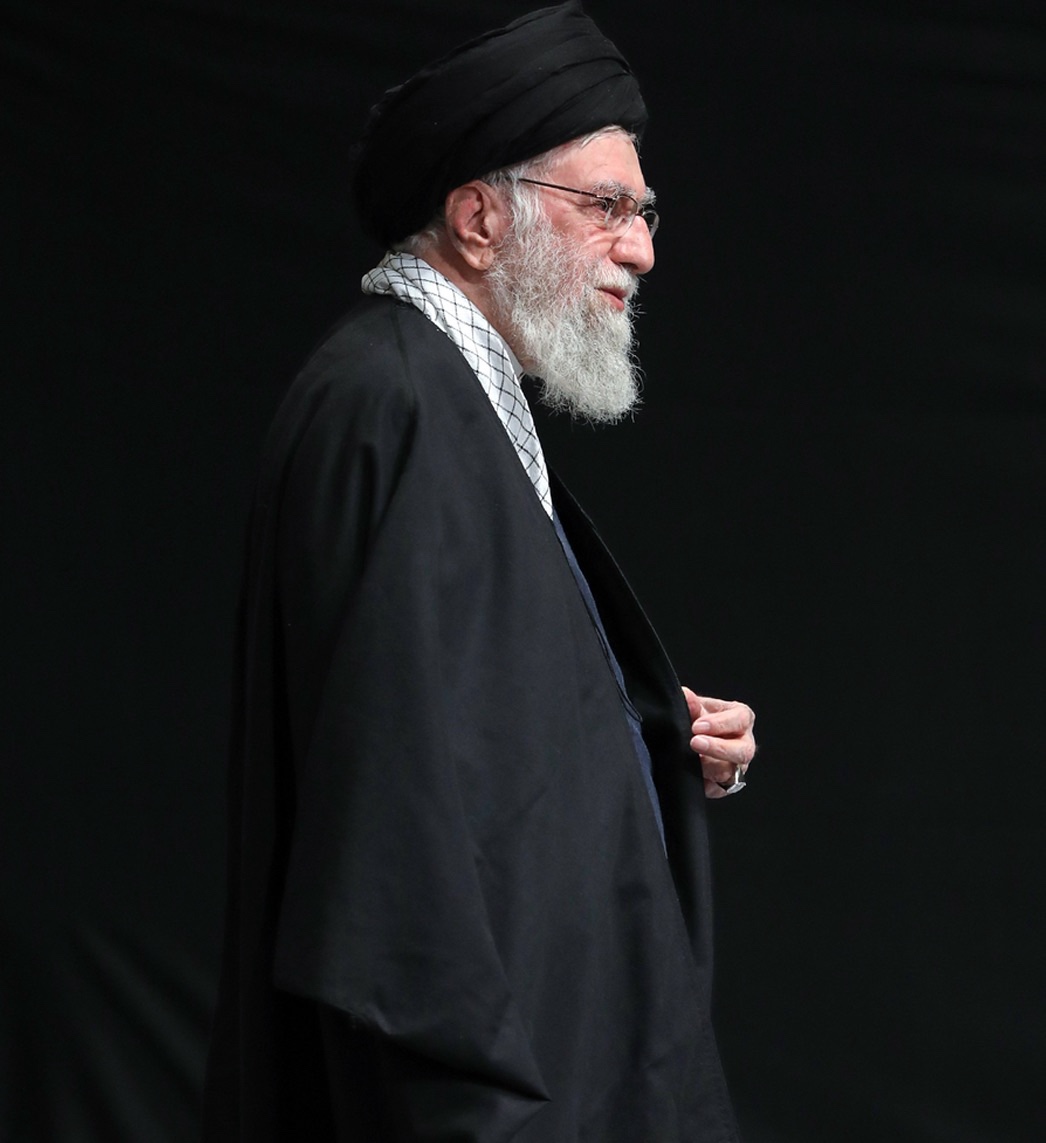
In 1979, upon the arrival of the exiled Ayatollah Ruhollah Khomeini in Iran, he was designated as the first supreme leader (until March 8, 2026, there had only been two). Khomeini’s Bayt was with him throughout his exile in France. Due to Khomeini’s unconventional status in exile, his Bayt necessarily assumed quite a few secular duties (i.e.; security, travel & transportation, event planning, etc.), as well as a Bayt’s more traditional religious duties. 

When Ayatollah Ruhollah Khomeini died 10 years later in 1989, it was assumed that his son would become the next supreme leader; it never happened. His son, Ahmad, was outmaneuvered by a conspiracy of Hashemi Rafsanjani and the now deceased Ayatollah Ali Khamenei. Khamenei became the supreme leader and Rafsanjani became President. It was Khamenei, with Rafsanjani’s support, who began transforming the Bayt he inherited into a formidable base of political control. The Bayt eventually numbered more than 4,000 staffers and a network of over 40,000 independent operatives.

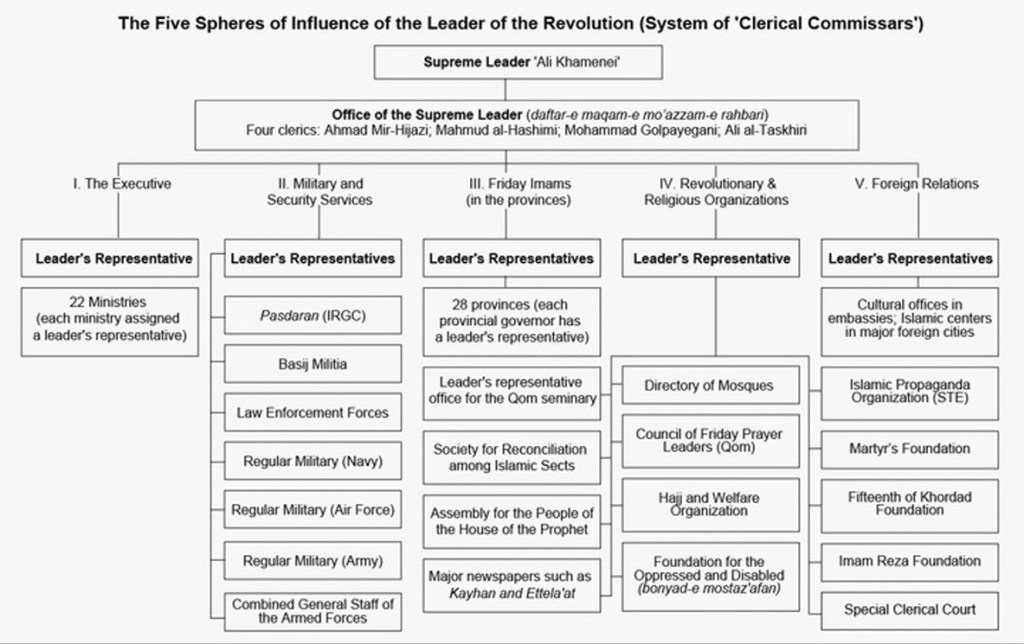
Shown below is how Khamenei’s Bayt was organized prior to his death a few weeks ago. All functions shown in boldface type are direct members of the Bayt. Although it’s not shown here, each non-Bayt institution has at least one commissar overseer who belongs to the Bayt.
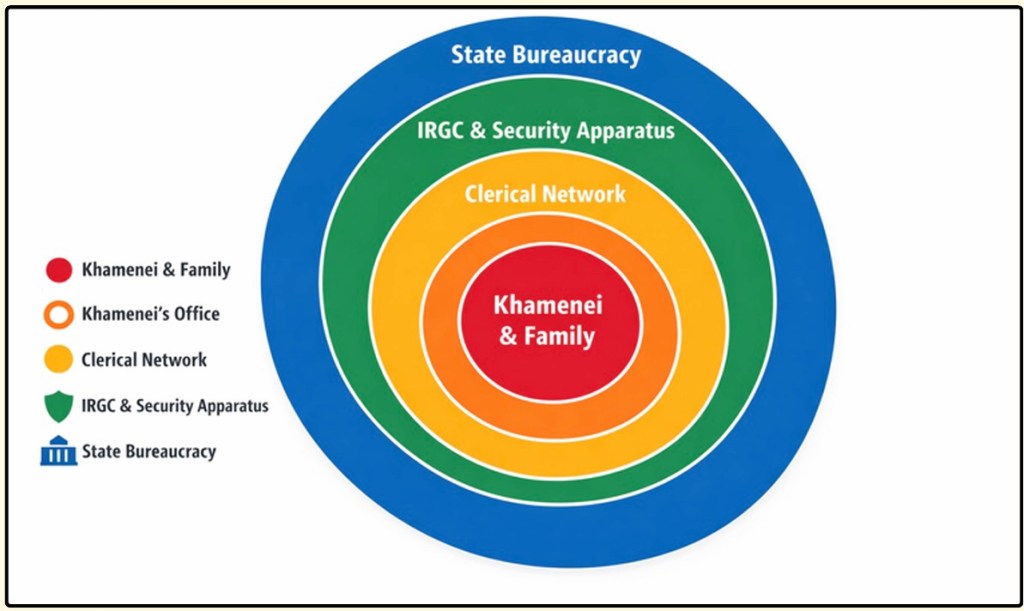
The accompanying graphic depicts how the supreme leader and the Bayt are organized in relation to each other. Other than the outer ring labeled “State Bureaucracy,” which are the public-facing official government agencies, everything else is part of the Bayt, which has no official designation. Since the IRGC functions as an elite military institution, and its headcount fluctuates from new recruits and departing guardsmen, only the officer corps is considered to be members of Bayt.
Khamenei and his hardline Bayt shadow government knew that over the ensuing decades, their infamous agenda would be on every western nation’s radar, especially the United States and Israel. Khamenei’s regime expected Iran would be attacked eventually, and it has. 

Expecting an attack in the future, Khamenei’s Bayt began creating a religious, political and paramilitary (IRGC) infrastructure that could withstand a sustained, massive attack. A western military offensive, like Operation Epic Fury, might wipe out the visible signs of public and military infrastructure, but the shadowy Bayt would still be fully functional. 

This “next-up-to-bat” dogma can readily be seen after Ali Khamenei’s death on the first day of bombing, including dozens and dozens of other regime officials. Only a week later, the remaining senior Bayt leaders met to vote-in the next supreme leader. The Israeli Mossad’s covert operatives identified the location of the selection conference; it was subsequently bombed, killing all of the attendees. Undaunted by the loss of so many senior leaders for the second time in a week, the remaining Bayt officials met, yet again, in an undisclosed location and chose Khamenei’s son, Mojtaba, as the new supreme leader. 

Subsequent to Mojtaba’s ascension, he has not been seen in public. Regime experts have opined about his absence, citing three plausible reasons: 1.) Out of an abundance of caution, his security detail has counseled him to remain in hiding for a while, or 2.) The known injuries he sustained during the attack on his father are serious enough that he is still recovering under a doctor’s care, and; 3.) Announcing Mojtaba’s promotion is a ruse to deflect from the fact that he’s actually dead. This dogged determination by the Bayt to soldier-on as the country crumbles around them, is a good example of unreasonable behavior from a western viewpoint. 

Applying the reasonable man theory in the face of relentless bombing, the death of more than 100 senior Bayt and government leaders, and the potential unfolding humanitarian disaster of the civilian populace, the remaining group of Bayt leaders should cease hostilities and sue for peace. But, that would be the actions of a reasonable, rational leadership team; the Bayt is clearly not that.

As long as the Bayt remains in power, regardless of how many senior officials and civilians might become casualties, the Bayt has achieved its ruthless goal of Regime survival. They literally do not care about the death and destruction surrounding them. 

What is Next?

Unless the Bayt has a change of heart, rather than retaining its unreasonable position instead, the bombing campaign will not stop. At some point, however, the only way that the U.S. and Israel can achieve their goals is to send in a special forces team to root out the remaining members of the Bayt. 

The difficulty of finding and eliminating a high profile adversary can be seen in the Israeli Defense Force’s hunt for Yahya Al-Sinwar, the embedded Hamas commander in the Gaza Strip. As formidable a military force anywhere, it took the IDF two weeks short of a year to locate and eliminate Al-Sinwar. Imagine the effort needed to find senior Bayt leaders in a country that’s twice the size of Alaska! President Trump and Benjamin Netanyahu have some sobering decisions to make if the Bayt leadership remains unreasonable.

Remember: What seems to be unreasonable to America, and her regional Arabic and Israeli allies, is not unreasonable from the Bayt’s viewpoint.

Seattle, Washington
USA
Standard
Afghanistan Evacuation, Donald Trump, Election 2024, Foreign Policy Research & Analysis, Intelligence Collection, Analysis & Estimates, Joe Biden, Kamala Harris, Middleeast, Military Operations, History & Cyber Warfare, National Security, U.S. Presidency

A Tribute to the 13 Troops Who Lost Their Lives at Hamid Karzai International Airport During the Evacuation of Afghanistan on August 26, 2021. 🇺🇸🫡🙏🎖️

Standard
Donald Trump, Election 2024, Foreign Policy Research & Analysis, Intelligence Collection, Analysis & Estimates, Military Operations, History & Cyber Warfare, near-peer adversary, U.S. Presidency

A.I.’s Impact on 60 million American Workers in jobs such as, office support, customer service/sales, food services, and light production, are susceptible to A.I. replacement. The necessary workforce retraining into other occupations will create a National Security risk over the next six years when the country is in a critical position of being pulled into a near-peer shooting war.

Standard
Foreign Policy Research & Analysis, Intelligence Collection, Analysis & Estimates, National Security, Terrorism Information

RNSK Vol I, Edition 5

September 3, 2020

Transnational Organized Crime: What Makes It An American National Security Interest?  

NGO: Transnational Organized Crime Groups Make US$ 2.2 trillion a Year   photo courtesy of Global Financial Integrity

Introduction

The expanding size, scope, and influence of transnational organized crime and its impact on U.S. and international security and governance represents one of the most important challenges to nearly every country. During the past 20 years, technological innovation and globalization have proven to be an overwhelming force for good. However, transnational criminal organizations have taken advantage of our increasingly interconnected world to expand their illicit enterprises.

Threat Risks From Transnational Organized Crime

• Penetration of Foreign Government Institutions, Corruption, and Threats to Their Governance. Developing countries with weak rule of law can be particularly susceptible to Transnational Organized Crime (TOC) penetration. TOC penetration of states is deepening, leading to co-option in a few cases and further weakening of governance in many others. The apparent growing nexus in some states among TOC groups and elements of government—including intelligence services—and high-level business figures represents a significant threat to economic growth and democratic institutions.

• Threats to the Economy, U.S. Competitiveness, and Strategic Markets. Transnational Organized Crime threatens U.S. economic interests and can cause significant damage to the world financial system through its subversion, exploitation, and distortion of legitimate markets and economic activity. U.S. business leaders worry that U.S. firms are being put at a competitive disadvantage by Transnational Organized Crime and corruption, particularly in emerging markets where many perceive that rule of law is less reliable. The World Bank estimates over $1 trillion is spent each year to bribe public officials, causing an array of economic distortions and damage to legitimate economic activity. The price of doing business in countries affected by Transnational Organized Crime is also rising as companies budget for additional security costs, adversely impacting foreign direct investment in many parts of the world.

• Crime-Terror-Insurgency Nexus. Terrorists and insurgents increasingly are turning to Transnational Organized Crime to generate funding and acquire logistical support to carry out their violent acts. The Department of Justice maintains a classified report known as the Consolidated Priority Organization Targets (CPOT) list. The last time CPOT was declassified via a FOIA request was 2015.  That edition of the CPOT listed a total of 63 organizations, 29 of which, are significant international drug trafficking organizations (DTOs) that threaten the United States, AND have links to terrorist groups. Involvement in the drug trade by the Taliban and the Revolutionary Armed Forces of Colombia (FARC) has been critical to the ability of these groups to fund terrorist activity. The U.S. Law Enforcement and  Intelligence Community is concerned about Hezbollah’s drug and criminal activities, as well as indications of links between al-Qaeda in the Lands of the Islamic Maghreb and the drug trade. Further, the terrorist organization al-Shabaab has engaged in criminal activities such as kidnapping for ransom and extortion, and may derive limited fees from extortion or protection of pirates to generate funding for its operations.  ISIS has also been very active in the TOC arena.

• Expansion of Drug Trafficking. Despite demonstrable counter-drug successes in the past 8-9 years, particularly against the cocaine trade, illicit drugs remain a serious threat to the health, safety, security, and financial well-being of Americans. The demand for illicit drugs, both in the United States and abroad, fuels the power, impunity, and violence of criminal organizations around the globe. Mexican DTOs have escalated their violence to consolidate their market share in the Western Hemisphere, protect their operations in Mexico, and expand their reach into the United States. In West Africa, Latin American cartels are exploiting local criminal organizations to move cocaine to Western Europe and the Middle East. Kenya, in Eastern Africa, has become a major distribution hub for heroin coming from Afghan DTOs to Europe and the United States. Many of the well-established organized criminal groups that had not been involved in drug trafficking—including those in Russia, China, Italy, and the Balkans—have now established ties to drug producers to develop their own distribution networks and markets.

• Human Smuggling/Trafficking. Human smuggling is the facilitation, transportation, attempted transportation, or illegal entry of a person or persons across an international border, in violation of one or more country’s laws, either clandestinely or through deception, whether with the use of fraudulent documents or through the evasion of legitimate border controls. It is a criminal commercial transaction between willing parties who go their separate ways once they have procured illegal entry into a country. The vast majority of people who are assisted in illegally entering the United States and other countries are smuggled, rather than trafficked. International human smuggling networks are linked to other transnational crimes including drug trafficking and the corruption of government officials.  In the past few years trafficking in children has begun to pick-up.

• Weapons Trafficking. Criminal networks and illicit arms dealers also play important roles in the black markets from which terrorists and drug traffickers procure some of their weapons. As detailed in the 2010 UN Organization on Drugs & Crime report, The Globalization of Crime (Note: this report was a massive undertaking and cannot be replicated yearly, however a new one was in preparation for 2020 before the COVID-19 Pandemic, so it is unlikely to be published this year), the value of the documented global authorized trade in small arms (i.e.; handguns, rifles, shotguns, machine guns) has been estimated at approximately $2.08 billion in 2010, with unrecorded but legal transactions making up another $120 million or so. The most commonly cited estimate for the size of the illicit market is approximately 20% of the legal market. According to the head of UNODC, these “illicit arms fuel the violence that undermines security, development and justice” worldwide. U.S. Federal law enforcement agencies have intercepted large numbers of weapons or related items being smuggled to China, Russia, Mexico, the Philippines, Somalia, Myanmar, Mali, Somalia, Turkmenistan, Syria and Yemen.  It is important to note this discussion does NOT include heavier weaponry, such as: Rocket Propelled Grenades, anti-tank rockets, heavy barrel machine guns (like the U.S. M2 .50 caliber machine gun, for example), fragmentation grenades, 40mm grenade launchers, mortars & field artillery.

• Intellectual Property Theft. TOC networks are engaged in the theft of critical U.S. intellectual property, including through intrusions into corporate and proprietary computer networks. Theft of intellectual property ranges from movies, music, and video games to imitations of popular and trusted brand names, to proprietary designs of high-tech devices and manufacturing processes. This intellectual property theft causes significant business losses, erodes U.S. competitiveness in the world marketplace, and in many cases threatens public health and safety. Between FY 2003 and FY 2010, the yearly domestic value of customs seizures at U.S. port and mail facilities related to intellectual property right (IPR) violations leaped from $94 million to $188 million. Products originating in China accounted for 66% of these IPR seizures in FY 2010.  Estimates for 2020 are in excess of $450 million, and China still leads the pack.

• Cybercrime. TOC networks are now significantly involved in cybercrime, as it has become increasingly difficult to launder money, and/or defeat institutional security systems which are controlled by networked computer systems.  Cybercrime costs consumers tens of billions of dollars annually, threatens sensitive corporate and government computer networks, and undermines worldwide confidence in the international financial system. Through cybercrime, transnational criminal organizations pose a significant threat to financial and trust systems—banking, stock markets, e-currency, and value and credit card services—on which the world economy depends. For example, some estimates indicate that online frauds perpetrated by Central European cybercrime networks have defrauded U.S. citizens or entities of more than $1 billion in a single year. According to the U.S. Secret Service, which investigates cybercrimes through its 31 Electronic Crimes Task Forces, financial crimes facilitated by anonymous online criminal elements, result in billions of dollars in losses to the Nation’s financial infrastructure. The National Cyber Investigative Joint Task Force, led by the Federal Bureau of Investigation (FBI), functions as a domestic focal point for 18 federal departments or agencies to coordinate, integrate, and share information related to cyber threat investigations, as well as make the Internet safer by pursuing terrorists, spies, and criminals who seek to exploit U.S. system.

Information Warfare. The 2016 Presidential Election demonstrated that shadowy foreign government agencies, in concert with private TOC groups, have a significant capability of committing Information Warfare by exploiting America’s open society and means of mass communication.  Common social media platforms, such as YouTube, Twitter, Instagram, TikTok, SnapChat, Facebook, Google, and others, have been infiltrated to influence public thinking.  Other aspects of criminal information warfare include developing misleading documents, such as the now debunked dossier procured by the Democratic National Committee that attempted to implicate the Trump Campaign in colluding with Russia to rig the election.  This dossier was actually used as evidence by the FBI to get a warrant to tap the phones of a Trump Campaign staffer.  We are seeing just the tip of the iceberg in TOC involvement in information warfare.  The allure of adversary governments using TOCs for these activities is simple:  TOCs are adept at working in the shadows, below the radar, because getting caught is not as big of a problem as losing tens or even hundreds of millions of dollars in the process.  TOCs could care less about their operatives going to jail; they are not happy about losing money.  Adversary governments and terrorist groups are more than willing to pay for access to a TOCs well-developed network of money launderers, cyber criminals, black bag experts, etc.  At this juncture, no one really knows how much money TOCs are pulling-in to facilitate information warfare projects.  It now appears that some of these same shadowy TOCs are acting as conduits for money, planning and organizing insurrection and subversive activities in the U.S.

Ciao,

Steve Miller, IAPWE – Certified & Member
Managing Editor
The Report on National Security Kinetics™
Seattle, WA. USA
vietvetsteve@millermgmtsys.com

Standard
Foreign Policy Research & Analysis, Intelligence Collection, Analysis & Estimates, Military Operations, History & Cyber Warfare, National Security, Terrorism Information, U.S. Presidency, Weapon Systems

RNSK Vol I, Edition 1

Introduction

     This is the premiere Edition of The Report on National Security Kinetics™ (RNSK).  There are dozens of publications out there with content that touches on some of the RNSK Focus Areas, but, require regular monitoring of a half-dozen or more of them to cover it all.  The RNSK format has been designed around a set of Focus Areas to help reduce a reader’s effort in keeping tabs on an important set of topics.

     The RNSK Focus Areas have been selected by the editor based on 40+ years of experience as a U.S. military veteran, national security analyst, international business manager, writer, foreign policy researcher, college teacher, and military & presidential historian.  It has been my honor to meet many women & men with similar backgrounds, including a shared belief in the importance of family, strong morals, human dignity, personal integrity, and putting country above self.  Recognizing the Kinetic nature of National Security, factual & timely information related to the Focus Areas is an important factor to this editor and like-minded individuals.

The RNSK National Security Focus Areas are:

  • Government-related Policy and Actions (U.S. & non-U.S.)
  • Weapon Systems
  • Intelligence Collection, Analysis and Counter-Terrorism
  • Military Operations & Cyber Warfare
  • Historical Commentary

     These Focus Areas may not always be covered in each edition.  Instead, the content will vary from one edition to the next based on what readers are asking for, global events, and the topical insights of RNSK correspondents with many decades of experience.  RNSK content is:

  • Reliable, well researched and factual;
  • Written with minimal opinions, speculation, or someone’s Ouija board;
  • Relative and timely, but, not a cyclical news source; RNSK has no competition-driven publishing deadlines.

The Need for Sources with Trustworthy, Verifiable Facts

     With the widespread use of the internet, it puts a staggering level of content at our fingertips.  The challenge for us, however, is determining the utility of what we read.  Because our research & reading time is limited, it leads us to determine which information sources are most utilitarian, and fit the closest to our needs.  For the serious consumer of useful web-based information, it is understood there is no “perfect” source, nor “one-size-fits-all.”  We look for reliable information sources that provide the best content, without investing too much of our limited time and resources.  In short, we want a good deal!

     When I think about reliable information sources, it reminds me of my paternal grandfather, Albert Miller, a veteran of World War I and World War II.  In between the wars, and for his last 20 years in the workforce, he was a pressroom manager for the Los Angeles Times.  Although he was a loyal consumer of L.A. Times content, he also was a strong proponent of the philosophy, “believe only half of what you read, and nothing of what you hear.”  He was a voracious reader of nearly everything he got his hands on.  Coupled with pondering and introspection, he developed strong convictions based on objectivity.  If he were alive today, he would have already applied his philosophy by carefully studying internet content for the favorable characteristics noted above.  He would be scolding the public for not following his advice, and the global fallout over “fake news.”

History Repeats Itself

     Prior to World War I, the average person was not overly challenged in differentiating between reliable and unreliable information purveyed to the public.  Name brand public information back then included respected outlets such as the New York Times, Wall Street Journal, The Economist, and The Nation.  After World War I, broadcast radio spread like wildfire across the globe, much the same way the Internet has in the past 20+ years.  To illustrate the rapid spread of broadcast radio going into 1922, the year opened with only 28 radio stations in the United States.  At the close of 1922, America could boast of having 570 commercial radio stations!

     Radio broadcasting became so pervasive by the 1930s that Congress enacted legislation to form the Federal Communications Commission to regulate the industry.  Just like television became the entertainment centerpiece in every home by the 1960s, radio held the same position from the 1920s through the 1940s.  In the first half of the 20th Century, radio was literally the human lifeline to the rest of the world, the same as the Internet is today.

     With the ever-increasing pace of a global society throughout the radio era, numerous people took the attitude that they were too busy, and did not have time to read a daily newspaper; the radio industry was more than happy to fill the gap.  Radio carried the news, weather, sports, church services, music, and programmed entertainment, to name a few.  Back then, different types of broadcasts were discernible…news programs and fictional entertainment were done in different styles.  The overreliance on radio for all aspects of life spawned a common phrase that carried the force-of-truth behind it, “hey, I just heard on the radio…”  If you heard it on the radio, it has to be true, right?

     The bubble of truth in radio was burst in 1938 with the broadcast that came to be known as, “The War of the Worlds.”  A 22-year old actor, Orson Welles, conducted a radio broadcast meant to be science fiction entertainment, but, it was delivered like a real newscast.  Millions of people heard Welles’ “report,” and actually thought the Earth was under alien invasion!  Even though Welles’ intent was entertainment, the public’s reliance on radio allowed them to be duped into thinking they were under alien attack.  If you heard it on the radio, it has to be true, right?

     Fast forward this to the internet age, but, with public overreliance on web-based content instead of radio, it has once again allowed agents-of-manipulation to blur the lines between fact and fiction.  An unchecked social media was/is the perfect place to sow disinformation and blur-the-lines.  In simple terms, with the veneer stripped back, it is slick, subtle lying; which isn’t very “social” by most people’s standards.  This is evident in all the stories about “fake news” and the Information Warfare conducted during the 2016 Presidential Election.  But, make no mistake, the blurring of fact and fiction seen in the past two years has nothing to do with entertainment, nor is it strictly one-upmanship between competing web-based information sources.

     Duping the public with disinformation during the age of radio, or today’s internet, is not just information warfare; the root of the matter goes much deeper.  So, it is true; history does repeat itself, but, why?

     Web-based information distortion in some cases is an act-of-war; much like the information subterfuge undertaken by both sides in World War II.  Let’s call it what it really is, a term that does not mince words…Espionage.  It may not be a shooting war, but, it is warfare, nonetheless.  The circumstances behind public communication in wartime England may have had its Fascist & Communists intriguers who angered government authorities and were carefully watched.  The moment they crossed-the-line from just stirring things up, to proof of subversion, they were going to jail for espionage, at the least.

How Does This Relate to the RNSK?

     The foregoing discussion bothers me…it bothers me a LOT.  We can all agree that fiction is entertaining, but, not when we are looking for, and expecting to find the facts.  But, even when we successfully cull-out fictional information, facts may still not be the facts.  What someone says or writes may not be pure fiction, or manipulated fake news, but, what about intentional or unintentional co-mingling of fact and opinion?  Any purveyor of information, regardless of media type, if they want to be seen as a viable source of factual information, they must exercise overt care in identifying when something is an expressed opinion, versus a confirmed fact.  Whether a purveyor of opinion is honestly expressing just their opinion, it can and does, influence other people’s thinking and opinions.  Expressing an opinion that is co-mingled with fact, is a disservice to the consumer, at best; at worst, it intends to convince someone how to think and act.

     When it comes to writing and publishing the RNSK, the intent is to avoid the foregoing communication/information problems by the guidelines previously mentioned, to wit:

  • Reliable, well researched and factual;
  • Written with minimal opinions, speculation, or someone’s Ouija board;
  • Relative and timely, but, not a cyclical news source; RNSK has no competition-driven publishing deadlines.

     So, if you have an interest in rounding-out your national security knowledge in today’s kinetic environment, and want the confidence of knowing the content is based on the foregoing parameters in a defined set of Focus Areas, and has been written with an eye toward the values imbued by America’s Founding Fathers, then The Report on National Security Kinetics™  is what you need…Welcome!

     This is enough for now; the introduction has been done.  Rather than trying to include an actual content article buried at the bottom of this premiere edition, where it likely would get lost, we will begin publishing informational content in the next edition.  In the beginning, RNSK will be published bi-weekly.  If a published article is prepared by a correspondent other than the editor, their name/credentials will appear at the end of it.  Unless otherwise noted, all other content is by the editor & chief correspondent.

Ciao,

Steve Miller
Editor
The Report on National Security Kinetics™
Seattle, WA. USA
http://www.millermgmtsys.com

Standard