
Foreign Policy Research & Analysis, Intelligence Collection, Analysis & Estimates, Israel, Middleeast, Military Operations, History & Cyber Warfare, National Security, The Islamic Republic of Iran

Is the Islamic Regime’s Refusal to Capitulate Unreasonable?

Introduction 

The catchphrase, “beauty is in the eyes of the beholder,” sets the tone for examining the term, “unreasonable.” What seems as unreasonable to one person (organization), may appear reasonable to someone else, and vice versa. 

As of March 11, 2026, the U.S. Navy and Air Force, along with the Israeli Air Force, have flown more than 6,000 strike sorties against 16,000 targets inside Iran’s Islamic Republic, as well as, key maritime targets. With Iran being on the receiving end of Operation EPIC FURY’s bombing campaign, the Islamic Regime’s refusal to capitulate seems unreasonable to the global community. 

As duplicitous as the Islamic Regime is known to be, it’s refusal to surrender should not be seen as a patriotic or religious act; it’s merely buying time to concoct a plan of further retaliation. The Islamic Regime cares nothing about being reasonable or unreasonable; neither state enters into their calculus. 

America has seen this sort of rigid defiance before by the Japanese and Germans in World War II, and by the Vietnamese Communists in Hanoi during the Vietnam War. All three of these foes were seen by Washington, D.C. leadership as being unreasonable. How America and her allies responded in the face of seemingly unreasonable behavior, varied for each of the three countries. In Germany, as long as Adolf Hitler was in-charge, unconditional surrender was off the table. Even after removal of Japan’s military government leaders, they were still hesitant to surrender unconditionally. The hardliner Hanoi Communists refused to accept any sort of capitulation, and were unreasonable during the Paris Peace Conference. They were forced back to the bargaining table as a result of America’s Christmas Bombing Offensive known as Operation LINEBACKER II. But, Hanoi never surrendered anything. 

The Utility of Declaring an Entity Reasonable or Unreasonable

Unless both parties in a dispute have the same or similar value system, determining reasonability is a zero sum game. As long as Party A chooses to label Party B as unreasonable, Party A has three choices: keep doing the same thing, hoping Party B will someday become reasonable, or change tactics to something that resolves the impasse, or reassess whether the situation is even worth pursuing, and walk away if it’s not. A real-life, high stakes unreasonableness situation is worth discussing here as an example.

In my book, The 99th Strategic Reconnaissance Squadron: The Air Force’s Story of Unmanned Reconnaissance in the Vietnam War,” I covered a situation involving reasonableness vs. unreasonableness in the run-up to the Vietnam War. 

In 1961, President John F. Kennedy issued National Security Action Memorandum (NSAM) 55, which directed the Joint Chiefs of Staff to conduct their duties as “more than military men,” by taking-in the geopolitical realities underlying national security issues.  NSAM 55 remained actionable throughout the Vietnam War, and was applicable if the three Vietnam Era Presidents (Johnson, Nixon, Ford), wanted to use it. As it turned out, each President did as he pleased, and NSAM 55 remained on the shelf, unused. Although NSAM 55 implied a standard of reasonableness, each President judged it by his own barometer. 

Maxwell Taylor, Chairman of the Joint Chiefs of Staff from 1960-1964, was the first senior military officer to put NSAM 55 to the test. He demonstrated good political chops, and easily navigated the halls of power in Washington, D.C., and the Pentagon. Simply put, Taylor fit well with NSAM 55.  

On the Eve of the Vietnam War 

In early 1964, the National Command Authority (President Johnson, Defense Secretary Robert McNamara, and General Taylor ) were receiving a steady stream of reports from Henry Cabot Lodge, U.S. Ambassador in Saigon, and his military counterpart in-charge of America’s local military assistance command, that the Saigon government and its military forces were struggling under a multitude of self-inflicted problems. 

Throughout 1964, U.S. military presence in and around South Vietnam numbered about 25,000 personnel representing the Navy, Army and Air Force. The vast majority of these G.I.s were special operation forces working as advisors to the South Vietnamese military. They were not conducting independent combat operations, but they accompanied their Vietnamese counterparts on offensive missions. 

The American military leaders in-country and the Embassy diplomats, all sensed it was only a matter of time before the North Vietnamese and the South’s Viet Cong significantly upped their game. 

In response to multiple intelligence reports coming into the National Command Authority from both the State Department and the Pentagon, a new NSAM was issued. This new memorandum directed the Admiral over the Pacific Command to develop a comprehensive list of strike targets in North Vietnam. 

There were no hard plans to conduct airstrikes in North Vietnam. The target list was developed for a rainy day. The Joint Chiefs of Staff were directed to evaluate the list, and develop a plan to implement an airstrike campaign, if needed. 

When the Joint Staff released the airstrike plan, it fell to the JCS Chairman, Maxwell Taylor, to prepare an executive briefing for the National Command Authority and other key players. The original recommendation was to exhaust every target on the strike list without letting up. To Taylor’s mind, war requires pressing the advantage until the foe either surrenders, or becomes combat ineffective. 

Taylor Applies the Tenets of NSAM 55

It was Taylor’s desire to comply with NSAM 55 which led him to soften the tone of his May 1964 JCS recommendation.  The JCS’ original wording stated the bombing campaign represented by the 94-Targets List was designed to eliminate (through destruction by bombing) North Vietnam’s physical ability to support the Viet Cong and Pathet Lao in waging an insurgency.

The plan of action was revised to specify one unannounced, surprise attack with a huge ordnance load covering major targets across the country.

Taylor’s rewording sought to look at things from a political standpoint based on the reactions of a “reasonable” man to a major, multi-pronged air attack on his homeland for supporting the destabilizing, political goals, and insurrection of groups in adjacent sovereign countries.  The Johnson Administration bought-in to the “reasonable man” theory. 

To a certain extent, President Johnson’s own political style of arm-twisting and backing the other guy into a corner, played a role in the Vietnam War policies adopted by the White House.  Throughout Johnson’s tenure on Capitol Hill as a Congressman and Senator , he counted on his opponent’s reasonableness when confronted with the opportunity to either acquire something they wanted, or avoid something they did not want.  

Western politicians believe that every reasonable man has his price.  Johnson, and his colleagues, failed to understand that as far as North Vietnam was concerned, the struggle by the Viet Cong, and Pathet Lao (and the Khmer Rouge later on), put them all in the same boat.  These communist-aligned insurgencies, as well as North Vietnam, all viewed the Saigon-based democratic government as being “on-the-wrong-side.”

I have always felt that as long as someone is not a psychopath or sociopath, and has a reasonable level of maturity, it puts them in the largest segment of the global population, or what I call the reasonable and rational majority.  Being in the majority has nothing to do with right or wrong, moral or immoral, nor does it mean a group member is always reasonable & rational; we all have our days.  

The majority of the population covers a broad spectrum of society, to include prominent people in the 1960s, such as: Dwight Eisenhower, John F. Kennedy, Ho Chi Minh, Nikita Khrushchev, and Fidel Castro.  Each of these well-known leaders had many followers, and many detractors.  Clearly, what one of these men felt was rational behavior on a given day, might be viewed by one of the others as irrational, or unreasonable.

 Robert McNamara and “The Fog of War”

An award-winning 2003 documentary entitled, “The Fog of War,” illustrates a real-life case of political reasonability experienced by Robert McNamara, the Defense Secretary during the Vietnam War. The Fog of War convincingly presents 11 truths he coined about national security, foreign policy & war.  

Truth #2 states: “you cannot count on rationality (reasonableness) to save the day.” This is 100% applicable to the frustration with both Hanoi’s and Tehran’s “never say die” behavior in the face of mounting military pressure.  To American leadership, both regimes were clearly being irrational & unreasonable.  McNamara arrived at his opinion about rationality and reasonableness based on his experience with the 1962 Cuban Missile Crisis; an encounter 30 years later would completely overturn his view. 

After resolving the impasse with Moscow about the missiles in Cuba, and tension abated, McNamara and other Kennedy Administration officials thought rational and reasonable behavior had won the day.  In 1993 McNamara attended a global symposium where he ran into Fidel Castro.  Civility & restraint were maintained by both men as they chatted for a few minutes.  

McNamara commented to El Presidente that a near catastrophe was averted in 1962 when cooler heads prevailed.  Castro said nuclear annihilation came a lot closer than anyone knew, including McNamara and his cohorts.  McNamara’s interest was piqued , and he inquired as to Castro’s meaning.  Castro told him that contrary to popular belief, when Washington thought they had nipped things in the bud, there were actually 126 nuclear warheads already on the island!  Until that moment in 1993, McNamara & the U.S. Government thought the warheads were still on a ship at sea, and had been turned back as a result of the U.S. Navy’s blockade of Cuba.

McNamara was stunned!  He quickly told Castro he had three questions: 1.) Did Castro know the warheads were there the whole time?  2.) What was Castro’s greatest concern throughout the Crisis?  3.) After the Crisis became public knowledge, and negotiations commenced between the White House and the Kremlin, what was Castro’s advice to Khrushchev?  

Castro admitted he knew all along the warheads were on the island.  His greatest fear was an all-out conventional air, land and sea attack on Cuba by the United States.  If this had occurred, his recommendation to Premier Khrushchev was to launch a nuclear attack on America from Cuba.

Castro’s revelation changed McNamara’s mind about a man’s reasonable behavior in the face of adversity.  Whereas, Hanoi’s unreasonable behavior was seen by McNamara and others as a one-off anomaly, it was instead, a validation that rational or reasonable behavior is not universally defined.  

Johnson, McNamara and General Taylor’s failure to comprehend Hanoi’s brand of reasonableness, led to 58,000 American deaths, and more than a million Vietnamese casualties. The Johnson Administration’s misreading of the conflict’s geopolitics led to the U.S.’ accelerated departure, leaving numerous unresolved issues at War’s end.  

Not understanding North Vietnam’s indifference led to the ineffective ROLLING THUNDER bombing campaign, starting in March 1965, and ran for three years. To the Washington establishment, Hanoi’s seeming unreasonable behavior was just one of the manifestations that defied western logic.

The Islamic Republic’s Disinterest in an Unconditional Surrender 

The “talking heads” on network news are speaking-out of both sides of their mouths regarding Operation EPIC FURY. On the one hand, Trump started a war when there is supposedly no imminent threat from Iran, which is a ridiculous assertion. On the other hand, the same group of reporters are incredulous that under a massive onslaught of destruction, why does the Islamic Regime allow it to continue and not sue for peace?

There is a simple answer to Iran’s seeming unreasonable indifference to the destruction. Above any other reason for the despotic regime’s behavior, is the survival of the Islamic hardliners controlling the country. 

Most people fail to recognize that the Islamic Regime has been planning and preparing for this day for 47 years. The organization pulling the strings of power is not part of the public-facing official government. It’s a shadow government that was created to rigidly control the country at every level of government, and all major civil and commercial institutions, and the largest industry segments, such as, banking, manufacturing, agriculture, transportation, the education sector and the oil industry, to name a few. This ruling, shadow institution is known as The Bayt (pronounced like “bait” used for fishing). The Bayt is designed to survive. 

The United Against a Nuclear Iran (UANI) organization 

The UANI published a landmark report in February 2026 entitled, “Unmasking the Bayt: Inside the Supreme Leader’s Office, the Hidden Nerve Center of the Islamic Republic.” The report was written by two Iranian-Americans PhDs,, Saeid Golkar, and Kasra Aarabi, the founders of UANI.

Golkar and Aarabi said in their Report about the Bayt, “What has become the most powerful political entity in the Islamic Republic has its roots in Shia Islam’s convention surrounding the Bayt-e Ulema (House of Religious Scholars).” The Bayt is an important part of Shia Islamic doctrine that is centuries old. 

In simple terms, senior Shia clerics who have been elevated to ayatollah status (does not necessarily mean they are a supreme leader), and have developed a publicly visible following, are bestowed with the title of “Marja-e-Taqhlid;” this stands for “source of emulation.” Once a cleric becomes a Marja-e-Taqhlid, they are entitled to establish a Bayt. At this point, the Bayt is the nucleus of the cleric’s paid office staff. Bayts commonly employ male members of a cleric’s family. Prior to Iran’s 1979 Revolution, a Bayt office was strictly for religious purposes. 

Evolution of the Islamic Republic’s Bayt

In 1979, upon the arrival of the exiled Ayatollah Ruhollah Khomeini in Iran, he was designated as the first supreme leader (until March 8, 2026, there had only been two). Khomeini’s Bayt was with him throughout his exile in France. Due to Khomeini’s unconventional status in exile, his Bayt necessarily assumed quite a few secular duties (i.e.; security, travel & transportation, event planning, etc.), as well as a Bayt’s more traditional religious duties. 

When Ayatollah Ruhollah Khomeini died 10 years later in 1989, it was assumed that his son would become the next supreme leader; it never happened. His son, Ahmad, was outmaneuvered by a conspiracy of Hashemi Rafsanjani and the now deceased Ayatollah Ali Khamenei. Khamenei became the supreme leader and Rafsanjani became President. It was Khamenei, with Rafsanjani’s support, who began transforming the Bayt he inherited into a formidable base of political control. The Bayt eventually numbered more than 4,000 staffers and a network of over 40,000 independent operatives.

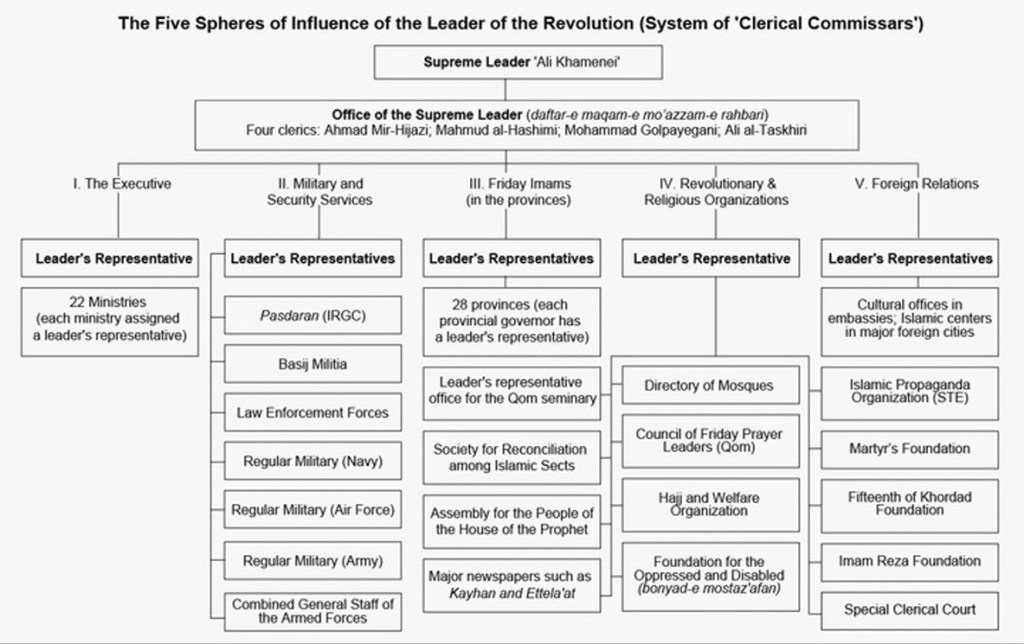
Shown below is how Khamenei’s Bayt was organized prior to his death a few weeks ago. All functions shown in boldface type are direct members of the Bayt. Although it’s not shown here, each non-Bayt institution has at least one commissar overseer who belongs to the Bayt.
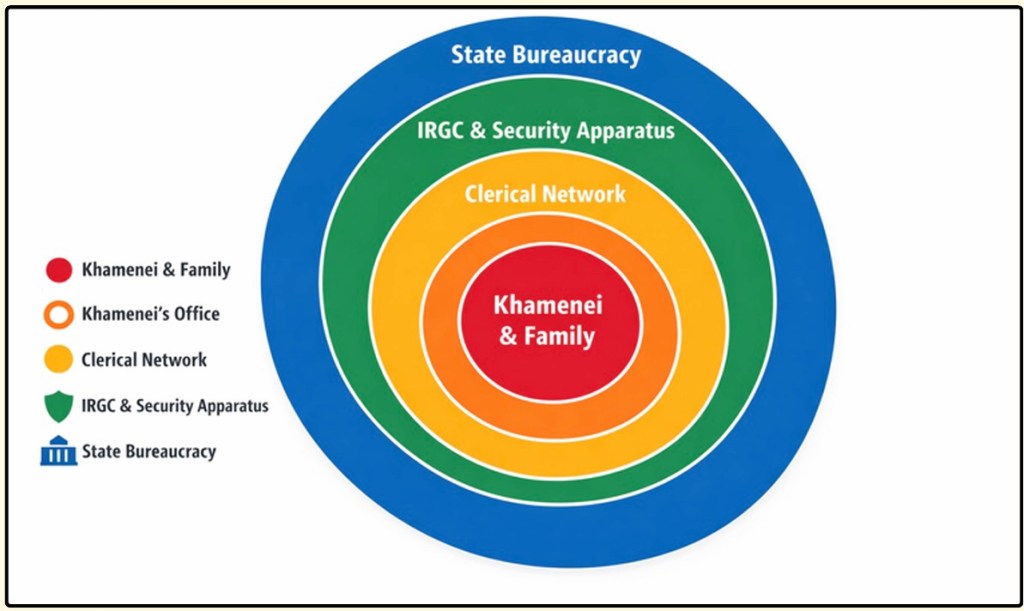
The accompanying graphic depicts how the supreme leader and the Bayt are organized in relation to each other. Other than the outer ring labeled “State Bureaucracy,” which are the public-facing official government agencies, everything else is part of the Bayt, which has no official designation. Since the IRGC functions as an elite military institution, and its headcount fluctuates from new recruits and departing guardsmen, only the officer corps is considered to be members of Bayt.
Khamenei and his hardline Bayt shadow government knew that over the ensuing decades, their infamous agenda would be on every western nation’s radar, especially the United States and Israel. Khamenei’s regime expected Iran would be attacked eventually, and it has. 

Expecting an attack in the future, Khamenei’s Bayt began creating a religious, political and paramilitary (IRGC) infrastructure that could withstand a sustained, massive attack. A western military offensive, like Operation Epic Fury, might wipe out the visible signs of public and military infrastructure, but the shadowy Bayt would still be fully functional. 

This “next-up-to-bat” dogma can readily be seen after Ali Khamenei’s death on the first day of bombing, including dozens and dozens of other regime officials. Only a week later, the remaining senior Bayt leaders met to vote-in the next supreme leader. The Israeli Mossad’s covert operatives identified the location of the selection conference; it was subsequently bombed, killing all of the attendees. Undaunted by the loss of so many senior leaders for the second time in a week, the remaining Bayt officials met, yet again, in an undisclosed location and chose Khamenei’s son, Mojtaba, as the new supreme leader. 

Subsequent to Mojtaba’s ascension, he has not been seen in public. Regime experts have opined about his absence, citing three plausible reasons: 1.) Out of an abundance of caution, his security detail has counseled him to remain in hiding for a while, or 2.) The known injuries he sustained during the attack on his father are serious enough that he is still recovering under a doctor’s care, and; 3.) Announcing Mojtaba’s promotion is a ruse to deflect from the fact that he’s actually dead. This dogged determination by the Bayt to soldier-on as the country crumbles around them, is a good example of unreasonable behavior from a western viewpoint. 

Applying the reasonable man theory in the face of relentless bombing, the death of more than 100 senior Bayt and government leaders, and the potential unfolding humanitarian disaster of the civilian populace, the remaining group of Bayt leaders should cease hostilities and sue for peace. But, that would be the actions of a reasonable, rational leadership team; the Bayt is clearly not that.

As long as the Bayt remains in power, regardless of how many senior officials and civilians might become casualties, the Bayt has achieved its ruthless goal of Regime survival. They literally do not care about the death and destruction surrounding them. 

What is Next?

Unless the Bayt has a change of heart, rather than retaining its unreasonable position instead, the bombing campaign will not stop. At some point, however, the only way that the U.S. and Israel can achieve their goals is to send in a special forces team to root out the remaining members of the Bayt. 

The difficulty of finding and eliminating a high profile adversary can be seen in the Israeli Defense Force’s hunt for Yahya Al-Sinwar, the embedded Hamas commander in the Gaza Strip. As formidable a military force anywhere, it took the IDF two weeks short of a year to locate and eliminate Al-Sinwar. Imagine the effort needed to find senior Bayt leaders in a country that’s twice the size of Alaska! President Trump and Benjamin Netanyahu have some sobering decisions to make if the Bayt leadership remains unreasonable.

Remember: What seems to be unreasonable to America, and her regional Arabic and Israeli allies, is not unreasonable from the Bayt’s viewpoint.

Seattle, Washington
USA
Standard
Military Operations, History & Cyber Warfare

Navy Releases Investigation Report of U.S. Patrol Boats Seized by Iran

navy-boat-crew-seizure_iran_jan2016

U.S. Navy boat crew held at gunpoint aboard their own vessel in a photograph taken at the time of the seizure.

A U.S. Navy investigation board’s Report was publicly released on June 30, 2016, via a FOIA request.  Although the Report had been classified Secret/NOFORN, the FOIA request triggered an MDR (Mandatory Declassification Review) by the Navy.  In my estimation, the MDR process did not go overboard in redacting too many important facts of the case; it was a fair review.  Vice Chief of Naval Operations, Admiral Michelle Howard, endorsed (with comments) the Report.

Rather than regurgitate the entire report, which, if read carefully cover-to-cover, takes about two hours, I will summarize the key facts here.  I also developed a map to help visualize the Persian Gulf geography that factored into the Iranian seizure incident.

In January 2016 two U.S. Navy coastal riverine patrol boats based out of Kuwait City received orders to make an all day trip through the Persian Gulf to the naval support facility in Bahrain.  Approximately half-way through their non-combat sortie, one of the two boats developed an engine casualty, and both boats stopped to troubleshoot and repair the problem.  While the two riverine boats sat dead-in-the-water in the middle (literally!) of the Persian Gulf, they drifted inside the territorial limit surrounding tiny, Farsi Island, which belongs to Iran.  Before the two Navy craft could make repairs, and get underway again, they were detained at gunpoint by patrol boats of the Iranian Revolutionary Guard Corps Navy (IRGCN).  The American boats and their crews were seized (without violence), and directed to follow the IRGCN boats to a jetty on Farsi Island.  The sailors and their boats were released 24 hours later unharmed, following high level negotiations.  A U.S. Navy investigation was immediately launched to determine the facts leading to the seizure incident.

Background Information

The entire Persian Gulf area, including the surrounding countries, fall under the jurisdiction of the U.S. military’s Central Command.  The naval warfare & maritime security component of U.S. Central Command is a dual-hat leadership command held by a Vice Admiral who also commands the Navy’s Fifth Fleet (CFF).  Carrier Strike Groups (CSGs) patrol the Persian (Arabian) Gulf, the Gulf of Aden, the Gulf of Oman, the Red Sea, and northwest portions of the Indian Ocean (i.e.; the Arabian Sea).

In addition to the CSGs, CCF has numerous support forces located in, and around, the Persian Gulf.  One of the most important of these is Task Force 56 (CTF56), headquartered in Bahrain.  CTF56 is commanded by a Navy Captain (O-6).  CTF56 has numerous Task Groups structured under it for such things as: EOD, diving & salvage, and maritime security.  The maritime security component is Task Group 56.7 (CTG56.7), headquartered in the United Arab Emirates’ (UAE) Jebel Ali port facility, adjacent to Dubai.  CTG56.7 is a command billet for a Navy Commander (O-5).  The two Navy patrol boats seized by Iran were part of CTG56.7.

Standard Navy practice for CTG56.7 is to deploy a complete Coastal Riverine Squadron (CRS) from CONUS for a six-month tour (sans a small reach-back staff left at home for unit coordination).  While the CRS is deployed, its billeted commander is dual-hatted as CTG56.7’s commander.  CTG56.7, at the time of the seizure incident, had four detachments; one co-located with CTG56.7 headquarters at Jebel Ali, and three sub-deployed (remote) detachments.  One detachment was located at the Port of Fujairah on the UAE’s eastern coast, almost directly due east of Dubai; it is reachable by car in less than two hours.  The other two remote detachments were located in Bahrain and Kuwait City.  The two boats involved in the seizure belonged to CTG56.7’s three-boat detachment in Kuwait City.

The two incident boats were U.S. Navy Riverine Command Boats (RCBs). The RCBs come from Sweden, and are labeled as: CB90-class, fast assault craft.  The U.S. Navy purchased six of these boats.  RCBs are 52’ long, drawing just 2½’ of water, with a flank speed of 40+ knots.  By U.S. Navy standards, RCBs are manned for combat by a crew of six sailors; only five per boat were aboard at the time of seizure.  A normal crew consists of a boat captain (usually an enlisted, Chief Petty Officer), a coxswain, a boat engineer, and three gunners.  Enlisted boat captains have been trained, qualified and previously served as coxswains, engineers, and gunners.  Likewise, coxswains have been engineers & gunners, and engineers are also experienced gunners.  RCBs have some features similar to the Navy’s 31’ PBRs successfully used in the Vietnam War.  These features include: being fast, highly maneuverable (due to the Jacuzzi-style water jet pumps), and can transition from flank speed to dead-in-the-water in just 2.5 boat lengths.  RCBs typically carry a Mark 19 automatic 40mm grenade launcher, and three .50 caliber heavy machine guns.  Another RCB feature (common to all small watercraft) is its limited, 130 nautical mile operating range with a full fuel load.  The RCB’s range would figure into the events leading up to the seizure.

Navy Riverine Boat

RCBs are typically crewed by Navy Special Warfare Combatant Craft Crewmen (SWCCs).  SWCCs are one of the most highly trained Navy career fields; almost as much as a SEAL.  Due to sequestration and budget cuts in 2012, The Navy merged Riverine Group 1 and the Maritime Expeditionary Security Group 2, into the Coastal Riverine Force (CRF).  CRF was created with two Coastal Riverine Groups, one near North Island in San Diego, and the other in Portsmouth, Virginia.  Each group has three CRS’ under its command.  CRS3 belongs to Coastal Riverine Group One in San Diego.  When the CRF was formed, it combined two groups with differing raisons d’être.  The new CRF launched comprehensive cross-training to level-set the skills needed to integrate the sailors from the two, now defunct, groups.

In-Theater Details Leading Up to the Seizure

At the time of the incident in January 2016, CRS3 was in the fifth month of its six-month deployment as CTG56.7.  When CRS3 arrived in-theater, the Kuwait City detachment did not exist.  After negotiating the Iranian Nuclear Agreement, the Pentagon deemed it prudent to activate a fourth detachment in Kuwait City to keep tabs on Iranian naval activity in the Gulf’s northern reaches.  To accomplish this, three RCBs and their crews, plus some support personnel, were ordered to stand-up a new detachment in Kuwait.

In my estimation, one of the ominous signs involving this new detachment was assigning a naval aviator as the Officer-in-Charge (OIC).  Giving the benefit of the doubt to the miscast OIC, I do not dispute the OIC’s leadership skills, above average intelligence, nor considerable educational background.  Beyond these “given” factors, however, it is not easily understood why a career aviator was assigned to lead a coastal riverine detachment that was outside of his normal skill-set.  The Navy investigation revealed that the naval aviator/OIC’s detachment leadership was laid back.  The detachment’s lax atmosphere was not a direct factor in the seizure incident; but, it was contributory.  Of greater concern to me was the questionable decision-making by CTF56 and CTG56.7 commanders.  Assigning an aviator as OIC of a riverine boat detachment was just one of the numerous, flawed leadership decisions made at both levels.

Based on investigation interviews, and the investigator’s additional research & fact-checking, the Report laid-out a character profile of Task Force 56’s skipper at the time of the RCB’s seizure.  I also took the time to conduct my own research into various aspects of the overall situation in CTF56, such as: its operating tempo, the regional situation it dealt with on a daily basis, command climate, ROEs, personnel issues, and the military equipment & weapon systems they employed.

My summary of the CTF56 commander can be stated using several common euphemisms, like: gung-ho, hard charger, failure is not an option, can-do attitude, et al.  In the arena of sociology and organizational behavior, some might translate the foregoing terms into a “Theory X” leadership style – often prevalent with a Type A personality.  There is nothing intrinsically wrong with these characterizations, as long as they are tempered at times with some moderation.  One of the themes that came through in the Report, and my own research, was the CTF56 skipper fostered a command climate of “will do,” not just “can do.”  Many decades ago I worked for a retired Army Colonel.  His command style was to shout, “jump” to everyone.  The only response he expected was two-fold: First, without hesitation, you leaped into-the-air; and the second response while you were airborne was simply, “how high?”  This may be an appropriate fit for the CTF56 command climate.

Speaking of command climate in CTF56, investigators traced several angles that surfaced in this regard.  One angle to bear fruit was the not-so-uncommon hesitancy to ask questions-of-clarity about command orders by lower ranking officers.  The officers indicated their concern about appearing like they were trying to “rock-the-boat,” as the saying goes.

About halfway through CRS3’s six-month tour in the Persian Gulf, orders came from U.S. Central Command to increase Navy maritime security presence in the northern Gulf.  This decision came in the wake of the successfully concluded Iranian nuclear deal.  The Bahraini detachment was the northernmost unit of CTG56.7.  Traveling from Bahrain to the northern gulf is about a 300-mile trip, one way; this far exceeded the RCB’s range.  CTG56.7 staffers immediately began planning the effort to stand-up a new detachment in Kuwait City for northern gulf patrols.  Although the Fifth Fleet could have ordered a larger, deep draft vessel already stationed in the Persian Gulf to take-on the new tasking, this was quickly ruled out for two reasons: 1.) Sending a larger combatant vessel into an area where they routinely did not operate might be seen as provocative by Tehran, and; 2.) Assigning a deep draft vessel to patrol the confines of the northern gulf posed an unhealthy security risk of being exposed to attack from too many directions at once, especially from land.  Since surveillance was the primary role of the new patrol – not armed reconnaissance – it was deemed more prudent to keep a low profile by using coastal riverine patrol boats.

The Kuwait detachment activation was carefully planned, and then back-briefed to CTF56 & CTG56.7 leadership.   The detachment activation plan was fully approved, and the planners received a pat-on-the-back for their efforts.  A good example of the well-planned detachment activation was the transport of the three 52’ RCBs from Bahrain-to-Kuwait.  The over-the-water distance between the two port-cities was almost 260 nautical miles – double the maximum operating range of an RCB.  The Kuwait action plan included loading the three RCBs aboard an Army coastal transport ship that went back n’ forth between Bahrain and Kuwait on a regular basis.  When the RCBs encountered the Iranian Navy a couple of months later, the two boats and 10 sailors were making a 259 nmi trip from Kuwait-to-Bahrain.  This is one of the numerous factors that belied the lack of effective two-way communication during CRS3’s Middle East deployment.  Deploying the boats to Kuwait was deemed to0 far for the boats to transit on their own, so, the Army hauled them up there.  Two months later, however, two boats were ordered by CTF56 to make the same lengthy trip (in reverse) under their own power.  None of the 10 crew members on the trip had ever made that long of a continuous, over-the-water journey in a small, open boat.  In order to accomplish the feat, the RCBs were scheduled to be refueled in open water, half-way through the trip.  Allowing the boats to make this long trip under their own power was a major factor leading to the seizure incident.

Considering the “will do” climate of CTF56, and the mirroring effect at CTG56.7, the orders for two boats to travel from Kuwait-to-Bahrain were not questioned.  The orders were issued with only a one-day notice.  In January 2016, the Kuwait boat detachment was significantly short-handed in maintenance personnel and spare parts.  In order to complete the mission, as ordered, the boat crews were up all night, making their own repairs by cannibalizing parts from the third boat.  The detachment OIC received permission from higher authority to cannibalize the third boat.  Instead of authorizing the cannibalization, higher authority should have probed the request, which would have revealed the lack of parts and mechanics. Another telling gaff resulting from the “midnight maintenance” work was the complete disregard for crew-rest requirements for small boat operators.  Crewing a coastal riverine boat at high speed in open ocean is just as debilitating as it can be for military aviators.  To say the least, the two RCB crews were exhausted before their trip even started.

One of the few correct actions taken prior to making the Kuwait-to-Bahrain trip was seeking route planning guidance from the navigator aboard the Army’s coastal transport; he made the trip dozens of times.  The accompanying map of the Persian Gulf shows the situational layout of the area.  Let me familiarize the reader about the maritime situation in the Persian Gulf.

Much has been spoken of the narrow Strait-of-Hormuz at the southern entrance to the Persian Gulf.  The strait at its narrowest point is 33 statute miles.  At sea-level, the two points-of-land are about nine miles over the horizon from each other.  In an interesting twist of geography vs. political sovereignty, the land on the Arabian side of the narrowest point in the strait is Omani, not the UAE, as many people think.  The land mass jutting toward Iran is the Musandam Peninsula, and there is only one small Omani fishing village, Kumzar, at the northern end.  Musandam is so mountainous, Kumzar is unreachable by land.  In fact, Musandam Province, Oman, is completely landlocked by the UAE from Oman proper.  The nearest Omani military facilities to Kumzar are 25 miles away by boat, in Khasab.  The U.S. Navy coastal riverine detachments in Fajairah & Jebel Ali, are approximately 70 miles and 120 miles, respectively, from the tip of the Musandam Peninsula.  The narrow confines of the Strait-of-Hormuz are carefully monitored 24/7, and it is extremely difficult (and potentially dangerous!) for any military force under, on, or over-the-water, to attempt an unnoticed provocative act.

Farsi Island

The foregoing is mentioned as a contrast to the relatively more open areas of the Gulf reaching north from the Straits-of-Hormuz.  Traveling by water from Hormuz, you must go 130 miles west-southwest, and then another 470 miles north-northwest, to reach the northern limits near the Iraq/Iran border.  After moving away from Hormuz into the open Gulf areas, the narrowest area between Saudi Arabia and Iran is just over 100 miles across.  This narrowest point on the Arabian coast is 52 miles north of the large port city, Dammam.  One of the major difficulties for any vessel transiting the Persian Gulf is the preexisting natural barriers and obstacles, including numerous islands, and sand bars.  These issues can further reduce the Gulf’s navigable waters.  And, as if this were not enough, the various countries all have territorial limits that further restricts what is considered open, navigable, international waters.  The location in which the boat seizure occurred was the Iranian-owned Farsi Island (Note: The Farsi Island land mass is less than one square mile!).  The Gulf is 130 miles wide at Farsi Island’s location, just about in the middle.  Saudi territorial waters completely surround Farsi Island.  This means that if any vessel transiting the area wants to remain in open, international waters, they cannot pass through the 65-mile gap between the Saudi coastline and Farsi Island; it would be an encroachment of Saudi sovereignty.  Standard procedure for any shipping without official business in Saudi waters, is to pass to the east of Farsi Island.  Over-the-water passage between Kuwait and Bahrain cannot be made via a direct route without crossing through sovereign, Saudi Arabian waters.  As noted on the map, Kuwait-to-Bahrain is almost a 260 mile, two-leg trip around Farsi Island.  This was the planned track the boats were expected to transit on-their-own, meeting a refueling ship en route.

Report findings show that not long after the Kuwait boat detachment was activated, the concept of “running-a-tight-ship” waned rather quickly.   When the Navy investigators dug into the root cause of the lapses in normal military practice, much of the blame fell on the discernable lack of senior “eyes-on management.”  In specific terms: throughout the six-month deployment of Coastal Riverine Squadron, Three, three of the four officers over Task Force 56, and Task Group 56.7 (i.e.; the CO and XO from both levels), never visited the Kuwait-based boat crews.  The only one to make the effort was the XO from CRS3/CTG56.7.

Details on the Day of Seizure

Aside from the detachment’s midnight maintenance mentioned above, the Bahrain transit mission had operational problems before the boats ever cast off their lines.  Chief amongst the mission day problems was a four-hour departure delay.  Since the trip would take most of the day, the crews wanted to complete it during daylight hours; the plan was to leave Kuwait early in the morning.  Most adverse incidents & accidents occur due to a series of unplanned events.  If just one event in the chain of many can be stopped or avoided, it is unlikely the future incident/accident would still occur.  Clearly, the four-hour departure delay should have aborted the trip, and reschedule it for the next day. Unfortunately for the two boat crews, the mission was not aborted; they departed four hours late.  Navy investigators learned from boat crew interviews that scrubbing the mission would be seen as a failure of the “will do” credo, and bring unwanted attention on the RCB sailors.  Eliminating an important risk avoidance factor of transiting in daylight hours by ignoring the four-hour delay, was seen by the Kuwait detachment as preferable to getting their butts chewed-out for aborting the mission.  The four-hour delay ensured the crews would not arrive in Bahrain until well after dark.

Another contributory factor was the lack of mission surveillance.  Standard doctrine for small boat missions is to not only maintain periodic radio communications between the boats and the Tactical Operations Center (TOC), but, also monitor the boat’s physical location via GPS and other tactical sensors.  On mission day for the two RCBs, the TOC was never informed in advance about the transit mission to Bahrain.  Once the two boats left Kuwait, no one knew where they were.  The lack of alerting the TOC about the mission frag is another example of poor mission planning (non-existent, for the most part).  Had the mission surveillance protocol been followed, the TOC would have been able to alert the boat crews that their mission navigation was faulty, that they were deviating from the planned track.  In terms of situational awareness, the only entity with some sort of knowledge about the boat’s mission that day, was the skipper & crew of the refueling ship sent to the rendezvous location.

In another case of missed opportunity in breaking the chain-of-events, had the TOC been following the mission track, they would have spotted the route deviation almost the moment the boats cleared the Kuwaiti port.  The reason the TOC would have spotted the deviation so quickly via route surveillance is shown on the accompanying map via the blue route.  The blue route represents an approximation of the RCB’s actual route.  In an effort to make-up for the four-hour delay, the embarked patrol officer and boat captains decided to take a short cut through Saudi waters, rather than go out and around Farsi Island.  When the Iranians encountered the two boats which had stopped for an engine repair, they were 1.5 miles from Farsi Island.

The actual seizure itself was contributed to via some poor decision-making by the boat captains and patrol officer.  In the case of the two boat crews, there were nine enlisted personnel and one commissioned officer.  Based on training and experience, the officer was not a mission-qualified patrol officer, yet.  In fact, only one of the Chief Petty Officers who were qualified boat captains, was also a qualified patrol officer.  Legally speaking, the commissioned officer was only boat captain qualified that day.  Although the crew’s orders showed the one Chief Petty Officer as the patrol officer, he tacitly deferred to the commissioned officer to exercise patrol officer duties.  Part of the abdication philosophy held by the CPO, was his overt acknowledgement that the commissioned officer had more experience & training in conducting maritime navigation.  Aside from the track deviation, the commissioned officer made several, key errors in judgment & leadership, both before, and after the boats encountered the Iranians.

Navy investigators determined that of the ten sailors involved in the seizure, only one (a woman) was found to have used good judgment during the incident.  U.S. Navy boats and ships carry camcorders, and are supposed to film situations involving a foreign combatant vessel; this did not occur aboard either RCB.  The bright spot in all of this is the female NCO had the presence of mind to discretely record some video on her Smartphone.  The same NCO, maintaining situational awareness, recognized the likelihood that no one knew where they were.  In order to leave some kind of clue to their whereabouts, she activated the boat’s EPIRB (emergency radio beacon).  In VCNO Howard’s Report endorsement, the female NCO was praised for her efforts in trying to make a bad situation, better.

The balance of the incident investigation covered what occurred over the next 24 hours after the boats were seized.  Mistakes were made by some of the 10 crew members just prior, during, after the seizure, and during their brief captivity.  I’m not going to cover all of this in great detail.  Except for some action/inaction decisions made after encountering the Iranian patrol boat, but, before actual seizure, the rest had no bearing in preventing the incident. After the preliminary investigation report began making its rounds for endorsement, questions arose about the legality of Iran’s actions.  This led the VCNO to direct a JAGMAN investigation into international maritime laws, and whether Iran broke any of them.  JAG attorneys said Iran clearly broke several international laws in seizing and boarding the boats, as well as, illegally detaining the crews.

Investigations like this always look at the training received by mishap crews.  Several of the 10 sailors made strong statements about being inadequately trained for the mission undertaken.  This sentiment strongly focused on the lack of open water, maritime navigation skills.  The preliminary report findings cast aspersions on inadequate pre-deployment training.  The VCNO also ordered a deeper investigation of pre-deployment training.  This supplemental investigation demonstrated that training prior to deployment was appropriate for the defined mission, and that CRS3’s final exercise scenario was done properly, and they were ready to deploy.  The lack of more intense training in maritime navigation was justified by denoting the sort of navigation used for the 259-mile trip was atypical for a coastal riverine boat crew.  The navigation skills determined to be of use in the Persian Gulf after arrival in-theater, was one that deployed leadership should have arranged for on-location, supplemental training.  Incremental, on-location training is one that all service branches are responsible to set-up when encountering a local, atypical situation.  So, instead of blaming the stateside training cadre for inadequate pre-deployment navigation training, it became another local command failure.

I am sure that my thoughts at the time of the seizure incident were no different than anyone else familiar with the U.S. military.  It was a foregone conclusion that somebody (probably plural) was going to get fired over this incident.  The biggest question was: How far up the chain-of-command would it go?  The CRS3/CTG56.7 skipper was relieved of his duty while the investigation was ongoing.  Once the final report was endorsed and released to the various commands, the CO and XO of Task Force 56 were also relieved.  When the Navy released the redacted report on June 30th, the JAG Corps was evaluating whether certain other individuals, such as members of the two boat crews, ought to receive administrative, non-judicial punishment under Article 15 of the UCMJ.  JAG lawyers were also assessing whether a UCMJ Article 32 hearing (sort of like a grand jury investigation) should be convened to decide if there was sufficient evidence to conduct a courts martial for certain individuals.  One of the concerns surfaced by incident investigators was the possible violation of the U.S. military’s Code-of-Conduct for service members forcibly detained by a foreign entity.  The investigators recommended that the Code-of-Conduct ought to be revised to better clarify a service member’s actions while in captivity.  Again, senior flag officers reviewing the Report concluded the Code-of-Conduct should not be revised; better training was needed instead.

Summary

The seizure incident & investigation underscored my longstanding belief that for the most part, when something untoward happens, it is usually related to one or more failures to comply with existing rules & regulations.  History teaches us that our first reaction to an incident is usually empathy for the person(s) wronged; in this case, the two boat crews.  An unfortunate fact-of-life is: The ensuing investigation often finds that one or more of the “good guys” erred in judgment, or maybe cut some corners.  It might be true that the Iranian seizure was unlawful, but, that had nothing to do with the multiple errors made before encountering the Iranian patrol boats.  My greatest hope is that further Navy action avoids ruining too many lives.  If any service members end up being punished, let it be no worse than someone being administratively separated, and not something adverse that will follow that person outside of the military.

Steve Miller, Copyright (c) 2016

Standard