National Security

National Security Letters: What Are They, How Are They Managed & Implemented, and What is Their Impact on U.S. National Security Policy?

national_security_letter-sample_nov2007

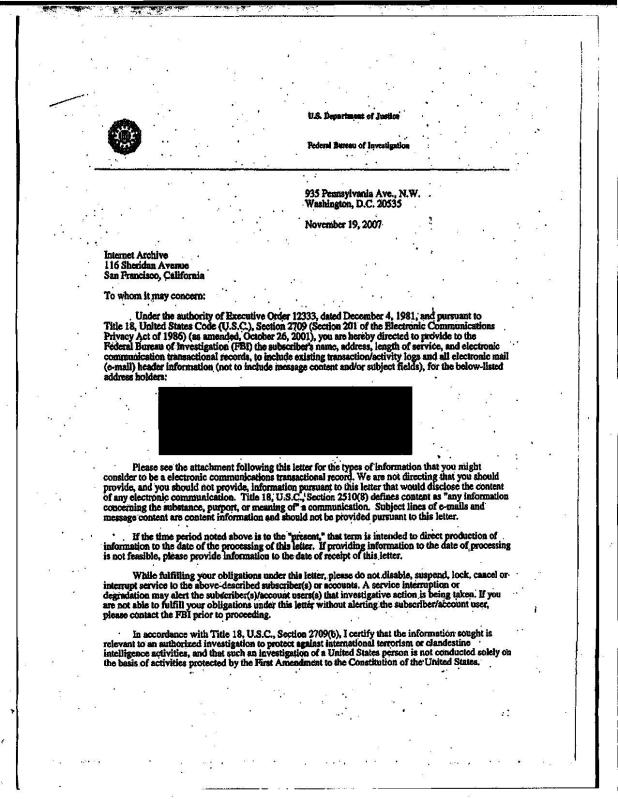
A National Security Letter issued to the Internet Archive by the FBI in November 2007.

A national security letter (NSL) is a type of subpoena that can be issued by designated U.S. intelligence & security establishments, and does not require approval by a federal court judge. The Right to Financial Privacy Act, Stored Communications Act and Fair Credit Reporting Act, all contain provisions that allow the USG to request & obtain information relevant to an approved national security investigation. Previously, there was no uniform statute implementing NSL procedures; so, a law to do so was enacted.  The two primary concerns voiced in opposition to the NSL’s usage is:  an NSL does not require a court order (i.e.; signed by a federal court judge), and NSL’s normally contain language directing the NSL recipient to not publicly disclose any aspect of the NSL, including the simple fact of acknowledging receipt of an NSL.

There are several federal court cases concerning the legality of the NSL Law.  It will likely end up in the Supreme Court’s hands because the two sides to the issue are not backing down based on lower court rulings thus far.  It doesn’t mean the Supreme Court will necessarily have to take the case; they could decline and let a lower court ruling stand as is.  The Law currently states an NSL can only request non-content information, for example: recorded transactions, dialed phone numbers, and e-mail addresses. Since the above statutes pertain to legal entities, such as a real person or a company, their names are not protected information.  Although organizations such as the phone company or an internet e-mail provider that receives an NSL are barred by the Law from disclosing the content of e-mails or phone calls, the names of the parties involved are releasable.

Steve Miller, (c) Copyright 2016

Standard
National Security

Academically speaking, what is “Security” in This Day and Age?

national-security-graphic_oct2016

The first factor to consider in discussing “Security,” or as it’s more commonly known, “National Security,” is some basic definitions applicable to any country.  These “basics” are not all inclusive, but, they represent the most common National Security factors that are intrinsic to any country’s sovereignty.

  1. Citizen protection, health & well being;
  2. Protecting a country’s strategic infrastructure;
  3. Physical protection of a country’s sovereign territory;
  4. Ensure the security of a country’s natural resources;
  5. Ensuring the political stability of the country’s governmental institutions (i.e.; executive branch, legislature, and judiciary);
  6. Maintain a country’s free access to adjacent international waters and airspace.

Every country has the right to at least the preceding National Security measures without encroachment by any other state actor, non-state actor, or by externally encouraged insurrection.

Most third world countries are incapable of looking beyond these six basic National Security factors.  The truth be told, many third world nations are challenged to the hilt just trying to keep their basic factors from encroachment.  In a general sense, third world countries are so self-absorbed just trying to get the six basics right, that there’s little means, opportunity or time to concern themselves with a crisis brewing in a far off land, and whether that other country’s strife could somehow effect their own country.  An example of this might be a country like Laos, and the ISIS conflict raging in Syria and Iraq.  It is unlikely the ISIS conflict has any direct or even indirect affect on Laotian National Security.  And if the ISIS conflict did have an impact on Laos, what could Laos do about it? Nothing.

But, could the same be said for ISIS’ impact on Great Britain?  No, it could not.  The larger the economy, the greater the infrastructure, the increased sophistication of a country’s society or industry, a higher degree of advanced education systems (i.e.; colleges, trade schools, etc), the higher per capita worker earnings, and Gross Domestic Product means a country like Great Britain has more tactical and strategic interest of problems brewing in other countries.  Great Britain may have a great need for Middle-eastern oil, or they have significant business interests in foreign countries, etc.  In a nutshell, a world economic and military power like Great Britain would not be able to maintain the security and prosperity it has attained by only concerning itself with the “basic six.”

The U.S. Congress enacted legislation over six years ago, requiring the President to publish every five years, a National Security Strategy.  I have pasted a hyperlink below, so you can review the 2015 NSS yourself.  Two definitions pasted below are the U.S. Government’s official position:

Security: 1. Measures taken by a military unit, activity, or installation to protect itself against all acts designed to, or which may, impair its effectiveness.  2. A condition that results from the establishment and maintenance of protective measures that ensure a state of inviolability from hostile acts or influences. 3. With respect to classified matter, the condition that prevents unauthorized persons from having access to official information that is safeguarded in the interests of national security.

National Security: A collective term encompassing both national defense and foreign relations of the United States with the purpose of gaining: a. A military or defense advantage over any foreign nation or group of nations; b. A favorable foreign relations position; or c. A defense posture capable of successfully resisting hostile or destructive action from within or without, overt or covert.

The 2015 NSS did not change the 2010 U.S. National Enduring Interests that form the backbone of the current NSS:

  1. The security of the United States, its citizens, and U.S. allies and partners;
  2. A strong, innovative, and growing U.S. economy in an open international economic system that promotes opportunity and prosperity;
  3. Respect for universal values at home and around the world, and;
  4. A rules-based international order advanced by U.S. leadership that promotes peace, security, and opportunity through stronger cooperation to meet global challenges.

The 2015 NSS listed the following top strategic risks to U.S. interests:

  1. Catastrophic attack on the U.S. homeland or critical infrastructure;
  2. Threats or attacks against U.S. citizens abroad and our allies;
  3. Global economic crisis or widespread economic slowdown;
  4. Proliferation and/or use of weapons of mass destruction;
  5. Severe global infectious disease outbreaks;
  6. Climate change;
  7. Major energy market disruptions, and;
  8. Significant security consequences associated with weak or failing states (including mass atrocities, regional spillover, and transnational organized crime).

The United States learned 115 years ago under the leadership of President Theodore Roosevelt, that America no longer had the ability to remain isolated; the relationship to other countries, was now of strategic interest to American prosperity.  This is why the U.S. Armed Forces are deployed globally to ensure a number of issues do not affect the United States.  The 9/11 terrorist attacks demonstrated what can and will happen on U.S. soil, if the U.S. fails to project their security interests worldwide.  The U.S. can no longer remain insulated and expect the problems overseas to remain there.  Problems & crises elsewhere will come to our shores if our National Security interests do not go beyond the basic six.

http://www.dtic.mil/doctrine/doc…

     Steve Miller, Copyright (c) 2016


Standard
Foreign Policy Research & Analysis, National Security, Terrorism Information

What actions have been taken so far as a result of the new American anti-terrorism law enacted in December 2015?

The primary thrust of this new law is to mitigate the risk of someone either living in the U.S., or travels there frequently, to become radicalized with terrorist ideals and training while outside the U.S., then comes home to launch a terrorist attack. This law reflects the San Bernardino, CA attack last year, whereby, an Islamic husband and wife (a U.S. citizen and a Foreign National spouse who entered the U.S. legally) traveled outside the U.S., received radicalization training, then returned home and committed a terrorist act.

On January 21st, the first set of revised immigration rules stemming from the new law, were activated. The new rules are as follows:

• Visa Waiver Program. U.S. immigration rules already in effect, provide a special arrangement – called the Visa Waiver Program – which authorizes passport holders from any of the following countries to enter the U.S. for up to 90 days without an entry visa.

VISA WAIVER PROGRAM COUNTRIES

• Andorra

• Australia

• Austria

• Belgium

• Brunei

• Chile

• Czech Republic

• Denmark

• Estonia

• Finland

• France

• Germany

• Greece

• Hungary

• Iceland

• Ireland

• Italy

• Japan

• Latvia

• Liechtenstein

• Lithuania

• Luxembourg

• Monaco

• Netherlands

• New Zealand

• Norway

• Portugal

• Republic of Malta

• San Marino

• Singapore

• Slovakia

• Slovenia

• South Korea

• Spain

• Sweden

• Switzerland

• Taiwan

• United Kingdom

The new immigration rules under the Act specify that travelers in the following categories are no longer eligible to travel or be admitted to the United States under the Visa Waiver Program (VWP):

– Nationals of VWP countries who have traveled to or been present in Iran, Iraq, Sudan, or Syria on or after March 1, 2011 (with limited exceptions for travel for diplomatic or military purposes in the service of a VWP country).

– Nationals of VWP countries who are also nationals of Iran, Iraq, Sudan, or Syria.

These individuals will still be able to apply for a visa using the regular immigration process at U.S. embassies or consulates. Prior to January 21st, citizens of VWP-eligible countries submitted a request for VWP recognition; this was documented in the Electronic System for Travel Authorizations (ESTAs) to make entries into, and exits from the U.S. ESTA also holds previous traveler information, indicating if they have dual citizenship in Iran, Iraq, Syria or Sudan. If an ESTA approved traveler hits either trip flare – entry to one of the four countries in the past five years, or they are dual citizens of a VWP country AND one of the four countries listed above – those travelers have had their ESTA authorizations revoked. Until they see a U.S. Consular Officer to apply for a visa waiver, they cannot enter the United States. Visa waivers (since they are no longer eligible for an ESTA authorization) are issued on a case-by-case basis…there’s no ready-made rule(s) on what will or will not get someone an approved visa waiver to get back into the U.S.

The Secretary of Homeland Security indicated some of the visa waiver possibilities, such as:

– Travelers to Iran, Iraq, Sudan or Syria on behalf of international organizations, regional organizations, and sub-national governments on official duty;

– Travelers to Iran, Iraq, Sudan or Syria on behalf of a humanitarian NGO on official duty;

– Travelers to Iran, Iraq, Sudan or Syria as a journalist for reporting purposes;

– Travelers to Iran for legitimate business-related purposes following the conclusion of the Joint Comprehensive Plan of Action (July 14, 2015); and

– Travelers to Iraq for legitimate business-related purposes.

Current U.S. passport holders and Foreign Nationals with resident Green Cards already have travel data on-file with Homeland Security in regard to their travel to one of the four, flagged countries, and any dual citizenship thereto. The new rules, so far, do not revoke someone’s Green Card for travel to, or dual citizenship from, the four flagged countries.

Steve Miller, Copyright (c) 2016
Standard
National Security

Understanding the Basics of Obtaining a U.S. Government Security Clearance

security-clearance-process_chart

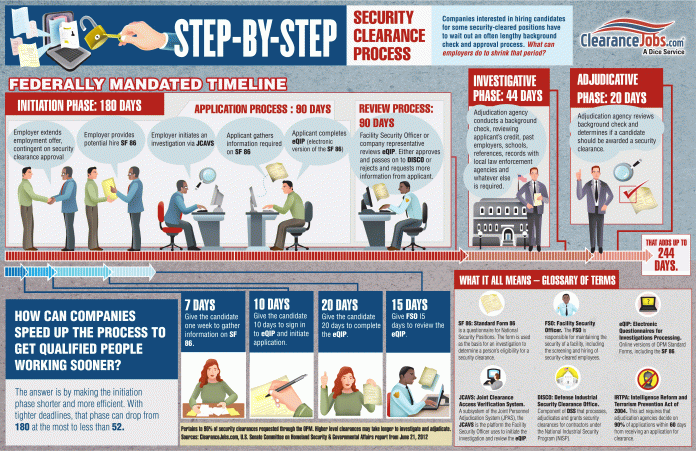
Nowadays the DOD uses a security clearance processing system that uses predictive modeling to gage the possibility of a security clearance denial.  An actual clearance denial, or revocation of an existing clearance, are significant black marks on a person’s record.  Obviously, the subject person wants to avoid a black mark; but, so does the DOD.

In the majority of situations, whether you are a uniformed member, a DOD civilian, or a contractor’s employee, security clearances are not required prior to stepping into a new, security cleared job.  For any security clearance job, the starting place is the U.S. Gov’ts security questionnaire known as a form “SF-86.”  The SF-86 is completed on-line in a DOD internet application known as “e-QIP.”  The assigned security officer handling your case is the person who sets-up your e-QIP access, and administers the process on your behalf.

Since even a Secret clearance for a recently enlisted 18 year old will take several months to 100% process and reach a final decision, the e-QIP system contains the predictive modeling software.  Based on your form SF-86 answers, e-QIP has the ability to assess key factors and within a few minutes it can issue an “Interim Secret” clearance.  Final hiring decisions are made based on a candidates ability to obtain an Interim Secret.  If e-QIP is unable to grant an Interim Secret clearance, it is NOT considered a denial.  Your application simply lacks enough pre-verifiable info.  Your SF-86 will have to take the usual, laborious route of manual verification by a DOD security officer.  If the officer is unable to grant the clearance, this is considered a denial.

Steve Miller, (c) Copyright 2016

Standard