National Security

Presidential Findings and Their Impact on U.S. National Security

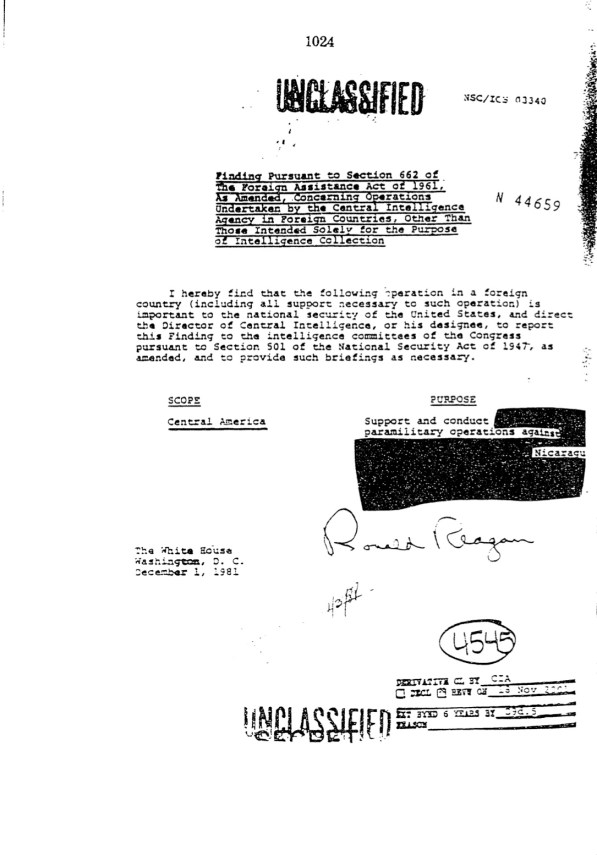
reagan-presidential-finding-nicaragua_dec1981Presidential Finding signed by President Reagan to authorize the CIA to conduct covert operations in Central America to aid the Contra rebels in their fight against the Communist-backed Sandinista government in Nicaraqua.

During the Vietnam War nearly every kind of intelligence operation you can think of was undertaken by the U.S. Intelligence Community.  The four most heavily engaged agencies, starting with the most utilized first, were: the Central Intelligence Agency, Defense Intelligence Agency, National Security Agency, and the State Department’s Bureau of Intelligence and Research.  As the War dragged on, with public, Congressional, and Presidential frustration mounting, increased pressure was applied on intelligence activities, especially the CIA, to help turn the War in a more positive direction.

Thomas Ahern, a CIA intelligence officer, who started his career in Southeast Asia during the Vietnam War, wrote an excellent book, “Vietnam Declassified,” about the CIA and the many types of intelligence operations undertaken in Vietnam.  He cites an exasperating meeting about a problem with a certain pacification program led by the CIA, during which someone tossed out a new idea. William Colby (future CIA director), who was the CIA’s Saigon station chief at the time, replied that he was willing to try anything—if it would work.  The mounting, across-the-board frustration, left the CIA and its cohort agencies, grasping at straws.

William Colby became the new Director of Central Intelligence (DCI) in September 1973, just a month after American combat activity ceased in Southeast Asia.  Colby’s tenure would be a brief 2 ½ years.  Before the year was over, allegations began to surface in the press about questionable intelligence activities during the War.  Press allegations continued throughout 1974, and murmurings started-up in Congress about possible Intelligence Community improprieties.   By time Colby left office he would arguably hold the distinction of testifying before Congress more than any other DCI.  By January 1975 both the Senate, and House of Representatives, were conducting hearings about the impropriety allegations.  Senator Frank Church chaired one committee, and Congressman Otis Pike chaired a similar investigation committee in the House.

All of this external attention on the Intelligence Community resulted in passage of several new laws to tighten-up accountability and oversight of certain critical, intelligence operations.  For the most part, the type of operations that were closely looked at, and caused the most angst with Congress, were those in which the importance to U.S. National Security was ill-defined; in essence, justifying a direct benefit to the Unites States was a stretch, at best.

U.S. Foreign Policy has a range of options available to the President in order to achieve his goals.  The low end of the scale espouses the use of diplomacy to achieve American goals overseas.  At the opposite end of the spectrum from diplomacy is military intervention.  Starting in the post-World War II era, and continuing to this day, foreign relations between countries have become so complex that often times using pure diplomacy is ineffective; but, military intervention is too much.  The gray area between State Department diplomacy, and Defense Department military operations, is often the domain of the CIA using Covert Action to achieve American foreign policy goals.  It is this genre of intelligence operations that garnered such a strong backlash from Congress and the public after Vietnam.

Regardless the type of intelligence operation being mounted, they all have an appropriate level of Operational Security – “OPSEC.”  OPSEC is usually manifested in three categories:

Clandestine operation:  An operation sponsored or conducted by  a U.S. government department or agency in such a way as to assure secrecy or concealment.  Clandestine operations are the usual means of OPSEC for espionage and/or intelligence collection, which is the “bread n’ butter” spying conducted by the CIA’s National Clandestine Service.  The biggest reason intelligence collection is conducted with clandestine OPSEC is most adversaries, upon detecting espionage activity, move quickly to render useless anything that was purloined.  For example, clandestinely photographing an enemy’s communication code books.  If the collection activity is discovered, the enemy will stop using the compromised codes, and the photographed code book has no further value.  Being undetected is paramount in clandestine operation.

Covert operation: An operation of the United States Government that is planned and executed to influence political, economic, or military conditions abroad, where it is intended that the role of the United States Government will not be apparent or acknowledged publicly (i.e.; plausible deniability).

Clandestine and Covert operation:  The operation must be undetected, and the sponsor’s identity is concealed.

By the very nature of clandestine operations, they tend to be low-key.  Any sort of violence associated with the operation tends to cause the lack of detection to be tossed right out the window.

Covert operations conducted by the CIA, for example, are less concerned about remaining undetected during the operation, or afterwards.  Of greater concern is running the operation so it cannot be traced back to the United States.  In this sense, it is a fact-of-life that covert operations tend to have more violence attached, destroying property and/or killing enemy personnel to prevent them from reporting who or what they saw.  As noted previously, when diplomacy fails, but, direct military intervention is too heavy handed, a plausibly deniable covert operation often becomes the tool-of-choice for resolving vexing problems.  Up until Colby’s DCI tour, and the Church & Pike Committees, the CIA regularly conducted operations using all three OPSEC categories.  Covert operations bears the majority of public and Congressional opposition.  This led Congress to add language in Title 50 U.S. Code, requiring a documented Presidential Finding for covert operations.

Prior to the law being changed to require a Presidential Finding, an extremely sensitive covert operation was usually briefed to the President for his buy-in.  The law was moot, however, on any formal requirement to seek the President’s buy-in, nor was there a requirement to document the Presidential Briefing in writing, nor to obtain an actual signature by the President, approving the covert action.  Aside from the President’s buy-in, the law was also silent about informing key members of Congress about an impending covert action.

Once the law took effect, all covert actions had to be documented in a signed Presidential Finding, and it had to contain an explanation of why it was necessary to conduct the operation, including the identifiable foreign policy objectives of the United States, and the covert action’s importance to U.S. National Security.  Lastly, the Presidential Finding must be presented to both Congressional intelligence committees.

Steve Miller, (c) Copyright 2016
Standard
Military Operations, History & Cyber Warfare

Understanding why U.S. Psychological Warfare Operations do not use drones to infiltrate propaganda into North Korea.

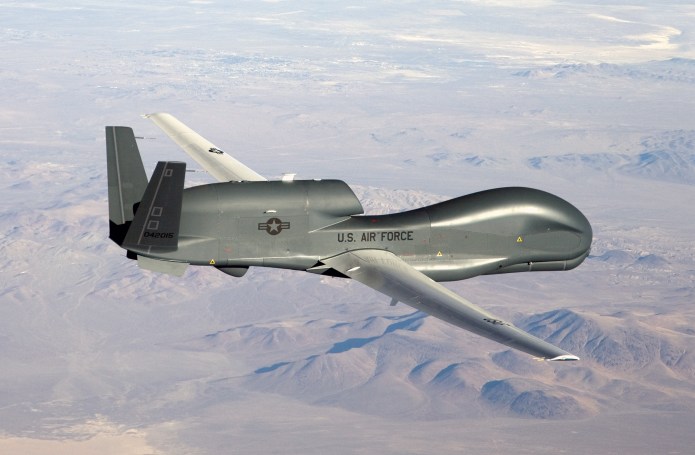
Global Hawk flying environmental mapping missions in Latin America, Caribbean An RQ-4 Global Hawk UAV, high altitude reconnaissance aircraft.   (U.S. Air Force photo/Bobbi Zapka)
     My USAF unit was the sole American military outfit that flew drone reconnaissance missions for 11 years during the Vietnam War in Southeast Asia .  Occasionally our unit, the 100th Strategic Reconnaissance Wing (SRW), was asked by the secretive Studies and Observations Group (SOG) to launch and fly “Psy Ops” drone missions over North Vietnam.  SOG was the unit reporting to the commander of the U.S. Military Assistance Command-Vietnam (MACV), that directed all of the covert military operations during the War.  MACV-SOG’s Psy Ops department cooked-up quite a few propaganda leaflet campaigns for dissemination over North Vietnam and the Ho Chi Minh Trail supply route in eastern Laos.  What follows here is drawn from our squadron’s experience and the operational challenges faced in flying leaflet dispensing sorties over territory that is denied airspace.

     Keep in mind that any sort of written propaganda operation has to be well thought-out to realize even the slightest amount of perceived value.  In any sort of Psy Ops program the greatest obstacle to success is the intended audience has been receiving a steady diet of propaganda manufactured by their own government.  This was the case with Germany in WW II, North Vietnam, and definitely with current-day North Korea.  In North Korea’s situation, their citizens have been subjected to a state-sponsored Psy Ops program for more than 60 years.  A good Pys Ops program contains a high percentage of factual information that will carefully lead someone to believe the whole thing.

     Airborne leaflet dispensing missions in denied airspace were/are extremely dangerous.  To have any effect at all, the leaflets have to be distributed by the millions over a wide area.  This means the air delivery vehicle has to be large enough to carry a heavy payload.  None of the quad-copters or other commercially available drones would be suitable…their payloads would be a mere drop-in-the-bucket.  Even the more common military drones, like the MQ-1 Predator, or the larger MQ-9 Reaper, would not have the sufficient payload, or ability to evade North Korean air defenses.

     In Vietnam, leaflet dispensing missions conducted in the less dense air defense areas were undertaken with MC-130E Combat Talon aircraft from the 15th Special Operations Squadron.  The MC-130s were specially equipped for flights through denied airspace.  But, no one was foolhardy enough to tempt fate by trying to fly an MC-130 on a Pys Ops mission over the heavily defended capital of Hanoi, or the deep-water port of Haiphong.  If a Psy Ops mission had to be conducted in those areas, our unit was asked to do it with a Ryan Aeronautical Model 147N jet-powered drone.

     Our Model 147 drones (later given the DOD designator AN/AQM-34) were all purpose-built for a certain type of reconnaissance mission – photo imagery, signals intelligence, etc.  Our unit became quite successful in flying high-speed reconnaissance drones over North Vietnam.  Eventually, the military spooks from MACV-SOG and other MACV departments began asking our operating location (OL-20) at Bien Hoa Air Base, near Saigon, to fly other types of drone missions besides reconnaissance.  One of the alternatives was for ECM (electronic counter-measures) missions to dump radar-defeating chaff.  Chaff dispensers (ALE-2,4 or 5) had been carried on fighter jets, but, the missions were getting too dangerous for the aircrews.  When OL-20 was asked to use Model 147 drones to fly chaff missions, they were not going to use the expensive versions crammed with intelligence collection gear; they had Ryan send over stripped-down versions with wing hard-points to upload the dispensers.  After flying a few successful ECM chaff missions, MACV-SOG inquired whether the same drones & chaff dispensers could deliver propaganda leaflets over Hanoi.  This was doable, and the slang term assigned to these birds/missions was “Bull_ _ _ _ Bomber.”

     The photograph shown below is a Ryan Aeronautical RPV (remotely piloted vehicle). OL-20’s drone crew chiefs are uploading ALE-4 leaflet dispensers to a Model 147N prior to a Psy Ops leaflet mission.  As you can see, the leaflet dispensers were large and very heavy.  It was SOP in the drone maintenance manuals to upload the birds first to the launch aircraft – then the leaflet dispensers were attached last.  Not wanting to take any chances, the technicians have temporarily installed a cargo strap under the drone as a safety measure.

     These no-frills drones were flown on dispenser missions, expecting them to not make it back home.  Ironically, however, quite a few managed to make it back to the recovery area in South Vietnam without being shot down!

     Several people have asked me about drone operations in denied airspace.  I hope that providing this information about American military exigencies in dealing with actual leaflet dispensing drone missions over North Vietnam will demonstrate what would have to occur to attempt something just as complex over North Korea.

                                                     Steve Miller, Copyright (c) 2016

Standard
Intelligence Collection, Analysis & Estimates

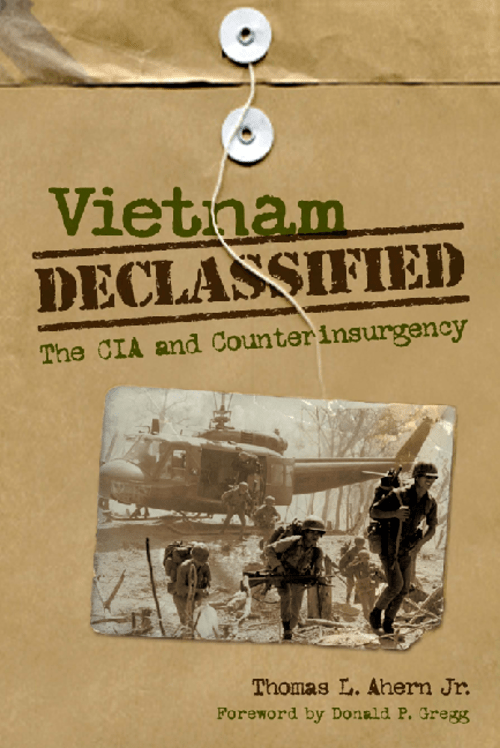
Book Review: Vietnam Declassified: The CIA and Counterinsurgency, by Thomas L. Ahern Jr.

Steve Miller, Copyright (c) 2011

vietnam-declassified-book-cover

Note: This article first appeared in the Air Force Research Institute’s “Air and Space Power Journal” in the Summer 2011 Edition.

Vietnam Declassified: The CIA and Counterinsurgency by Thomas L. Ahern Jr. University Press of Kentucky, 2010, 450 pp., $40.00 (hardcover).

Anyone intent upon a serious study of the Vietnam War or of the Central Intelligence Agency’s (CIA) operations in general, must read this book. Of the more than 1,000 hours I’ve spent researching the war and the nearly 300 books and oral interview transcripts I have read, Ahern’s study stands as one of the best accounts of America’s involvement in Indochina. He deserves a standing ovation for giving us the unvarnished truth.

Anytime an author attempts to write a book about a controversial subject, he or she knows that not everyone will agree with the results. The real challenge involves getting the story right without creating more negative thinkers. Given the amount of mud tossed around about Vietnam, an author must have iron-willed courage to buck the trend—exactly the case with Ahern. He properly acknowledges situations in which judgment should have been better or which produced mediocre results. But Ahern does three things that reflect his integrity:

1. He stays clear of making editorial comments or offering personal opinions.

2. Even though many different types of intelligence operations ran simultaneously, Ahern keeps the reader informed about the chronology and the direct or indirect linkages between them.

3. He avoids using his professional expertise to fill-in gaps in the story or fabricate topic linkages. Ahern wisely keeps his literary license in his pocket, letting the facts tell the story.

I appreciate the author’s effort to prepare a balanced narrative that covers the various intelligence programs. He takes the right course by not dwelling on the well-known Civil Operations and Revolutionary Development Support (CORDS) or Phoenix Program. By time a reader finishes the book, it is apparent that very few programs did poorly while the CIA was in-charge. Ahern notes the common project pattern: develop and launch it in one or two provinces, prove that it works, and then decide to roll it out nationally. Generally speaking, project incubation went well under CIA guidance.  It was not uncommon, however, for a Program to fall on hard times when it transitioned to a larger effort and the CIA relinquished control.

In the best part of Vietnam Declassified, the author shows how he and his colleagues tirelessly pressed forward, trying to salvage something of enduring value. Ahern notes that most CIA officers serving in Vietnam realized the near impossibility of having an operation develop the “legs” to do well all over the country or make any long-term gains. He cites an exasperating meeting about a problem with a certain pacification program, during which someone tossed out a new idea. William Colby (the CIA station chief in Saigon, and a future CIA director) replied that he was willing to try anything—if it would work (pp. 69, 86).

Ahern purposely—and correctly, I might add—calls the reader’s attention to repeating themes throughout the text. Vietnam Declassified shows the many recurring actions/inactions outside CIA control for which the agency nevertheless received blame and/or an assignment to tidy up a mess not of its making.

The book clearly points out that for any given intelligence operation, the Saigon government and armed forces, provincial as well as local leaders, and the US military or State Department might have held differing goals for the desired outcome; however, Ahern demonstrates the CIA’s consistency in resisting involvement in actions having dubious intelligence value. He demonstrates the fine line present in operations, whether overt or covert, that successfully hid a clandestine intelligence-collection effort. Early in the book, he explains one of the more common accusations made about the CIA in Vietnam—that it participated in operations perceived to have no intelligence value. Ahern reveals that, on the one hand, outsiders who concluded that the CIA’s participation in an operation produced nothing beneficial, actually validated the agency’s concealment of an intelligence operation inside a pacification program. On the other hand, the CIA had to “take it on the chin” for purportedly spending taxpayer dollars on something without intelligence value.

Coming out of Vietnam, the CIA carried the undeserved image of a power-hungry loose cannon, but the author debunks this paradigm. Ahern explains that, aside from avoiding power grabs on ethical grounds, the CIA actually had the least amount of manpower and one of the smallest budgets in-country. Although he does not say so explicitly, I have the impression that the CIA saw its role as a “counterinsurgency project manager,” not as a full-scale “production (i.e., combatant) manager.”

One of the thorniest issues Ahern mentions had to do with convincing South Vietnamese leaders that the war was in the countryside, not in the cities. The CIA routinely coached Saigon leaders on the “battle” not being against Hanoi or merely about stopping the Vietcong from bothering rural peasants. The author reminds us that the Americans constantly repeated and demonstrated this particular message, starting in 1954 when they arrived and the French left. According to the CIA, the real task lay in convincing the peasants to side with Saigon before the Vietcong talked them into going the other way.

Vietnam Declassified left a lasting impression. Specifically, Ahern writes in several places about the CIA as a trailblazer in Vietnam, as was the author himself. In fact, he observes that “most [CIA] officers who served there had no previous experience of third world insurgency, and many of us . . . found ourselves facing challenges and exercising authority at a level well above the norm for our rank and experience” (p. 4). It seems that in situations in which young officers lack the extrinsic benefits of manpower, money, equipment, precedence, and experience yet still need to get the job done, they do so, according to the author, by using intrinsic skills they could not buy or receive from someone else—tenacity, creativity, and courage.

When I closed Thomas Ahern’s book, a time-honored passage kept ringing in my ears: “We who have done so much, for so long, with so little, are now qualified to do everything with nothing.” Excellent work, Mr. Ahern.

Steve Miller, Copyright (c) 2011

Standard