Military Operations, History & Cyber Warfare

Why Is the White House Coordinating the War against ISIS Instead of the Pentagon?

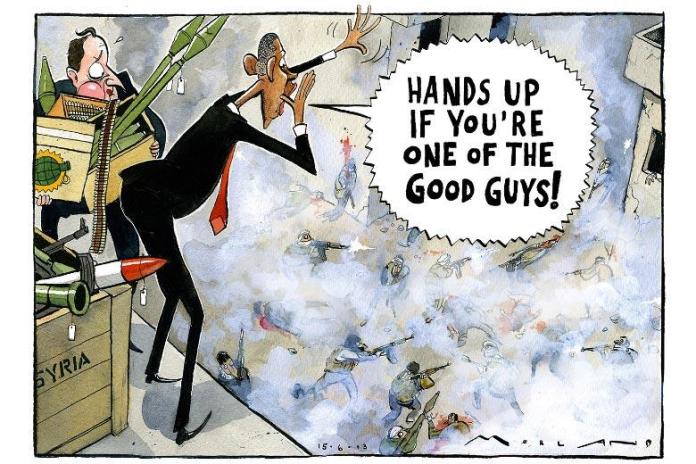
isis-war-cartoon
Cartoon by Morton Morehead, accessed October 2014 on reddit.com
The facts on the ground in Syria and Iraq are very complex.  Trying to ensure coalition leadership gets the targeting done right is akin to attempting to pull your kid off of a spinning merry-go-round blindfolded…there’s lots of opportunity to get it wrong.  A comment posted on reddit.com in response to Morehead’s cartoon says it all:  “Shoot the guys with the beards!  No the other beards…The brown guys with the headscarves! The ones running away, and the other ones not running away. F_ _ _-it…kill everyone to be sure we got……?” (italics added for emphasis) Comment attributed to reddit.com subscriber ‘1blckbx’
Aside from writing, consulting and other workstreams I am involved in, I also do professional speaking and teach college.  Anyone who has attended one of my events knows that almost everything I see in life starts out in my mind as a funny thought.  In most forums where serious material is being discussed, I suppress my humorous anecdotes and stick to the discussion at hand.   But, the confusion and conflicting agendas seen in Iraq and Syria that are faced 24/7 by the forces involved in Operation INHERENT RESOLVE, is sometimes so exasperating that the best antidote is to just shake your head and have a non-verbal chuckle.  All laughing aside, I will put my game face on, and give the topic the serious answer it deserves.
As of today, September 6, 2016, the Coalition nations conducting  airstrikes in Iraq include the United States, Australia, Belgium,  Canada, Denmark, France, Jordan, the Netherlands and the United Kingdom.  The Coalition nations conducting airstrikes in Syria include the United  States, Bahrain, Canada, Jordan, Saudi Arabia, Turkey and the United Arab  Emirates.  All of these assets are coordinated through one air component combatant commander for Operation INHERENT RESOLVE.

The current ground combatants in Syria for INHERENT RESOLVE includes the Syrian Army, the original Rebel Insurgents who have been trying to topple Bashar Al-Asad’s Administration for the past four plus years, and ISIS.  To be sure, ISIS is clearly a faction of opportunists who took advantage of the civil war raging between the other two groups and accomplished quite a lot in a very short timeframe.

Similarly in Iraq, ISIS recognized the disheveled Iraqi Government and a shaky infrastructure, then looked at the semi-autonomous Kurds and decided they could also exploit the disjointed and dysfunctional situation in Iraq.

Considering all of this, and there are five Islamic-based countries flying sorties for the coalition, the United States cannot afford to misstep in the bombing campaign.  You ask why the Obama Administration is so heavy handed in managing the air war?  Because this military action could easily become an albatross around President Obama’s neck, and become the legacy he is saddled with as he leaves the White House.  Basically, a situation very reminiscent of the baggage carried by President Bush when he turned over the keys to Obama in January 2009.  Numerous people in, and supporting the Obama Administration derided the Bush Administration for overseeing an apparent botched job in OEF and OIF.  The Obama Administration has learned by the school of hard knocks that managing a combat operation in the Middle East is not as easy as it looks.

You can look to the Johnson Administration during the Vietnam War and see a President also micro-managing a complex bombing campaign.  Whether you are Lyndon Johnson or Barack Obama, if you are really worried about the “kids not coloring inside the lines,” then you grab the crayons and start coloring the picture yourself.  Take the time to watch the HBO TV-movie from 2002, “Path to War,” about the Johnson White House during the Vietnam War.  It is very instructive in comprehending how a sitting President tried extremely hard to get the right facts about the War raging in Southeast Asia, so that good, intelligent decisions could be made about the bombing operations in North Vietnam.  I have no doubt there have been many heated discussions within the Obama Administration about INHERENT RESOLVE’s air war, and the constant efforts to get the bombing done correctly for the ground combatants the Coalition is supporting.  But, make no mistake, numerous parallels are eyed every day in and out of the Administration in terms of how things are measuring up to both the Johnson legacy and the Bush legacy.

The risk of “getting-it-wrong” in Syria and Iraq is much too high for the Obama team to feel comfortable letting go of the reins.

Steve Miller, (c) Copyright 2015
Standard
National Security

Understanding the Basics of Obtaining a U.S. Government Security Clearance

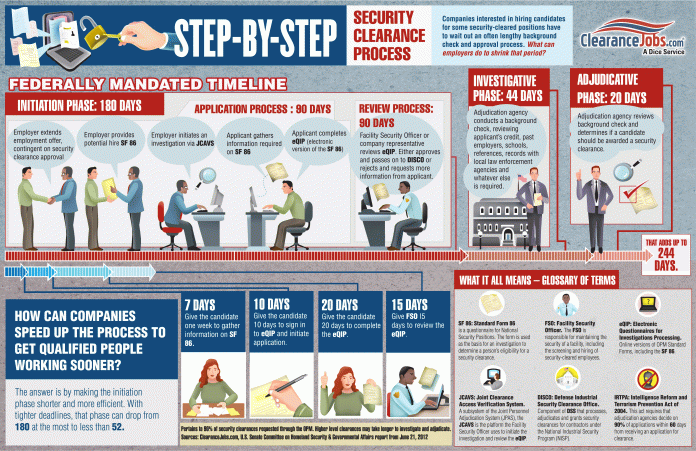
security-clearance-process_chart

Nowadays the DOD uses a security clearance processing system that uses predictive modeling to gage the possibility of a security clearance denial.  An actual clearance denial, or revocation of an existing clearance, are significant black marks on a person’s record.  Obviously, the subject person wants to avoid a black mark; but, so does the DOD.

In the majority of situations, whether you are a uniformed member, a DOD civilian, or a contractor’s employee, security clearances are not required prior to stepping into a new, security cleared job.  For any security clearance job, the starting place is the U.S. Gov’ts security questionnaire known as a form “SF-86.”  The SF-86 is completed on-line in a DOD internet application known as “e-QIP.”  The assigned security officer handling your case is the person who sets-up your e-QIP access, and administers the process on your behalf.

Since even a Secret clearance for a recently enlisted 18 year old will take several months to 100% process and reach a final decision, the e-QIP system contains the predictive modeling software.  Based on your form SF-86 answers, e-QIP has the ability to assess key factors and within a few minutes it can issue an “Interim Secret” clearance.  Final hiring decisions are made based on a candidates ability to obtain an Interim Secret.  If e-QIP is unable to grant an Interim Secret clearance, it is NOT considered a denial.  Your application simply lacks enough pre-verifiable info.  Your SF-86 will have to take the usual, laborious route of manual verification by a DOD security officer.  If the officer is unable to grant the clearance, this is considered a denial.

Steve Miller, (c) Copyright 2016

Standard
Intelligence Collection, Analysis & Estimates

Book Review: Vietnam Declassified: The CIA and Counterinsurgency, by Thomas L. Ahern Jr.

Steve Miller, Copyright (c) 2011
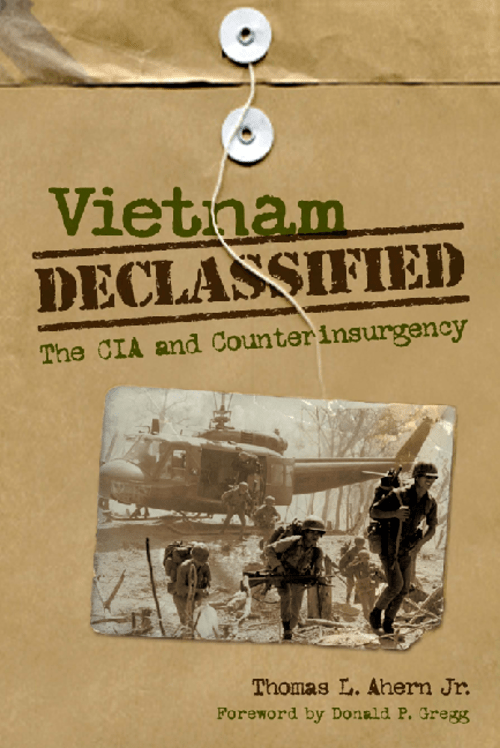
vietnam-declassified-book-cover

Note: This article first appeared in the Air Force Research Institute’s “Air and Space Power Journal” in the Summer 2011 Edition.

Vietnam Declassified: The CIA and Counterinsurgency by Thomas L. Ahern Jr. University Press of Kentucky, 2010, 450 pp., $40.00 (hardcover).

Anyone intent upon a serious study of the Vietnam War or of the Central Intelligence Agency’s (CIA) operations in general, must read this book. Of the more than 1,000 hours I’ve spent researching the war and the nearly 300 books and oral interview transcripts I have read, Ahern’s study stands as one of the best accounts of America’s involvement in Indochina. He deserves a standing ovation for giving us the unvarnished truth.

Anytime an author attempts to write a book about a controversial subject, he or she knows that not everyone will agree with the results. The real challenge involves getting the story right without creating more negative thinkers. Given the amount of mud tossed around about Vietnam, an author must have iron-willed courage to buck the trend—exactly the case with Ahern. He properly acknowledges situations in which judgment should have been better or which produced mediocre results. But Ahern does three things that reflect his integrity:

1. He stays clear of making editorial comments or offering personal opinions.

2. Even though many different types of intelligence operations ran simultaneously, Ahern keeps the reader informed about the chronology and the direct or indirect linkages between them.

3. He avoids using his professional expertise to fill-in gaps in the story or fabricate topic linkages. Ahern wisely keeps his literary license in his pocket, letting the facts tell the story.

I appreciate the author’s effort to prepare a balanced narrative that covers the various intelligence programs. He takes the right course by not dwelling on the well-known Civil Operations and Revolutionary Development Support (CORDS) or Phoenix Program. By time a reader finishes the book, it is apparent that very few programs did poorly while the CIA was in-charge. Ahern notes the common project pattern: develop and launch it in one or two provinces, prove that it works, and then decide to roll it out nationally. Generally speaking, project incubation went well under CIA guidance.  It was not uncommon, however, for a Program to fall on hard times when it transitioned to a larger effort and the CIA relinquished control.

In the best part of Vietnam Declassified, the author shows how he and his colleagues tirelessly pressed forward, trying to salvage something of enduring value. Ahern notes that most CIA officers serving in Vietnam realized the near impossibility of having an operation develop the “legs” to do well all over the country or make any long-term gains. He cites an exasperating meeting about a problem with a certain pacification program, during which someone tossed out a new idea. William Colby (the CIA station chief in Saigon, and a future CIA director) replied that he was willing to try anything—if it would work (pp. 69, 86).

Ahern purposely—and correctly, I might add—calls the reader’s attention to repeating themes throughout the text. Vietnam Declassified shows the many recurring actions/inactions outside CIA control for which the agency nevertheless received blame and/or an assignment to tidy up a mess not of its making.

The book clearly points out that for any given intelligence operation, the Saigon government and armed forces, provincial as well as local leaders, and the US military or State Department might have held differing goals for the desired outcome; however, Ahern demonstrates the CIA’s consistency in resisting involvement in actions having dubious intelligence value. He demonstrates the fine line present in operations, whether overt or covert, that successfully hid a clandestine intelligence-collection effort. Early in the book, he explains one of the more common accusations made about the CIA in Vietnam—that it participated in operations perceived to have no intelligence value. Ahern reveals that, on the one hand, outsiders who concluded that the CIA’s participation in an operation produced nothing beneficial, actually validated the agency’s concealment of an intelligence operation inside a pacification program. On the other hand, the CIA had to “take it on the chin” for purportedly spending taxpayer dollars on something without intelligence value.

Coming out of Vietnam, the CIA carried the undeserved image of a power-hungry loose cannon, but the author debunks this paradigm. Ahern explains that, aside from avoiding power grabs on ethical grounds, the CIA actually had the least amount of manpower and one of the smallest budgets in-country. Although he does not say so explicitly, I have the impression that the CIA saw its role as a “counterinsurgency project manager,” not as a full-scale “production (i.e., combatant) manager.”

One of the thorniest issues Ahern mentions had to do with convincing South Vietnamese leaders that the war was in the countryside, not in the cities. The CIA routinely coached Saigon leaders on the “battle” not being against Hanoi or merely about stopping the Vietcong from bothering rural peasants. The author reminds us that the Americans constantly repeated and demonstrated this particular message, starting in 1954 when they arrived and the French left. According to the CIA, the real task lay in convincing the peasants to side with Saigon before the Vietcong talked them into going the other way.

Vietnam Declassified left a lasting impression. Specifically, Ahern writes in several places about the CIA as a trailblazer in Vietnam, as was the author himself. In fact, he observes that “most [CIA] officers who served there had no previous experience of third world insurgency, and many of us . . . found ourselves facing challenges and exercising authority at a level well above the norm for our rank and experience” (p. 4). It seems that in situations in which young officers lack the extrinsic benefits of manpower, money, equipment, precedence, and experience yet still need to get the job done, they do so, according to the author, by using intrinsic skills they could not buy or receive from someone else—tenacity, creativity, and courage.

When I closed Thomas Ahern’s book, a time-honored passage kept ringing in my ears: “We who have done so much, for so long, with so little, are now qualified to do everything with nothing.” Excellent work, Mr. Ahern.

Steve Miller, Copyright (c) 2011
Standard