National Security, Terrorism Information, u.s. constitution, U.S. Presidency

RNSK Vol I, Edition 2

Defending the U.S. Against Foreign & Domestic Enemies
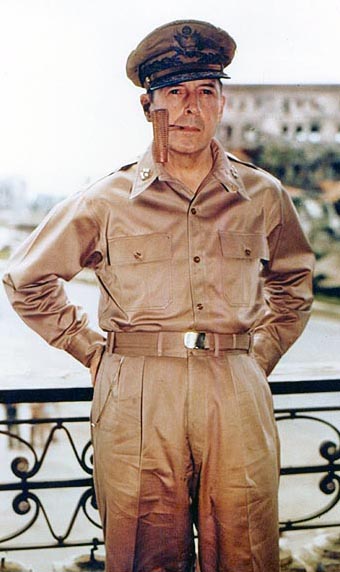
macarthur_manila

“I am concerned for the security of our great Nation; not so much because of any treat from without, but because of the insidious forces working from within.”

Douglas MacArthur, General of the Army

There is a reason why our Founding Fathers were concerned about defending the Constitution against enemies foreign and domestic, though this specific language did not expressly come to pass until the enactment of Title 5, Code of Federal Regulations in 1966.

When did our Founding Fathers become aware of the concern over domestic enemies?  For a decade or more prior to 1776, there were violent and divisive elements at work in the 13 colonies, intent upon keeping the oppressive yoke of the British Crown over everyone.  This concern was memorialized and enumerated in the list of grievances noted in the Declaration of Independence.  This was the first document of lasting importance to denounce the practice of fomenting domestic enemies, to wit in reference to King George: “He has excited domestic insurrections amongst us…”  America’s first leaders had no reason to believe that by simply declaring their independence, enemies bent on fomenting domestic insurrection would stop such actions.

The concern over these issues was aptly expressed later on in the Constitutional Convention by John Adams:

“We have no government armed with power capable of contending with human passions unbridled by morality and religion.  Avarice, ambition, revenge, or gallantry, would break the strongest cords of our Constitution as a whale goes through a net.  Ours is made only for moral and religious people.  It is wholly inadequate to the government of any other.”

Considering all of the social strife and upheaval in 2020 America, this article will focus on domestic enemies and disruptive, homegrown violence.

When America declared its independence, the whole world was a potential foreign enemy. It took two years of fighting on its own before France became the first sovereign nation to sign a treaty backing the United States of America. Domestic enemies were a concern because there were people living in the original 13 colonies at the time of the Revolution who did not support American independence. The signers of the Declaration of Independence pledged their lives and all they had for an independent America. Had any of them ever been caught by the British, they would have been tried and executed for treason against the British Crown. Supporters of the Revolution did not even know if they could trust their neighbors or members of their own family.

The Founding Fathers were similarly concerned about future domestic enemies, because from a national security perspective, it is natural to watch for external enemies, but not domestically. Why be concerned about domestic enemies? In simplest terms, our Founding Fathers recognized they were creating a nation with more citizen freedoms than any country on Earth.  Prior to the American Revolution, there had never been a constitutional democracy operated solely of the people, by the people, and for the people.  All previous efforts to create this sort of nation-state failed, largely due to internal upheaval.  The  Founding Fathers recognized the democratic freedoms they hoped to create could be abused & breed internal subversion and violent insurrection.

The need for addressing issues related to domestic enemies, insurrection and subversion first came under the watchful eye of General George Washington when he became commander of the Continental Army.  Dr. Matthew Spalding of The Heritage Foundation stated in a constitutional essay, “In England, subjects were required to swear loyalty to the reigning monarch; many early American documents included oaths of allegiance to the British king. During the American Revolution, General George Washington required all officers and men to subscribe to an oath renouncing any allegiance to King George III and pledging their fidelity to the United States. Most of the new state constitutions included elaborate oaths that tied allegiance to and provided a summary of the basic constitutional principles animating American constitutionalism.”

Washington’s actions became the first practical steps taken to make specific individuals accountable for avoiding the fomentation of insurrection and subversion in the United States.  Washington made good on his promise to enforce the oath when several officers and soldiers banded together with the intent of overthrowing the Continental Congress as a means of addressing their grievances.  When the plot was uncovered, Washington had the men arrested, tried under a summary courts martial, and ultimately convicted for insubordination and treason.  All of the men were punished, and the two most central figures were executed by hanging.

In the 1780s after the Revolutionary War ended in an American victory, the Congress convened a Constitutional Convention.  The Convention delegates from the 13 colonies elected George Washington to preside over the proceedings. The Constitutional Framers clearly wanted to establish a three-part governmental structure comprising a legislature, an executive and a judiciary.  Article I of the Constitution covers the legislature and spells out numerous specific duties the U.S. Congress is empowered to handle.  Article III covering the judiciary is concise and specific in narrowly defining the duties of this branch.  Once these two branches were constitutionally defined, Article II set about the duties of the executive branch.  It is important to note the generally recognized legal principal that once a law defines certain details of what must or must not be done, and no provision is made for any issue that falls outside the scope of the defined details, it means that such issues are not specifically forbidden, and therefore not against the law.  Until the law is revised to more narrowly define an issue outside the current scope, it is essentially lawful.

In order to avoid leaving too many loopholes in the Constitution when it came to defining the duties of each branch of the National Government, the Framers specified the executives duties in Article II to be everything else not assigned to the legislature or the judiciary.  To cement the executive’s all encompassing duties, the Framers added a word-for-word, specific oath of office in Article II, Section 1, Clause 8 of the Constitution:

Before he enter on the Execution of his Office, he shall take the following Oath or Affirmation: — “I do solemnly swear (or affirm) that I will faithfully execute the Office of President of the United States, and will to the best of my Ability, preserve, protect and defend the Constitution of the United States.”

Vasan Kesavan, in his Heritage Foundation article on the Presidential Oath of Office said, “The Framers…plainly believed that a special oath for the president was indispensable. At the Constitutional Convention…George Mason and James Madison moved to add the ‘preserve, protect and defend’ language.”  Kesavan went on to say, “The prospect of George Washington’s becoming president cannot be discounted.  The Framers perhaps desired an oath that would replicate the public values of the man who was presiding over the Convention. More significantly, because the presidency was unitary, there were no available internal checks, as there were in the other branches with their multiple members. A specially phrased internal check was therefore necessary, one that tied the president’s duty to “preserve, protect and defend” to his obligations to God, which is how the Founders understood what was meant by an oath or affirmation.”

The first time the Constitutional Framers actually memorialized their concern over foreign or domestic enemies was in Article IV, Section 4, which has become known as the Guarantee Clause, to wit:

“The United States shall guarantee to every State in this Union a Republican Form of Government, and shall protect each of them against Invasion; and on Application of the Legislature, or of the Executive (when the Legislature cannot be convened), against domestic Violence.”

Robert G. Natelson, a Senior Fellow in Constitutional Jurisprudence at Independence Institute, stated “the federal government will assure the states ‘a republican form of government.’ This assurance did not appear in the Articles of Confederation. The guarantee of protection from domestic violence can also be seen as part of the republican guarantee.”  Natelson made a key point in understanding how domestic violence, or the more modern term, “domestic enemies,” related to a republican form of government and protection from invasion.  He stated, in part, “Founding-era dictionaries defined a ‘republic’ as a ‘commonwealth,’ a ‘free state,’ and ‘a state or government in which the supreme power is lodged in more than one.’ In other words, a republic was a state governed by those citizens who enjoyed the franchise rather than by a monarch or autocrat. Accordingly, founding-era dictionaries often defined ‘republican’ as ‘placing the government in the people.”

Natelson went on to point out that the Constitutional Framers generally identified “three criteria of republicanism, the lack of any of which would render a government un-republican.”  Natelson listed the following criteria:

  1. Popular rule. The Founders believed that for government to be republican, political decisions had to be made by a majority (or in some cases, a plurality) of voting citizens. The citizenry might act either directly or through elected representatives. Either way, republican government was government accountable to the citizenry.
  2. There could be no monarch. The participants in the constitutional debates believed that monarchy, even constitutional monarchy, was inconsistent with republican government. When Alexander Hamilton proposed a president with lifetime tenure, the delegates disagreed so strongly that they did not even take the time to respond.
  3. A republic was the rule of law, a concept deemed fundamental to a free state. The Framers believed that ex post facto laws—most kinds of retroactive legislation, for example—were inconsistent with the rule of law, and therefore un-republican.  Simply put, you could not make something against the law, and then rewind the clock to go punish someone who committed or omitted an act not previously defined under the rule of law.

The primary purpose of the Guarantee Clause was to protect against any kind of monarchy.  Natelson noted, “based on precedents in ancient Greece, the drafters feared that kings in one or more of the states would attempt to expand their power in ways that would destabilize the entire federation. They believed that having a republican government in each state was necessary to protect republican government throughout the United States.”  Relating all of this back to domestic violence or domestic enemies, recall one of the primary grievances the Founding Fathers enumerated in the Declaration of Independence in reference to King George: “He has excited domestic insurrections amongst us…”  Framers of the Constitution did not want any of the states to adopt even a constitutional monarchy, for fear that it could lead to suppression of the rights enumerated in the Preamble, thereby fomenting insurrection, meaning, domestic violence or enabling domestic enemies.  The Preamble states:

“We the People of the United States, in Order to form a more perfect Union, establish Justice, insure domestic Tranquility, provide for the common defense, promote the general Welfare, and secure the Blessings of Liberty to ourselves and our Posterity, do ordain and establish this Constitution for the United States of America.”

After addressing the president’s oath to preserve, protect and defend the Constitution at a macro level, and the governing structure and relationship between the National & State governments, the Framers understood that the president had to rely on others at the national and state levels to support and defend the Constitution on a micro level.  This was covered in the Oaths Clause in Article VI:

The Senators and Representatives before mentioned, and the Members of the several State Legislatures, and all executive and judicial Officers, both of the United States and of the several States, shall be bound by Oath or Affirmation, to support this Constitution….

The Constitution only stipulated exact wording of the presidential oath, but, not for other government officials.  Part of the problem found with the Constitution’s predecessor, the Articles of Confederation, was it so heavily favored state’s right that it rendered the National Government impotent in creating any cohesion between the former 13 colonies.  This became a major reason for convening the Constitutional Convention.  Matthew Spalding noted in his constitutional essay that, “Edmund Randolph proposed, as part of the Virginia Plan, ‘that the Legislative, Executive & Judiciary powers within the several States ought to be bound by oath to support the articles of Union.’ When it was objected that this would unnecessarily intrude on state jurisdiction, Randolph responded that he considered it as necessary to prevent that competition between the National Constitution & laws, and those of the particular States, which had already been felt. The officers of the States are already under oath to the States. To preserve a due impartiality they ought to be equally bound to the National Government. The National authority needs every support we can give it.”  The convention delegates agreed with Randolph, but, rightly opined that the Oaths Clause should be revised to include national officials, and so it was.

The very first law passed by the first session of the House of Representatives was “An Act to regulate the Time and Manner of administering certain Oaths.”  By statute, the oath was simply worded: “I, [name], do solemnly swear (or affirm) that I will support the Constitution of the United States.”  Fred Warner noted in a May 2019 article for the New Right Network, entitled, Domestic Enemy Defined: Jaw-Dropping Realizations, that based on the Constitution and Title 5, Code of Federal Regulations, the following individuals are required to take this oath of office:

  • U.S. Senators and Representatives, both current & past;
  • Members of the Presidential & Vice Presidential Electoral College;
  • Civilian employees of the U.S. Government;
  • Uniformed members of the U.S. military and Coast Guard;
  • Members of state legislatures;
  • Executive or judicial officers of any state.

The simple 1789 oath promulgated by Congress remained unchanged until the Civil War, when they significantly amended the oath’s statute to require civilian employees and military members to not only swear allegiance to the United States, but, also to affirm they had not engaged in any previous disloyal conduct. Congress repealed the latter condition in 1884, leaving wording that is nearly identical to the current oath promulgated in Title 5 in 1966.  Under current law, the parties listed above are required to take the following oath, which is the first time the oath contained the specific language of “…against all enemies, foreign and domestic:”

“I, [name], do solemnly swear (or affirm) that I will support and defend the Constitution of the United States against all enemies, foreign and domestic; that I will bear true faith and allegiance to the same; that I take this obligation freely, without any mental reservation or purpose of evasion; and that I will well and faithfully discharge the duties of the office on which I am about to enter.” 

The Constitutional Convention dragged on throughout the sweltering Philadelphia summer of 1787.  The final version of the Constitution was a delicate compromise between a national government with enough clout to act on the world stage and bind the states together for the benefit of all, versus allowing individual states to retain a semblance of rights to govern as suited them locally.  States rights advocates were also concerned about a powerful national government trampling an individual citizen’s rights and freedoms.  Many of the states had addressed an individual’s rights in their state constitutions.  Proponents of a strong central government argued that the Constitution enumerated the powers and limits of the national government, which by implication constrained it from infringing upon an individual’s rights, leaving that in the hands of each state government.  The Constitutional language stood, as written, and 39 of the 53 delegates signed-off, which exceeded the agreed upon two-thirds super majority needed to submit it to the state legislatures for comment and ratification.

Not unexpected, James Madison of Virginia, pressed to make an individual citizen’s rights more universally explicit in the national Constitution, rather than the implication that each state could take-up the subject as they pleased at their level.  Ultimately, the Constitution was ratified, as is, and national elections were held in the autumn of 1788 for the President, Vice President, Senators and Representatives.  As soon as the First Congress was convened in 1789, they immediately set about creating the Bill of Rights, the first 10 Constitutional Amendments.  At the time of creation, no one considered there was anything contained in the amendments that particularly related to the individual state’s responsibility for subduing or preventing insurrection, subversion, domestic violence or the rise of domestic enemies. Neither did anyone make the connection of this responsibility based on republican government content in Article IV, Section 4, or the simple wording enacted by the First Congress to fulfill the Oaths Clause, which was: “I, [name], do solemnly swear (or affirm) that I will support the Constitution of the United States.”  Seventy years later the Civil War would change everything.

Of the 10 Amendments included in the Bill of Rights that would later have significance in a state’s responsibility for subduing or preventing insurrection, subversion, domestic violence or the rise of domestic enemies, it was the 10th Amendment.  Charles Cooper, Chairman of Cooper & Kirk, PLLC, a renowned constitutional law firm, wrote: “The Tenth Amendment expresses the principle that undergirds the entire plan of the original Constitution: the national government possesses only those powers delegated to it, and ‘leaves to the several States a residuary and inviolable sovereignty over all other objects.’  In The Federalist No. 39, The Framers of the Tenth Amendment had two purposes in mind when they drafted it. The first was a necessary rule of construction. The second was to reaffirm the nature of the federal system.”  The 10th Amendment reads as follows:

“The powers not delegated to the United States by the Constitution, nor prohibited by it to the States, are reserved to the States respectively, or to the people.”

As envisioned, the entire purpose of the 10th Amendment was to be a footnote of the previous nine, that just because the Bill of Rights was being made universal throughout the entirety of the United States, it did NOT imply that the national government’s reach of responsibility extended into any other areas of governance, except as originally delineated in the Constitution.  Proponents of the 10th Amendment were essentially hearkening back to one of John Heywood’s Proverbs of 1546, “Give him an inch, and he will take a mile.”  The basic concept of the Bill of Rights was, it was a one-time, “package deal,” with no intent to confer any other rights or duties on the national government.  In very simple terms, state’s rights advocates were asserting to the strong central government proponents, “stay out of our business; we will call you when we need you.”  What comes to mind are two old proverbs, “be careful what you wish for, as you just might get it,” and, “live by the sword, die by the sword.”  The southern states would learn this the hard way 70 years later.

When the Civil War broke out in 1860, the United States Government underpinned their opposition to the seceding states using all of the foregoing Constitutional information.  The national and state leaders of the seceding states had taken an oath of office to support the Constitution, which included the republican form of government, and because the 10th Amendment ensured that each state had all the authority to operate its government under the Constitution as it saw fit, and the Constitution gave no policing powers to the national government, ergo, it fell on the state governments to ensure the Preamble’s promise of domestic tranquility, and as Article IV noted, prevent domestic violence.  The United States Government saw that the elected officials of the seceding states had failed in their essential purpose, and thereby violated the Constitution.  Based on the tenets of Article IV, Section 4, “The United States shall guarantee to every State in this Union a Republican Form of Government, and shall protect each of them against…domestic Violence.”  President Lincoln and by Congressional Resolution, invoked this clause to stop the insurrection, subversion and domestic violence being fomented by people who were deemed domestic enemies of the state.  This same interpretation exists today in 2020 in reference to fomenting of domestic violence by domestic enemies of the state.

After the Civil War was over, President Abraham Lincoln’s assassination created a major shift in the plans and actions of Reconstruction in the former Confederate states.  Lincoln decided before his 1864 re-election bid to replace his Vice President, Hannibal Hamlin, on the ticket with Andrew Johnson, his Military Governor of Tennessee.  Johnson was an accomplished politician with more than 20 years of experience that included 10 years in the House of Representatives and six years in the Senate.  Had Lincoln not been assassinated, there is no doubt his steadying hand would have made good use of Johnson’s experience with southern politicians, and Reconstruction likely would have been less contentious.  Instead, Johnson found himself pinned between northern politicians bent on punishing the southern states, and southern politicians trying to avoid the severe treatment, and get their states back into play in Washington, D.C.

Numerous bills came across Johnson’s desk that he vetoed as being overly punitive.  One of the most sweeping pieces of legislation was what became the 14th Amendment to the Constitution.  Johnson was eager to get Reconstruction over with, which included some controversial presidential pardons of prominent southerners.  The Congress was determined to not allow former Confederate leaders to simply get re-elected and act like the rebellious Civil War never happened, and they played no part in it.  To that end, the 14th Amendment, Section 3, was ratified and became law in June 1868.  Here is the language of Section 3:

“No person shall be a Senator or Representative in Congress, or elector of President and Vice-President, or hold any office, civil or military, under the United States, or under any State, who, having previously taken an oath, as a member of Congress, or as an officer of the United States, or as a member of any State legislature, or as an executive or judicial officer of any State, to support the Constitution of the United States, shall have engaged in insurrection or rebellion against the same, or given aid or comfort to the enemies thereof. But Congress may by a vote of two-thirds of each House, remove such disability.”

Paul Mereno, the William and Berniece Grewcock Chair in Constitutional History at Hillsdale College, said this about the new Section 3, “The disqualification of former rebels for federal and state office was the most controversial section of the Fourteenth Amendment. Some called it vindictive. On the other hand, those who had taken a solemn oath to support the United States and had reneged on the oath could, it was argued, justifiably be prevented from simply re-assuming positions of authority in the government. Moreover, many former U.S. officials who had joined the Confederacy led the resistance to the passage of Reconstruction legislation and had supported the imposition of the onerous Black Codes on the freedmen. Other objections to the Disqualification Clause asserted that it intruded on the president’s pardon power, but obviously a constitutional amendment could modify that previously unlimited power. In any event, Congress might well have thought it prudent to limit President Andrew Johnson’s pro-Southern actions.”  Eventually, Congress removed all disqualifications for previous disloyal conduct in 1898.  The remainder of Section 3 is still in effect when it comes to government officers who may participate in insurrection or rebellion, including terrorist activities.”  In modern practice, the most important aspect of this section is that elected or appointed government officials can be held accountable by commission or omission for insurrection, subversion, domestic violence and/or failure to take action in foiling the acts of domestic enemies.  They themselves could be labeled a domestic enemy for failure to act in the face of insurrection, subversion or domestic violence.

But, even if we hold government officers accountable as noted above, it still does not answer the question: who are the insurgents, subversives and domestic enemies that are committing acts of domestic violence to take down local, state or the Federal Government?  In September 2013, then commander of Thule Air Base, Greenland, Colonel Joseph L. Prue, cited in an Air Force article, “Identifying the domestic enemy,” that “Insurgents are difficult to identify as they typically blend into the population and naturally thrive in a failed state environment.”  Then Connor Boyack of the Libertas Institute said, “the enemy is comprised  of one’s neighbors, friends, business associates, fellow church-goers, or amiable, well known individuals.”  In short, a domestic enemy can literally be anyone.

In May 2016, David Alpher, an adjunct professor from the School for Conflict Analysis and Resolution at George Mason University, wrote an article for The Conversation blog site entitled, “In America, Domestic Extremists Are a Bigger Risk than Foreign Terrorism.”  Alpher’s blog post started with a header line of, “Take America back from those who have stolen it.  Protect America from those who want to destroy it.  Restore the principles that these usurpers betrayed.”  Alpher went on to say, “I have spent nearly 15 years studying how the risk of violence grows within societies around the world, and running programs designed to stem the tide. I have [seen] rhetoric like this, used to mobilize violence in countries like Iraq and Kenya.  This same dynamic is taking shape within American society now.  Fear and anger make for strong motivation.”

Alpher continued his colloquy, “every violent group in history describes its own violence as the legitimate response to a threat that was forced on them.  Groups survive in the long term when that description makes sense to enough of the population to buy them tolerance and safe space to operate, plan and grow; that’s true of terrorism and violent extremism.  Their reasoning usually orbits around the belief that they are defending the Constitution, or stopping the theft of the political process, and resisting the takeover by hostile powers.”

In 2020, just about every American can read the foregoing and shake their head up & down vigorously, and say Alpher’s words are about homegrown Islamic extremists, or Antifa, or the socialist movement fueled by Bernie Sanders & Alexandria Ocasio-Cortez, or the Deep State (whoever that is), or gun-toting right wing radicals, or racial injustice extremists, or the Cancel Culture, or the COVID-19 social backlash, or supporters of Donald Trump.

Here is the conundrum with Alpher’s commentary:  In 2016, all of his words were solely focused on Donald Trump and his supporters.  Supposedly, no one else was to blame.  The reality of how insurgents, subversives and domestic enemies work is: they do not care about the socio-political platform of any of these groups.  Their goal is to create anarchy, mob rule, breakdown of the social structure, overtax the politicians and government agencies, and create an environment of chaos with all of the aforementioned groups pointing fingers at each other.  The domestic enemies win.

I understand the injustice to all minorities, but, the BLM and other groups seeking social justice are getting their movements hijacked by subversives who are exploiting our country’s strife. For all the people who’ve unjustly lost their lives, such as George Floyd and Breonna Taylor, I believe they’re looking down on us & can see the difference between peaceful protest vs subversive actors fomenting riots, destroying property, killing cops and innocents, and the cancel culture. At this time in our country, we are destroying ourselves from within.

Regardless who is right or wrong, there is only one thing that matters right now, and that is reasserting our republican form of government and the rule of law.  We are reminded of these duties stated earlier in Article IV, Section 4, of the Constitution, known as the Guarantee Clause:

“The United States shall guarantee to every State in this Union a Republican Form of Government, and shall protect each of them against Invasion; and on Application of the Legislature, or of the Executive (when the Legislature cannot be convened), against domestic Violence.”

Based on this article in the Constitution, state and local governments have the first line of responsibility to preserve law and order, and restore domestic tranquility.  Allowing mob rule and rioting to go unchecked with the attitude that people will get tired and go home, is weak leadership, and emboldens further violence.  As it is noted in the Guarantee Clause, if the states decline to restore domestic tranquility, then the United States Government is obligated to take action.  And state & local officials who refuse to take action, are abetting domestic enemies and can be held accountable as is noted in the 14th Amendment, Section 3.

It is also important to keep in mind, that state & local law enforcement are being caught in the middle between domestic enemies and government leaders who fail to act properly.  When it comes to foiling domestic enemies, or a first strike by a foreign enemy, it’s not the U.S. military who will protect our national security…it will be local law enforcement. When the World Trade Center was attacked, it was local law enforcement and firefighters who ran TOWARD the danger & lost their lives. We need critical thinking & pondering by everyone to defeat social injustice & subversion.

Americans need to educate themselves on the rights and responsibilities all citizens and government leaders have to preserve, protect and defend the Constitution of the United States of America.

In June 1858 at the state capitol in Springfield, Illinois, Abraham Lincoln delivered his acceptance speech as the Republican nominee for the U.S. Senate.  What is likely one of the best known phrases uttered in a political campaign speech, came from Lincoln that day: “A house divided against itself, cannot stand.” It is my belief that these words in 2020 could never be more true.

I humbly pray that the Lord will grant us wisdom in determining who are America’s real domestic enemies, and hold our leaders and each other accountable to solve this terrible problem.  Amen.

Steve Miller
Editor
The Report on National Security Kinetics™
Seattle, WA. USA
vietvetsteve@reportnatlsecykinetics.com
Standard
Foreign Policy Research & Analysis, Intelligence Collection, Analysis & Estimates, Military Operations, History & Cyber Warfare, National Security, Terrorism Information, U.S. Presidency, Weapon Systems

RNSK Vol I, Edition 1

Introduction

     This is the premiere Edition of The Report on National Security Kinetics™ (RNSK).  There are dozens of publications out there with content that touches on some of the RNSK Focus Areas, but, require regular monitoring of a half-dozen or more of them to cover it all.  The RNSK format has been designed around a set of Focus Areas to help reduce a reader’s effort in keeping tabs on an important set of topics.

     The RNSK Focus Areas have been selected by the editor based on 40+ years of experience as a U.S. military veteran, national security analyst, international business manager, writer, foreign policy researcher, college teacher, and military & presidential historian.  It has been my honor to meet many women & men with similar backgrounds, including a shared belief in the importance of family, strong morals, human dignity, personal integrity, and putting country above self.  Recognizing the Kinetic nature of National Security, factual & timely information related to the Focus Areas is an important factor to this editor and like-minded individuals.

The RNSK National Security Focus Areas are:

  • Government-related Policy and Actions (U.S. & non-U.S.)
  • Weapon Systems
  • Intelligence Collection, Analysis and Counter-Terrorism
  • Military Operations & Cyber Warfare
  • Historical Commentary

     These Focus Areas may not always be covered in each edition.  Instead, the content will vary from one edition to the next based on what readers are asking for, global events, and the topical insights of RNSK correspondents with many decades of experience.  RNSK content is:

  • Reliable, well researched and factual;
  • Written with minimal opinions, speculation, or someone’s Ouija board;
  • Relative and timely, but, not a cyclical news source; RNSK has no competition-driven publishing deadlines.

The Need for Sources with Trustworthy, Verifiable Facts

     With the widespread use of the internet, it puts a staggering level of content at our fingertips.  The challenge for us, however, is determining the utility of what we read.  Because our research & reading time is limited, it leads us to determine which information sources are most utilitarian, and fit the closest to our needs.  For the serious consumer of useful web-based information, it is understood there is no “perfect” source, nor “one-size-fits-all.”  We look for reliable information sources that provide the best content, without investing too much of our limited time and resources.  In short, we want a good deal!

     When I think about reliable information sources, it reminds me of my paternal grandfather, Albert Miller, a veteran of World War I and World War II.  In between the wars, and for his last 20 years in the workforce, he was a pressroom manager for the Los Angeles Times.  Although he was a loyal consumer of L.A. Times content, he also was a strong proponent of the philosophy, “believe only half of what you read, and nothing of what you hear.”  He was a voracious reader of nearly everything he got his hands on.  Coupled with pondering and introspection, he developed strong convictions based on objectivity.  If he were alive today, he would have already applied his philosophy by carefully studying internet content for the favorable characteristics noted above.  He would be scolding the public for not following his advice, and the global fallout over “fake news.”

History Repeats Itself

     Prior to World War I, the average person was not overly challenged in differentiating between reliable and unreliable information purveyed to the public.  Name brand public information back then included respected outlets such as the New York Times, Wall Street Journal, The Economist, and The Nation.  After World War I, broadcast radio spread like wildfire across the globe, much the same way the Internet has in the past 20+ years.  To illustrate the rapid spread of broadcast radio going into 1922, the year opened with only 28 radio stations in the United States.  At the close of 1922, America could boast of having 570 commercial radio stations!

     Radio broadcasting became so pervasive by the 1930s that Congress enacted legislation to form the Federal Communications Commission to regulate the industry.  Just like television became the entertainment centerpiece in every home by the 1960s, radio held the same position from the 1920s through the 1940s.  In the first half of the 20th Century, radio was literally the human lifeline to the rest of the world, the same as the Internet is today.

     With the ever-increasing pace of a global society throughout the radio era, numerous people took the attitude that they were too busy, and did not have time to read a daily newspaper; the radio industry was more than happy to fill the gap.  Radio carried the news, weather, sports, church services, music, and programmed entertainment, to name a few.  Back then, different types of broadcasts were discernible…news programs and fictional entertainment were done in different styles.  The overreliance on radio for all aspects of life spawned a common phrase that carried the force-of-truth behind it, “hey, I just heard on the radio…”  If you heard it on the radio, it has to be true, right?

     The bubble of truth in radio was burst in 1938 with the broadcast that came to be known as, “The War of the Worlds.”  A 22-year old actor, Orson Welles, conducted a radio broadcast meant to be science fiction entertainment, but, it was delivered like a real newscast.  Millions of people heard Welles’ “report,” and actually thought the Earth was under alien invasion!  Even though Welles’ intent was entertainment, the public’s reliance on radio allowed them to be duped into thinking they were under alien attack.  If you heard it on the radio, it has to be true, right?

     Fast forward this to the internet age, but, with public overreliance on web-based content instead of radio, it has once again allowed agents-of-manipulation to blur the lines between fact and fiction.  An unchecked social media was/is the perfect place to sow disinformation and blur-the-lines.  In simple terms, with the veneer stripped back, it is slick, subtle lying; which isn’t very “social” by most people’s standards.  This is evident in all the stories about “fake news” and the Information Warfare conducted during the 2016 Presidential Election.  But, make no mistake, the blurring of fact and fiction seen in the past two years has nothing to do with entertainment, nor is it strictly one-upmanship between competing web-based information sources.

     Duping the public with disinformation during the age of radio, or today’s internet, is not just information warfare; the root of the matter goes much deeper.  So, it is true; history does repeat itself, but, why?

     Web-based information distortion in some cases is an act-of-war; much like the information subterfuge undertaken by both sides in World War II.  Let’s call it what it really is, a term that does not mince words…Espionage.  It may not be a shooting war, but, it is warfare, nonetheless.  The circumstances behind public communication in wartime England may have had its Fascist & Communists intriguers who angered government authorities and were carefully watched.  The moment they crossed-the-line from just stirring things up, to proof of subversion, they were going to jail for espionage, at the least.

How Does This Relate to the RNSK?

     The foregoing discussion bothers me…it bothers me a LOT.  We can all agree that fiction is entertaining, but, not when we are looking for, and expecting to find the facts.  But, even when we successfully cull-out fictional information, facts may still not be the facts.  What someone says or writes may not be pure fiction, or manipulated fake news, but, what about intentional or unintentional co-mingling of fact and opinion?  Any purveyor of information, regardless of media type, if they want to be seen as a viable source of factual information, they must exercise overt care in identifying when something is an expressed opinion, versus a confirmed fact.  Whether a purveyor of opinion is honestly expressing just their opinion, it can and does, influence other people’s thinking and opinions.  Expressing an opinion that is co-mingled with fact, is a disservice to the consumer, at best; at worst, it intends to convince someone how to think and act.

     When it comes to writing and publishing the RNSK, the intent is to avoid the foregoing communication/information problems by the guidelines previously mentioned, to wit:

  • Reliable, well researched and factual;
  • Written with minimal opinions, speculation, or someone’s Ouija board;
  • Relative and timely, but, not a cyclical news source; RNSK has no competition-driven publishing deadlines.

     So, if you have an interest in rounding-out your national security knowledge in today’s kinetic environment, and want the confidence of knowing the content is based on the foregoing parameters in a defined set of Focus Areas, and has been written with an eye toward the values imbued by America’s Founding Fathers, then The Report on National Security Kinetics™  is what you need…Welcome!

     This is enough for now; the introduction has been done.  Rather than trying to include an actual content article buried at the bottom of this premiere edition, where it likely would get lost, we will begin publishing informational content in the next edition.  In the beginning, RNSK will be published bi-weekly.  If a published article is prepared by a correspondent other than the editor, their name/credentials will appear at the end of it.  Unless otherwise noted, all other content is by the editor & chief correspondent.

Ciao,

Steve Miller
Editor
The Report on National Security Kinetics™
Seattle, WA. USA
http://www.millermgmtsys.com

Standard
Foreign Policy Research & Analysis, Intelligence Collection, Analysis & Estimates, Terrorism Information

What are the best open source global intelligence databases?

Let me share some tips with you that I’ve picked-up along the way that helps me do what I do, and am sought after for Global Intelligence Research & Analysis (GIRA). I’ll apologize in advance if I share something you already know, or are aware of. Since I do not know you, nor your current level of knowledge, I am not going to make any assumptions.

One of the things I have determined over the years about GIRA is simply this: There are two types of people doing GIRA…the professionals who are really good at it, and then everybody else. How can you tell if someone has the intrinsic “stuff” to be really good at GIRA? I like illustrating things using metaphors and examples; so, here’s one on being a GIRA expert. Have you ever heard of the social science concept called “Abraham Maslow’s Hierarchy of Needs?” Maslow theorized that human behavior can be categorized based on one of five need levels, and the level someone is on currently, can go up or down on a real-time basis in the blink-of-an-eye. The five levels are:

  1. Physiological Needs. These are the things to sustain human life. Breathing oxygen is as basic as it can get.
  2. Security Needs. Shelter, clothing, avoiding immediate danger.
  3. Socialization Needs. The human trait to interact with other humans.
  4. Recognition, Achievement Needs. Human desire to advance, self-worth, be seen by others as adding value.
  5. Self-Actualization Needs. Ever wonder why someone will voluntarily jump out of a perfectly good airplane to use a parachute? Why does a NASCAR racing driver want to drive a 3,000+ lb car at 200 mph while he’s literally bumper-to-bumper and door-to-door – only inches apart – from three or four other cars? Why did Air Force pilot, Chuck Yeager, want to fly an airplane to break the sound barrier in 1947? These are examples of people self-actualizing; doing something because there is a burning desire inside them that is so important, it defies understanding by most people…except for the few others with the same unfulfilled need.

If you want to be a really good GIRA expert, your desire must derive from Maslow’s 5th level. A good example of a self-actualizing GIRA expert is me…how important is it to me to self-actualize GIRA? Well, I am writing about it right now on Christmas Day. Not too many people will see this as being a burning need, so much so, I need to do it on Christmas. The GIRA tips and techniques I will describe are only useful if you put them to work…you gotta, wanna know.

Tips on Open Source Intelligence Research & Analysis

  1. Establish your personal knowledge baseline. My four kids are all grown and on their own. When they were in grade school they frequently asked me, “Dad, what do we have to do to be smart?” My answer was: “Read anything and everything you can get your hands on.” When I said anything and everything, I told the kids that meant if they were just waiting in the grocery store checkout line, read the ingredients on the box of cookies in your basket! You have to be a voracious reader. The reason it is so critical to have an ultra-high level personal knowledge baseline is simply because when you start to get serious about GIRA, you are not going to have the time to focus on a topic to produce a GIRA product of integrity quick enough to do someone any good if you have to go school yourself, first. Sometimes you have that luxury; but, if someone is paying you money for your intellectual product, you can’t take too much time to produce it. People and/or companies requesting GIRA from you, view time & money in the same context. This being said, having an evolving, expanding knowledge baseline in general, and a certain topic, in specific, allows you to monitor global happenings within the topic area and quickly spot something that’s not part of your baseline knowledge and determine whether it’s something significant enough to dig further.
  2. Determining if your generic personal knowledge baseline is adequate. About 15 years ago when I decided to start dabbling in GIRA for-hire, I knew already that my ability to find, absorb & analyze data for myself, or for the seminars & college classes I taught, or the magazine articles I wrote, or my management duties, was adequate. But, I wondered what I could do to compare my knowledge against a recognized base of global knowledge? I don’t know if you’ve ever sat for any type of professionally recognized credentialing exam, like the CPA (certified public accountant), or the Bar exam to be an attorney, or the exam to become a licensed U.S. Customs Broker, etc. These are some of the toughest exams anywhere. For the level of knowledge needed on a global scale, I decided to apply for candidacy to become a Foreign Service Officer in the U.S. Diplomatic Corps. Before the State Dept will even interview, you have to pass the FSO exam. These days the FSO jobs are highly sought after, which makes the candidacy process very competitive. For anyone without 10-15 yrs of experience that’s useful in the Diplomatic Corps, the younger, entry-level candidates won’t get too far in the application process unless they at least have a Masters Degree. So, when you sit for the FSO exam, if you are not extremely well versed in a broad range of global topics, you won’t pass. I’ve taken numerous professional credential exams before; the FSO exam is/was the toughest I’ve ever taken…but, I passed. That was good enough for me, and I didn’t pursue FSO idea further. It intrigued me, but at 50 back then, I decided I’d to let the idea go. You don’t need to go this far to see if your knowledge measures up; but, you get my drift…you have to really know your stuff.
  3. Where to find GIRA primary source material. There’s two types of GIRA, Static Data R&A, and Dynamic, Emergent Data R&A. SDRA is generally the history-based side of GIRA. SDRA can be at either a macro or micro level. Sources for this type of analysis are not difficult to find because the SDRA report you generate is not meant to give actively changing, ongoing emergent R&A. Don’t get me wrong; SDRA reports are not supposed to contain just stale (i.e.; mostly past tense that’s not changing anymore) information, unless the requester has asked specifically for a mostly historical report. SDRAs I’ve done for corporations, like an inquiry about a country’s climate for a new business venture, need a mix of historical data, and anything relevant to the current business climate. If you were writing an SDRA report on Indonesia and during your R&A an airliner crashes on takeoff from Jakarta’s international airport, it’s not likely to impact report, and it would be too early to include it until the impact to your report, if any is understood. On the flip side, reporting intelligence information that’s in the DEDRA category requires primary source material that is extremely time sensitive. This is when your ability to identify information sources beyond the typical is really important. There are many sources that can cover static (historical) and dynamic (emergent) information. Remember: regardless what kind of data a source has available on the internet, it didn’t get there for free…it’s being paid for somehow. Some of the primary sources I list below are those you cannot access for free. One thing about GIRA…are you looking to prepare a macro report or a micro one? What I’ve listed below is not everything I use, just the ones I’ve used reliably from time-to-time (some a lot more than others). I have other sources I’ll use to fine tune my info and double check my facts. I pick-up new sources all of the time.

Lastly, GIRA is not an expertise you can just learn out of a textbook. My methods, sources and thoughts expressed here, work for me, and there may be 100 people out there that disagrees. So be it. Everyone can choose their own path that makes them happy and/or financially successful. What you do with all of this info I’ve provided is now up to you! Note: Due to the dozens and dozens of sources I listed, I did not take the time to add-in all of the hyperlinks…gotta leave ya with something to do!

Best of luck!

Air Force E-publishing

USAF Air University

Air Power Australia

American Special Operations

AVIALOGS

Aviation Week & Space Technology

Baseops.net Flight Planning, Aviation Weather & Military Discounts

Bibliography of the Vietnam War

Black Vault

Boeing Acronyms And Definitions

Currency Converter

Defense Department

Defense One

Defense Technical Information Center

Demand Media Studios

Designation-Systems.Net

Federal Aviation Administration

Federation of American Scientists –

Global Digital Media Network

Guide to Military Equipment and Civil Aviation

International Rescue Committee (IRC)

Joe Baugher's Military Aircraft Index

Joint Electronic Library, Joint Concepts

Mach One Manuals

Mine Action Group

MIT Security Studies Program (SSP)

Myinforms World News

National Security Archive

National Security Council

National Security Internet Archive

NATO

OECD

Pacific War Online Encyclopedia

RadioReference.com

SearchMil.com

SIPRI

Spyflight

The Library of Congress.

Time Zone Map

U.S. Military – CNN.com

World Health Organization

United Nations International Childrens’ Fund (UNICEF)

United Nations High Commission for Refugees

United Nations Educational, Scientific and Cultural Organization

United Nations Development Programme

United Nations Peacekeeping Operations

The World Bank

International Labor Organization

World Food Programme

Center for Intelligence and Security Studies

Center for Strategic and International Studies

RAND Corp Research Services and Public Policy Analysis

SmartBrief | Industry E-mail Newsletters for Professionals

Sanctions Programs and Country Information

American History [ushistory.org]

DoDBuzz

Global Security

Department of Homeland Security

Heritage Foundation

National Security Network

Military.com

U.S. State Dept.

Stratfor

Office of the Director of National Intelligence

The National Counterintelligence Executive

The National Counterterrorism Center

Bureau of Intelligence and Research

National Technical Information Service

Office of Terrorism and Financial Intelligence

ProQuest

Federal Research Division of Library of Congress

U.S. Army Foreign Military Studies Office

Defense Intelligence Agency

NATO Open Source Intelligence Handbook

OSINT Deep Web Search for user names and e-mail addresses

NATO OSINT Reader

Open Source Solutions

Janes.com

Digital Globe – High Resolution Global Imagery

Foreign Policy.com

U.S. Dept of Commerce

Steve Miller, Copyright (c) 2006, 2012, 2015, 2018

Standard
Foreign Policy Research & Analysis, National Security, Terrorism Information

What is the legal definition of “National Security” established by the US Courts?

To get the full treatment on the topic of National Security from the U.S. point of view, take a look at my series of general FAQs I wrote for Quora at the following link:

https://www.quora.com/topic/National-Security/faq

One of the FAQs provides the U.S. Government definition of National Security, as follows:

Within the context of how the United States defines National Security, it was developed and promulgated via Joint Publication #1 by the Department of Defense, Joint-Chiefs-of-Staff. The meaning is: A collective term encompassing both national defense and foreign relations of the United States with the purpose of gaining: a. A military or defense advantage over any foreign nation or group of nations; b. A favorable foreign relations position; or c. A defense posture capable of successfully resisting hostile or destructive action from within or without, overt or covert.

In terms of a “legal” definition of National Security either in the U.S. Code of Federal Regulations (CFRs), or anything based on a Federal District, Appeals or Supreme Court ruling that might create “case law,” you will not find anything. The reason why is the term, by its very nature, is too broad, and any level in the U.S. court system would be committing “judicial suicide” if they attempted to render a felony trial verdict based on an attempt to fully encapsulate a definition of National Security.

Not trying to be flippant, but, attempting to create a single, legally binding definition of National Security that could hold up to an ultimate determination by the U.S. Supreme Court, would be just as difficult as to pin down as legally defining the term “Chocolate Donut.”

Seriously, take a look at my National Security FAQs. Part of the problem with trying to pin down a legally binding definition of National Security is simply that it is a moving target that is constantly evolving. My FAQs denote some of the more recent developments that now pose a National Security threat that no one would have dreamed of 50–60 years ago. Here are a few examples of what I mean:

  1. Global Climate Change;
  2. Trans-National Crime;
  3. A Global Disease Pandemic;
  4. Cyber-based Infrastructure Threats;
  5. Space-borne Threats. And this is not just “Star Wars” stuff with killer satellites and lasers. The U.S. is the ONLY country in the World to track the tens of thousands of pieces of space junk, defunct satellites, micro-meteorites, et al, that could potentially enter the earth’s atmosphere, or possibly collide accidentally with an important spacecraft up there. A burned-out Russian satellite has already collided with an American in-use satellite that before the collision, there were just two objects, and now the debris has made thousands of objects.

If you go back to the 1930s, not only were the threats listed above either unknown, or considered non-threatening, but, no one had an inkling about a nuclear holocaust being a National Security threat either.

These are just some of the things we have added to the National Security threat list since World War II. I am sure there is more to come, and our understanding of what constitutes National Security will continue to evolve, too.

Standard
Military Operations, History & Cyber Warfare

Navy Releases Investigation Report of U.S. Patrol Boats Seized by Iran

navy-boat-crew-seizure_iran_jan2016

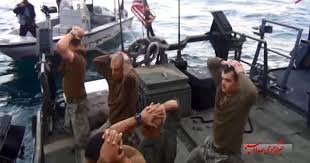
U.S. Navy boat crew held at gunpoint aboard their own vessel in a photograph taken at the time of the seizure.

A U.S. Navy investigation board’s Report was publicly released on June 30, 2016, via a FOIA request.  Although the Report had been classified Secret/NOFORN, the FOIA request triggered an MDR (Mandatory Declassification Review) by the Navy.  In my estimation, the MDR process did not go overboard in redacting too many important facts of the case; it was a fair review.  Vice Chief of Naval Operations, Admiral Michelle Howard, endorsed (with comments) the Report.

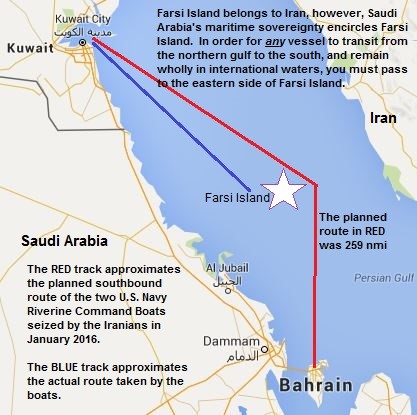
Rather than regurgitate the entire report, which, if read carefully cover-to-cover, takes about two hours, I will summarize the key facts here.  I also developed a map to help visualize the Persian Gulf geography that factored into the Iranian seizure incident.

In January 2016 two U.S. Navy coastal riverine patrol boats based out of Kuwait City received orders to make an all day trip through the Persian Gulf to the naval support facility in Bahrain.  Approximately half-way through their non-combat sortie, one of the two boats developed an engine casualty, and both boats stopped to troubleshoot and repair the problem.  While the two riverine boats sat dead-in-the-water in the middle (literally!) of the Persian Gulf, they drifted inside the territorial limit surrounding tiny, Farsi Island, which belongs to Iran.  Before the two Navy craft could make repairs, and get underway again, they were detained at gunpoint by patrol boats of the Iranian Revolutionary Guard Corps Navy (IRGCN).  The American boats and their crews were seized (without violence), and directed to follow the IRGCN boats to a jetty on Farsi Island.  The sailors and their boats were released 24 hours later unharmed, following high level negotiations.  A U.S. Navy investigation was immediately launched to determine the facts leading to the seizure incident.

Background Information

The entire Persian Gulf area, including the surrounding countries, fall under the jurisdiction of the U.S. military’s Central Command.  The naval warfare & maritime security component of U.S. Central Command is a dual-hat leadership command held by a Vice Admiral who also commands the Navy’s Fifth Fleet (CFF).  Carrier Strike Groups (CSGs) patrol the Persian (Arabian) Gulf, the Gulf of Aden, the Gulf of Oman, the Red Sea, and northwest portions of the Indian Ocean (i.e.; the Arabian Sea).

In addition to the CSGs, CCF has numerous support forces located in, and around, the Persian Gulf.  One of the most important of these is Task Force 56 (CTF56), headquartered in Bahrain.  CTF56 is commanded by a Navy Captain (O-6).  CTF56 has numerous Task Groups structured under it for such things as: EOD, diving & salvage, and maritime security.  The maritime security component is Task Group 56.7 (CTG56.7), headquartered in the United Arab Emirates’ (UAE) Jebel Ali port facility, adjacent to Dubai.  CTG56.7 is a command billet for a Navy Commander (O-5).  The two Navy patrol boats seized by Iran were part of CTG56.7.

Standard Navy practice for CTG56.7 is to deploy a complete Coastal Riverine Squadron (CRS) from CONUS for a six-month tour (sans a small reach-back staff left at home for unit coordination).  While the CRS is deployed, its billeted commander is dual-hatted as CTG56.7’s commander.  CTG56.7, at the time of the seizure incident, had four detachments; one co-located with CTG56.7 headquarters at Jebel Ali, and three sub-deployed (remote) detachments.  One detachment was located at the Port of Fujairah on the UAE’s eastern coast, almost directly due east of Dubai; it is reachable by car in less than two hours.  The other two remote detachments were located in Bahrain and Kuwait City.  The two boats involved in the seizure belonged to CTG56.7’s three-boat detachment in Kuwait City.

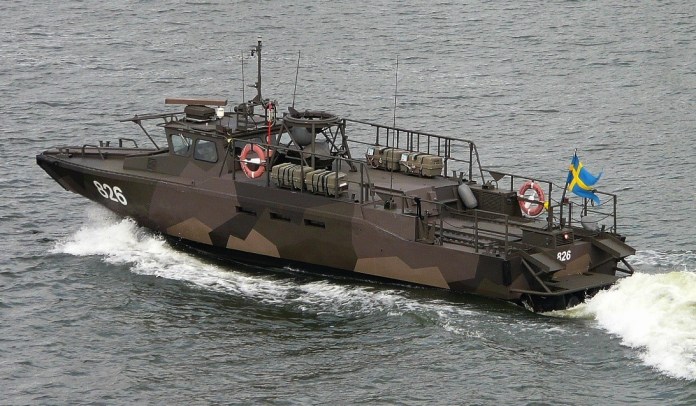
The two incident boats were U.S. Navy Riverine Command Boats (RCBs). The RCBs come from Sweden, and are labeled as: CB90-class, fast assault craft.  The U.S. Navy purchased six of these boats.  RCBs are 52’ long, drawing just 2½’ of water, with a flank speed of 40+ knots.  By U.S. Navy standards, RCBs are manned for combat by a crew of six sailors; only five per boat were aboard at the time of seizure.  A normal crew consists of a boat captain (usually an enlisted, Chief Petty Officer), a coxswain, a boat engineer, and three gunners.  Enlisted boat captains have been trained, qualified and previously served as coxswains, engineers, and gunners.  Likewise, coxswains have been engineers & gunners, and engineers are also experienced gunners.  RCBs have some features similar to the Navy’s 31’ PBRs successfully used in the Vietnam War.  These features include: being fast, highly maneuverable (due to the Jacuzzi-style water jet pumps), and can transition from flank speed to dead-in-the-water in just 2.5 boat lengths.  RCBs typically carry a Mark 19 automatic 40mm grenade launcher, and three .50 caliber heavy machine guns.  Another RCB feature (common to all small watercraft) is its limited, 130 nautical mile operating range with a full fuel load.  The RCB’s range would figure into the events leading up to the seizure.

Navy Riverine Boat

RCBs are typically crewed by Navy Special Warfare Combatant Craft Crewmen (SWCCs).  SWCCs are one of the most highly trained Navy career fields; almost as much as a SEAL.  Due to sequestration and budget cuts in 2012, The Navy merged Riverine Group 1 and the Maritime Expeditionary Security Group 2, into the Coastal Riverine Force (CRF).  CRF was created with two Coastal Riverine Groups, one near North Island in San Diego, and the other in Portsmouth, Virginia.  Each group has three CRS’ under its command.  CRS3 belongs to Coastal Riverine Group One in San Diego.  When the CRF was formed, it combined two groups with differing raisons d’être.  The new CRF launched comprehensive cross-training to level-set the skills needed to integrate the sailors from the two, now defunct, groups.

In-Theater Details Leading Up to the Seizure

At the time of the incident in January 2016, CRS3 was in the fifth month of its six-month deployment as CTG56.7.  When CRS3 arrived in-theater, the Kuwait City detachment did not exist.  After negotiating the Iranian Nuclear Agreement, the Pentagon deemed it prudent to activate a fourth detachment in Kuwait City to keep tabs on Iranian naval activity in the Gulf’s northern reaches.  To accomplish this, three RCBs and their crews, plus some support personnel, were ordered to stand-up a new detachment in Kuwait.

In my estimation, one of the ominous signs involving this new detachment was assigning a naval aviator as the Officer-in-Charge (OIC).  Giving the benefit of the doubt to the miscast OIC, I do not dispute the OIC’s leadership skills, above average intelligence, nor considerable educational background.  Beyond these “given” factors, however, it is not easily understood why a career aviator was assigned to lead a coastal riverine detachment that was outside of his normal skill-set.  The Navy investigation revealed that the naval aviator/OIC’s detachment leadership was laid back.  The detachment’s lax atmosphere was not a direct factor in the seizure incident; but, it was contributory.  Of greater concern to me was the questionable decision-making by CTF56 and CTG56.7 commanders.  Assigning an aviator as OIC of a riverine boat detachment was just one of the numerous, flawed leadership decisions made at both levels.

Based on investigation interviews, and the investigator’s additional research & fact-checking, the Report laid-out a character profile of Task Force 56’s skipper at the time of the RCB’s seizure.  I also took the time to conduct my own research into various aspects of the overall situation in CTF56, such as: its operating tempo, the regional situation it dealt with on a daily basis, command climate, ROEs, personnel issues, and the military equipment & weapon systems they employed.

My summary of the CTF56 commander can be stated using several common euphemisms, like: gung-ho, hard charger, failure is not an option, can-do attitude, et al.  In the arena of sociology and organizational behavior, some might translate the foregoing terms into a “Theory X” leadership style – often prevalent with a Type A personality.  There is nothing intrinsically wrong with these characterizations, as long as they are tempered at times with some moderation.  One of the themes that came through in the Report, and my own research, was the CTF56 skipper fostered a command climate of “will do,” not just “can do.”  Many decades ago I worked for a retired Army Colonel.  His command style was to shout, “jump” to everyone.  The only response he expected was two-fold: First, without hesitation, you leaped into-the-air; and the second response while you were airborne was simply, “how high?”  This may be an appropriate fit for the CTF56 command climate.

Speaking of command climate in CTF56, investigators traced several angles that surfaced in this regard.  One angle to bear fruit was the not-so-uncommon hesitancy to ask questions-of-clarity about command orders by lower ranking officers.  The officers indicated their concern about appearing like they were trying to “rock-the-boat,” as the saying goes.

About halfway through CRS3’s six-month tour in the Persian Gulf, orders came from U.S. Central Command to increase Navy maritime security presence in the northern Gulf.  This decision came in the wake of the successfully concluded Iranian nuclear deal.  The Bahraini detachment was the northernmost unit of CTG56.7.  Traveling from Bahrain to the northern gulf is about a 300-mile trip, one way; this far exceeded the RCB’s range.  CTG56.7 staffers immediately began planning the effort to stand-up a new detachment in Kuwait City for northern gulf patrols.  Although the Fifth Fleet could have ordered a larger, deep draft vessel already stationed in the Persian Gulf to take-on the new tasking, this was quickly ruled out for two reasons: 1.) Sending a larger combatant vessel into an area where they routinely did not operate might be seen as provocative by Tehran, and; 2.) Assigning a deep draft vessel to patrol the confines of the northern gulf posed an unhealthy security risk of being exposed to attack from too many directions at once, especially from land.  Since surveillance was the primary role of the new patrol – not armed reconnaissance – it was deemed more prudent to keep a low profile by using coastal riverine patrol boats.

The Kuwait detachment activation was carefully planned, and then back-briefed to CTF56 & CTG56.7 leadership.   The detachment activation plan was fully approved, and the planners received a pat-on-the-back for their efforts.  A good example of the well-planned detachment activation was the transport of the three 52’ RCBs from Bahrain-to-Kuwait.  The over-the-water distance between the two port-cities was almost 260 nautical miles – double the maximum operating range of an RCB.  The Kuwait action plan included loading the three RCBs aboard an Army coastal transport ship that went back n’ forth between Bahrain and Kuwait on a regular basis.  When the RCBs encountered the Iranian Navy a couple of months later, the two boats and 10 sailors were making a 259 nmi trip from Kuwait-to-Bahrain.  This is one of the numerous factors that belied the lack of effective two-way communication during CRS3’s Middle East deployment.  Deploying the boats to Kuwait was deemed to0 far for the boats to transit on their own, so, the Army hauled them up there.  Two months later, however, two boats were ordered by CTF56 to make the same lengthy trip (in reverse) under their own power.  None of the 10 crew members on the trip had ever made that long of a continuous, over-the-water journey in a small, open boat.  In order to accomplish the feat, the RCBs were scheduled to be refueled in open water, half-way through the trip.  Allowing the boats to make this long trip under their own power was a major factor leading to the seizure incident.

Considering the “will do” climate of CTF56, and the mirroring effect at CTG56.7, the orders for two boats to travel from Kuwait-to-Bahrain were not questioned.  The orders were issued with only a one-day notice.  In January 2016, the Kuwait boat detachment was significantly short-handed in maintenance personnel and spare parts.  In order to complete the mission, as ordered, the boat crews were up all night, making their own repairs by cannibalizing parts from the third boat.  The detachment OIC received permission from higher authority to cannibalize the third boat.  Instead of authorizing the cannibalization, higher authority should have probed the request, which would have revealed the lack of parts and mechanics. Another telling gaff resulting from the “midnight maintenance” work was the complete disregard for crew-rest requirements for small boat operators.  Crewing a coastal riverine boat at high speed in open ocean is just as debilitating as it can be for military aviators.  To say the least, the two RCB crews were exhausted before their trip even started.

One of the few correct actions taken prior to making the Kuwait-to-Bahrain trip was seeking route planning guidance from the navigator aboard the Army’s coastal transport; he made the trip dozens of times.  The accompanying map of the Persian Gulf shows the situational layout of the area.  Let me familiarize the reader about the maritime situation in the Persian Gulf.

Much has been spoken of the narrow Strait-of-Hormuz at the southern entrance to the Persian Gulf.  The strait at its narrowest point is 33 statute miles.  At sea-level, the two points-of-land are about nine miles over the horizon from each other.  In an interesting twist of geography vs. political sovereignty, the land on the Arabian side of the narrowest point in the strait is Omani, not the UAE, as many people think.  The land mass jutting toward Iran is the Musandam Peninsula, and there is only one small Omani fishing village, Kumzar, at the northern end.  Musandam is so mountainous, Kumzar is unreachable by land.  In fact, Musandam Province, Oman, is completely landlocked by the UAE from Oman proper.  The nearest Omani military facilities to Kumzar are 25 miles away by boat, in Khasab.  The U.S. Navy coastal riverine detachments in Fajairah & Jebel Ali, are approximately 70 miles and 120 miles, respectively, from the tip of the Musandam Peninsula.  The narrow confines of the Strait-of-Hormuz are carefully monitored 24/7, and it is extremely difficult (and potentially dangerous!) for any military force under, on, or over-the-water, to attempt an unnoticed provocative act.

Farsi Island

The foregoing is mentioned as a contrast to the relatively more open areas of the Gulf reaching north from the Straits-of-Hormuz.  Traveling by water from Hormuz, you must go 130 miles west-southwest, and then another 470 miles north-northwest, to reach the northern limits near the Iraq/Iran border.  After moving away from Hormuz into the open Gulf areas, the narrowest area between Saudi Arabia and Iran is just over 100 miles across.  This narrowest point on the Arabian coast is 52 miles north of the large port city, Dammam.  One of the major difficulties for any vessel transiting the Persian Gulf is the preexisting natural barriers and obstacles, including numerous islands, and sand bars.  These issues can further reduce the Gulf’s navigable waters.  And, as if this were not enough, the various countries all have territorial limits that further restricts what is considered open, navigable, international waters.  The location in which the boat seizure occurred was the Iranian-owned Farsi Island (Note: The Farsi Island land mass is less than one square mile!).  The Gulf is 130 miles wide at Farsi Island’s location, just about in the middle.  Saudi territorial waters completely surround Farsi Island.  This means that if any vessel transiting the area wants to remain in open, international waters, they cannot pass through the 65-mile gap between the Saudi coastline and Farsi Island; it would be an encroachment of Saudi sovereignty.  Standard procedure for any shipping without official business in Saudi waters, is to pass to the east of Farsi Island.  Over-the-water passage between Kuwait and Bahrain cannot be made via a direct route without crossing through sovereign, Saudi Arabian waters.  As noted on the map, Kuwait-to-Bahrain is almost a 260 mile, two-leg trip around Farsi Island.  This was the planned track the boats were expected to transit on-their-own, meeting a refueling ship en route.

Report findings show that not long after the Kuwait boat detachment was activated, the concept of “running-a-tight-ship” waned rather quickly.   When the Navy investigators dug into the root cause of the lapses in normal military practice, much of the blame fell on the discernable lack of senior “eyes-on management.”  In specific terms: throughout the six-month deployment of Coastal Riverine Squadron, Three, three of the four officers over Task Force 56, and Task Group 56.7 (i.e.; the CO and XO from both levels), never visited the Kuwait-based boat crews.  The only one to make the effort was the XO from CRS3/CTG56.7.

Details on the Day of Seizure

Aside from the detachment’s midnight maintenance mentioned above, the Bahrain transit mission had operational problems before the boats ever cast off their lines.  Chief amongst the mission day problems was a four-hour departure delay.  Since the trip would take most of the day, the crews wanted to complete it during daylight hours; the plan was to leave Kuwait early in the morning.  Most adverse incidents & accidents occur due to a series of unplanned events.  If just one event in the chain of many can be stopped or avoided, it is unlikely the future incident/accident would still occur.  Clearly, the four-hour departure delay should have aborted the trip, and reschedule it for the next day. Unfortunately for the two boat crews, the mission was not aborted; they departed four hours late.  Navy investigators learned from boat crew interviews that scrubbing the mission would be seen as a failure of the “will do” credo, and bring unwanted attention on the RCB sailors.  Eliminating an important risk avoidance factor of transiting in daylight hours by ignoring the four-hour delay, was seen by the Kuwait detachment as preferable to getting their butts chewed-out for aborting the mission.  The four-hour delay ensured the crews would not arrive in Bahrain until well after dark.

Another contributory factor was the lack of mission surveillance.  Standard doctrine for small boat missions is to not only maintain periodic radio communications between the boats and the Tactical Operations Center (TOC), but, also monitor the boat’s physical location via GPS and other tactical sensors.  On mission day for the two RCBs, the TOC was never informed in advance about the transit mission to Bahrain.  Once the two boats left Kuwait, no one knew where they were.  The lack of alerting the TOC about the mission frag is another example of poor mission planning (non-existent, for the most part).  Had the mission surveillance protocol been followed, the TOC would have been able to alert the boat crews that their mission navigation was faulty, that they were deviating from the planned track.  In terms of situational awareness, the only entity with some sort of knowledge about the boat’s mission that day, was the skipper & crew of the refueling ship sent to the rendezvous location.

In another case of missed opportunity in breaking the chain-of-events, had the TOC been following the mission track, they would have spotted the route deviation almost the moment the boats cleared the Kuwaiti port.  The reason the TOC would have spotted the deviation so quickly via route surveillance is shown on the accompanying map via the blue route.  The blue route represents an approximation of the RCB’s actual route.  In an effort to make-up for the four-hour delay, the embarked patrol officer and boat captains decided to take a short cut through Saudi waters, rather than go out and around Farsi Island.  When the Iranians encountered the two boats which had stopped for an engine repair, they were 1.5 miles from Farsi Island.

The actual seizure itself was contributed to via some poor decision-making by the boat captains and patrol officer.  In the case of the two boat crews, there were nine enlisted personnel and one commissioned officer.  Based on training and experience, the officer was not a mission-qualified patrol officer, yet.  In fact, only one of the Chief Petty Officers who were qualified boat captains, was also a qualified patrol officer.  Legally speaking, the commissioned officer was only boat captain qualified that day.  Although the crew’s orders showed the one Chief Petty Officer as the patrol officer, he tacitly deferred to the commissioned officer to exercise patrol officer duties.  Part of the abdication philosophy held by the CPO, was his overt acknowledgement that the commissioned officer had more experience & training in conducting maritime navigation.  Aside from the track deviation, the commissioned officer made several, key errors in judgment & leadership, both before, and after the boats encountered the Iranians.

Navy investigators determined that of the ten sailors involved in the seizure, only one (a woman) was found to have used good judgment during the incident.  U.S. Navy boats and ships carry camcorders, and are supposed to film situations involving a foreign combatant vessel; this did not occur aboard either RCB.  The bright spot in all of this is the female NCO had the presence of mind to discretely record some video on her Smartphone.  The same NCO, maintaining situational awareness, recognized the likelihood that no one knew where they were.  In order to leave some kind of clue to their whereabouts, she activated the boat’s EPIRB (emergency radio beacon).  In VCNO Howard’s Report endorsement, the female NCO was praised for her efforts in trying to make a bad situation, better.

The balance of the incident investigation covered what occurred over the next 24 hours after the boats were seized.  Mistakes were made by some of the 10 crew members just prior, during, after the seizure, and during their brief captivity.  I’m not going to cover all of this in great detail.  Except for some action/inaction decisions made after encountering the Iranian patrol boat, but, before actual seizure, the rest had no bearing in preventing the incident. After the preliminary investigation report began making its rounds for endorsement, questions arose about the legality of Iran’s actions.  This led the VCNO to direct a JAGMAN investigation into international maritime laws, and whether Iran broke any of them.  JAG attorneys said Iran clearly broke several international laws in seizing and boarding the boats, as well as, illegally detaining the crews.

Investigations like this always look at the training received by mishap crews.  Several of the 10 sailors made strong statements about being inadequately trained for the mission undertaken.  This sentiment strongly focused on the lack of open water, maritime navigation skills.  The preliminary report findings cast aspersions on inadequate pre-deployment training.  The VCNO also ordered a deeper investigation of pre-deployment training.  This supplemental investigation demonstrated that training prior to deployment was appropriate for the defined mission, and that CRS3’s final exercise scenario was done properly, and they were ready to deploy.  The lack of more intense training in maritime navigation was justified by denoting the sort of navigation used for the 259-mile trip was atypical for a coastal riverine boat crew.  The navigation skills determined to be of use in the Persian Gulf after arrival in-theater, was one that deployed leadership should have arranged for on-location, supplemental training.  Incremental, on-location training is one that all service branches are responsible to set-up when encountering a local, atypical situation.  So, instead of blaming the stateside training cadre for inadequate pre-deployment navigation training, it became another local command failure.

I am sure that my thoughts at the time of the seizure incident were no different than anyone else familiar with the U.S. military.  It was a foregone conclusion that somebody (probably plural) was going to get fired over this incident.  The biggest question was: How far up the chain-of-command would it go?  The CRS3/CTG56.7 skipper was relieved of his duty while the investigation was ongoing.  Once the final report was endorsed and released to the various commands, the CO and XO of Task Force 56 were also relieved.  When the Navy released the redacted report on June 30th, the JAG Corps was evaluating whether certain other individuals, such as members of the two boat crews, ought to receive administrative, non-judicial punishment under Article 15 of the UCMJ.  JAG lawyers were also assessing whether a UCMJ Article 32 hearing (sort of like a grand jury investigation) should be convened to decide if there was sufficient evidence to conduct a courts martial for certain individuals.  One of the concerns surfaced by incident investigators was the possible violation of the U.S. military’s Code-of-Conduct for service members forcibly detained by a foreign entity.  The investigators recommended that the Code-of-Conduct ought to be revised to better clarify a service member’s actions while in captivity.  Again, senior flag officers reviewing the Report concluded the Code-of-Conduct should not be revised; better training was needed instead.

Summary

The seizure incident & investigation underscored my longstanding belief that for the most part, when something untoward happens, it is usually related to one or more failures to comply with existing rules & regulations.  History teaches us that our first reaction to an incident is usually empathy for the person(s) wronged; in this case, the two boat crews.  An unfortunate fact-of-life is: The ensuing investigation often finds that one or more of the “good guys” erred in judgment, or maybe cut some corners.  It might be true that the Iranian seizure was unlawful, but, that had nothing to do with the multiple errors made before encountering the Iranian patrol boats.  My greatest hope is that further Navy action avoids ruining too many lives.  If any service members end up being punished, let it be no worse than someone being administratively separated, and not something adverse that will follow that person outside of the military.

Steve Miller, Copyright (c) 2016

Standard